 Add to Chrome
 Add to Firefox
 Add to Edge
MedAI: Evaluating TxAgent's Therapeutic Agentic Reasoning in the NeurIPS CURE-Bench Competition
Dec 12, 2025
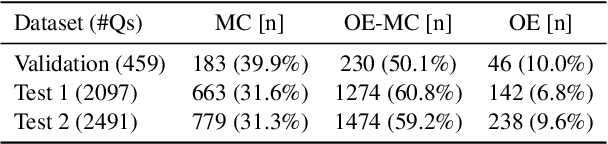
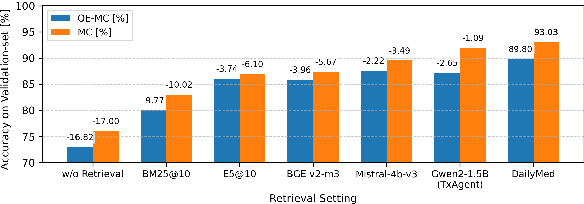
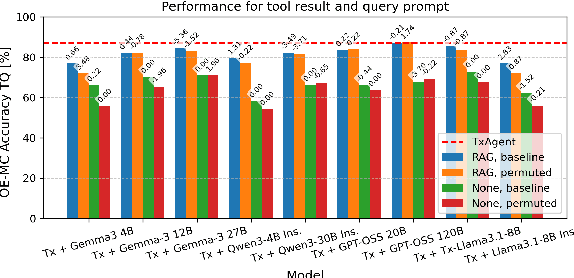
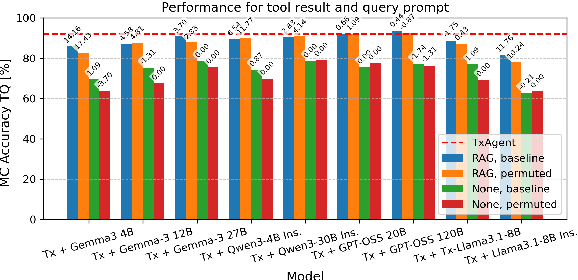
Therapeutic decision-making in clinical medicine constitutes a high-stakes domain in which AI guidance interacts with complex interactions among patient characteristics, disease processes, and pharmacological agents. Tasks such as drug recommendation, treatment planning, and adverse-effect prediction demand robust, multi-step reasoning grounded in reliable biomedical knowledge. Agentic AI methods, exemplified by TxAgent, address these challenges through iterative retrieval-augmented generation (RAG). TxAgent employs a fine-tuned Llama-3.1-8B model that dynamically generates and executes function calls to a unified biomedical tool suite (ToolUniverse), integrating FDA Drug API, OpenTargets, and Monarch resources to ensure access to current therapeutic information. In contrast to general-purpose RAG systems, medical applications impose stringent safety constraints, rendering the accuracy of both the reasoning trace and the sequence of tool invocations critical. These considerations motivate evaluation protocols treating token-level reasoning and tool-usage behaviors as explicit supervision signals. This work presents insights derived from our participation in the CURE-Bench NeurIPS 2025 Challenge, which benchmarks therapeutic-reasoning systems using metrics that assess correctness, tool utilization, and reasoning quality. We analyze how retrieval quality for function (tool) calls influences overall model performance and demonstrate performance gains achieved through improved tool-retrieval strategies. Our work was awarded the Excellence Award in Open Science. Complete information can be found at https://curebench.ai/.

Attention-Based CNN-BiLSTM for Sleep State Classification of Spatiotemporal Wide-Field Calcium Imaging Data
Jan 16, 2024Background: Wide-field calcium imaging (WFCI) with genetically encoded calcium indicators allows for spatiotemporal recordings of neuronal activity in mice. When applied to the study of sleep, WFCI data are manually scored into the sleep states of wakefulness, non-REM (NREM) and REM by use of adjunct EEG and EMG recordings. However, this process is time-consuming, invasive and often suffers from low inter- and intra-rater reliability. Therefore, an automated sleep state classification method that operates on spatiotemporal WFCI data is desired. New Method: A hybrid network architecture consisting of a convolutional neural network (CNN) to extract spatial features of image frames and a bidirectional long short-term memory network (BiLSTM) with attention mechanism to identify temporal dependencies among different time points was proposed to classify WFCI data into states of wakefulness, NREM and REM sleep. Results: Sleep states were classified with an accuracy of 84% and Cohen's kappa of 0.64. Gradient-weighted class activation maps revealed that the frontal region of the cortex carries more importance when classifying WFCI data into NREM sleep while posterior area contributes most to the identification of wakefulness. The attention scores indicated that the proposed network focuses on short- and long-range temporal dependency in a state-specific manner. Comparison with Existing Method: On a 3-hour WFCI recording, the CNN-BiLSTM achieved a kappa of 0.67, comparable to a kappa of 0.65 corresponding to the human EEG/EMG-based scoring. Conclusions: The CNN-BiLSTM effectively classifies sleep states from spatiotemporal WFCI data and will enable broader application of WFCI in sleep.