 Add to Chrome
 Add to Firefox
 Add to Edge
Learning from Limited and Incomplete Data: A Multimodal Framework for Predicting Pathological Response in NSCLC
Mar 16, 2026
Major pathological response (pR) following neoadjuvant therapy is a clinically meaningful endpoint in non-small cell lung cancer, strongly associated with improved survival. However, accurate preoperative prediction of pR remains challenging, particularly in real-world clinical settings characterized by limited data availability and incomplete clinical profiles. In this study, we propose a multimodal deep learning framework designed to address these constraints by integrating foundation model-based CT feature extraction with a missing-aware architecture for clinical variables. This approach enables robust learning from small cohorts while explicitly modeling missing clinical information, without relying on conventional imputation strategies. A weighted fusion mechanism is employed to leverage the complementary contributions of imaging and clinical modalities, yielding a multimodal model that consistently outperforms both unimodal imaging and clinical baselines. These findings underscore the added value of integrating heterogeneous data sources and highlight the potential of multimodal, missing-aware systems to support pR prediction under realistic clinical conditions.

Handling Missing Modalities in Multimodal Survival Prediction for Non-Small Cell Lung Cancer
Jan 15, 2026Accurate survival prediction in Non-Small Cell Lung Cancer (NSCLC) requires the integration of heterogeneous clinical, radiological, and histopathological information. While Multimodal Deep Learning (MDL) offers a promises for precision prognosis and survival prediction, its clinical applicability is severely limited by small cohort sizes and the presence of missing modalities, often forcing complete-case filtering or aggressive imputation. In this work, we present a missing-aware multimodal survival framework that integrates Computed Tomography (CT), Whole-Slide Histopathology (WSI) Images, and structured clinical variables for overall survival modeling in unresectable stage II-III NSCLC. By leveraging Foundation Models (FM) for modality-specific feature extraction and a missing-aware encoding strategy, the proposed approach enables intermediate multimodal fusion under naturally incomplete modality profiles. The proposed architecture is resilient to missing modalities by design, allowing the model to utilize all available data without being forced to drop patients during training or inference. Experimental results demonstrate that intermediate fusion consistently outperforms unimodal baselines as well as early and late fusion strategies, with the strongest performance achieved by the fusion of WSI and clinical modalities (73.30 C-index). Further analyses of modality importance reveal an adaptive behavior in which less informative modalities, i.e., CT modality, are automatically down-weighted and contribute less to the final survival prediction.
Multimodal Doctor-in-the-Loop: A Clinically-Guided Explainable Framework for Predicting Pathological Response in Non-Small Cell Lung Cancer
May 02, 2025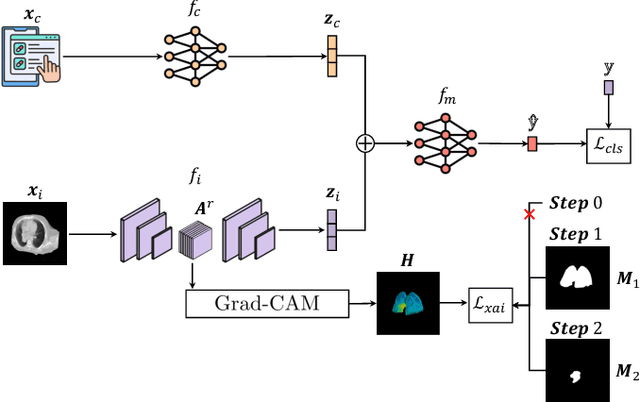
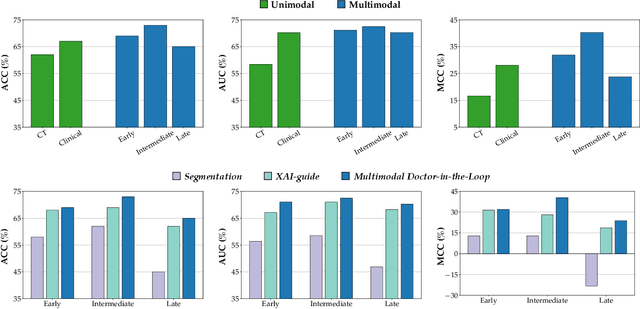
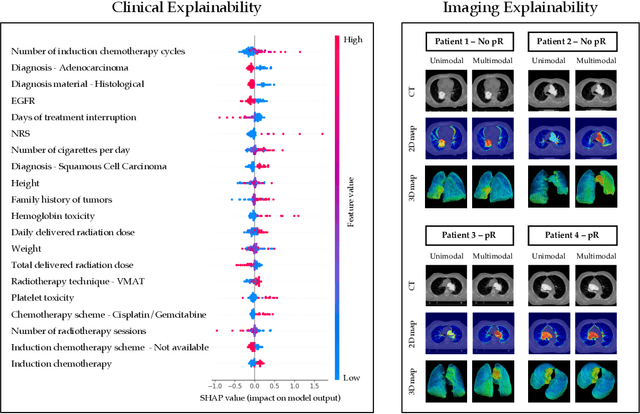
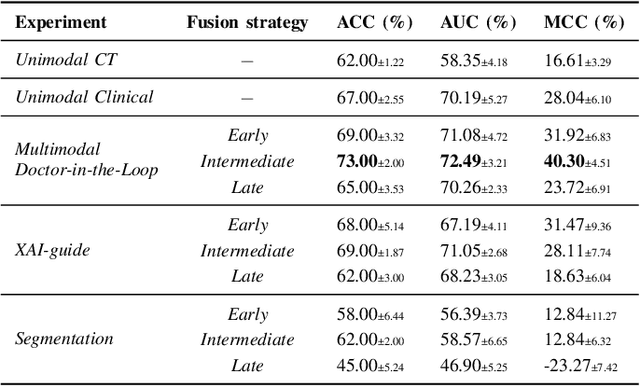
This study proposes a novel approach combining Multimodal Deep Learning with intrinsic eXplainable Artificial Intelligence techniques to predict pathological response in non-small cell lung cancer patients undergoing neoadjuvant therapy. Due to the limitations of existing radiomics and unimodal deep learning approaches, we introduce an intermediate fusion strategy that integrates imaging and clinical data, enabling efficient interaction between data modalities. The proposed Multimodal Doctor-in-the-Loop method further enhances clinical relevance by embedding clinicians' domain knowledge directly into the training process, guiding the model's focus gradually from broader lung regions to specific lesions. Results demonstrate improved predictive accuracy and explainability, providing insights into optimal data integration strategies for clinical applications.
Doctor-in-the-Loop: An Explainable, Multi-View Deep Learning Framework for Predicting Pathological Response in Non-Small Cell Lung Cancer
Feb 21, 2025Non-small cell lung cancer (NSCLC) remains a major global health challenge, with high post-surgical recurrence rates underscoring the need for accurate pathological response predictions to guide personalized treatments. Although artificial intelligence models show promise in this domain, their clinical adoption is limited by the lack of medically grounded guidance during training, often resulting in non-explainable intrinsic predictions. To address this, we propose Doctor-in-the-Loop, a novel framework that integrates expert-driven domain knowledge with explainable artificial intelligence techniques, directing the model toward clinically relevant anatomical regions and improving both interpretability and trustworthiness. Our approach employs a gradual multi-view strategy, progressively refining the model's focus from broad contextual features to finer, lesion-specific details. By incorporating domain insights at every stage, we enhance predictive accuracy while ensuring that the model's decision-making process aligns more closely with clinical reasoning. Evaluated on a dataset of NSCLC patients, Doctor-in-the-Loop delivers promising predictive performance and provides transparent, justifiable outputs, representing a significant step toward clinically explainable artificial intelligence in oncology.