 Add to Chrome
 Add to Firefox
 Add to Edge
IMMENSE: Inductive Multi-perspective User Classification in Social Networks
Aug 05, 2026
Online social networks increasingly expose people to users who propagate discriminatory, hateful, and violent content. Young users, in particular, are vulnerable to exposure to such content, which can have harmful psychological and social repercussions. Given the massive scale of today's social networks, in terms of both published content and number of users, there is an urgent need for effective systems to aid Law Enforcement Agencies (LEAs) in identifying and addressing users that disseminate malicious content. In this work we introduce IMMENSE, a machine learning-based method for detecting malicious social network users. Our approach adopts a hybrid classification strategy that integrates three perspectives: the semantics of the users' published content, their social relationships and their spatial information. Such contextual perspectives potentially enhance classification performance beyond text-only analysis. Importantly, IMMENSE employs an inductive learning approach, enabling it to classify previously unseen users or entire new networks without the need for costly and time-consuming model retraining procedures. Experiments carried out on a real-world Twitter/X dataset showed the superiority of IMMENSE against five state of the art competitors, confirming the benefits of its hybrid approach for effective deployment in social network monitoring systems.

DNS-GT: A Graph-based Transformer Approach to Learn Embeddings of Domain Names from DNS Queries
Mar 11, 2026Network intrusion detection systems play a crucial role in the security strategy employed by organisations to detect and prevent cyberattacks. Such systems usually combine pattern detection signatures with anomaly detection techniques powered by machine learning methods. However, the commonly proposed machine learning methods present drawbacks such as over-reliance on labeled data and limited generalization capabilities. To address these issues, embedding-based methods have been introduced to learn representations from network data, such as DNS traffic, mainly due to its large availability, that generalise effectively to many downstream tasks. However, current approaches do not properly consider contextual information among DNS queries. In this paper, we tackle this issue by proposing DNS-GT, a novel Transformer-based model that learns embeddings for domain names from sequences of DNS queries. The model is first pre-trained in a self-supervised fashion in order to learn the general behavior of DNS activity. Then, it can be finetuned on specific downstream tasks, exploiting interactions with other relevant queries in a given sequence. Our experiments with real-world DNS data showcase the ability of our method to learn effective domain name representations. A quantitative evaluation on domain name classification and botnet detection tasks shows that our approach achieves better results compared to relevant baselines, creating opportunities for further exploration of large-scale language models for intrusion detection systems. Our code is available at: https://github.com/m-altieri/DNS-GT.
Semi-supervised Predictive Clustering Trees for (Hierarchical) Multi-label Classification
Jul 19, 2022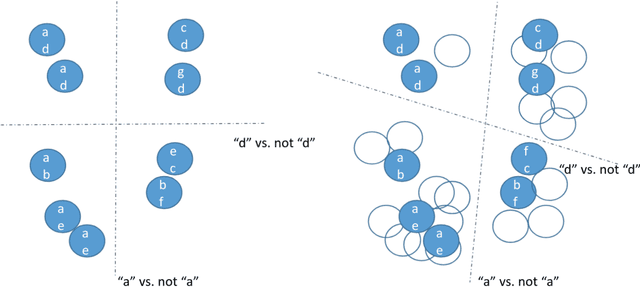
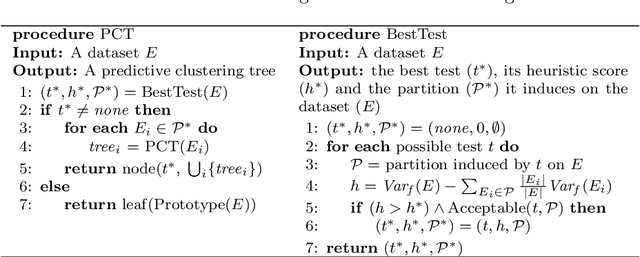
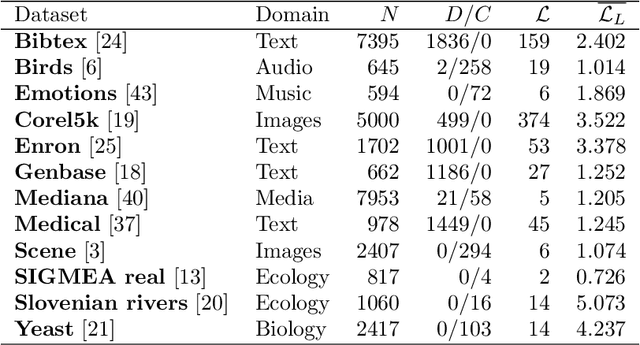
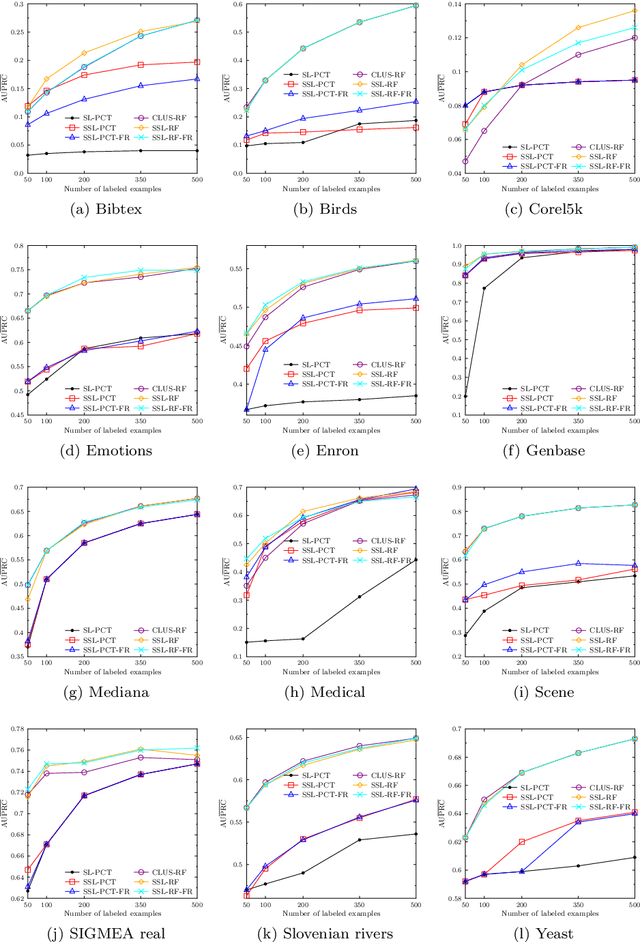
Semi-supervised learning (SSL) is a common approach to learning predictive models using not only labeled examples, but also unlabeled examples. While SSL for the simple tasks of classification and regression has received a lot of attention from the research community, this is not properly investigated for complex prediction tasks with structurally dependent variables. This is the case of multi-label classification and hierarchical multi-label classification tasks, which may require additional information, possibly coming from the underlying distribution in the descriptive space provided by unlabeled examples, to better face the challenging task of predicting simultaneously multiple class labels. In this paper, we investigate this aspect and propose a (hierarchical) multi-label classification method based on semi-supervised learning of predictive clustering trees. We also extend the method towards ensemble learning and propose a method based on the random forest approach. Extensive experimental evaluation conducted on 23 datasets shows significant advantages of the proposed method and its extension with respect to their supervised counterparts. Moreover, the method preserves interpretability and reduces the time complexity of classical tree-based models.
Temporal Pattern Mining from Evolving Networks
Sep 20, 2017Recently, evolving networks are becoming a suitable form to model many real-world complex systems, due to their peculiarities to represent the systems and their constituting entities, the interactions between the entities and the time-variability of their structure and properties. Designing computational models able to analyze evolving networks becomes relevant in many applications. The goal of this research project is to evaluate the possible contribution of temporal pattern mining techniques in the analysis of evolving networks. In particular, we aim at exploiting available snapshots for the recognition of valuable and potentially useful knowledge about the temporal dynamics exhibited by the network over the time, without making any prior assumption about the underlying evolutionary schema. Pattern-based approaches of temporal pattern mining can be exploited to detect and characterize changes exhibited by a network over the time, starting from observed snapshots.