 Add to Chrome
 Add to Firefox
 Add to Edge
Representation Gap: Explaining the Unreasonable Effectiveness of Neural Networks from a Geometric Perspective
May 20, 2026
Characterizing precisely the asymptotic generalization error of neural networks using parameters that can be estimated efficiently is a crucial problem in machine learning, which relies heavily on heuristics and practitioners' intuition to make key design choices. In order to mitigate this issue, we introduce the Representation Gap, a metric closely related to the generalization error, but admitting better-behaved asymptotic dynamics. Focusing on equivariant diffusion models and leveraging results from optimal quantization and point-process theory, we derive a precise asymptotic equivalent of the Representation Gap and show that it is governed by a single parameter, the \textit{intrinsic dimension} of the task, which is easy to interpret, efficient to estimate, and can be linked to the equivariances of common neural network architectures. We show that this asymptotic dynamic also extends to a broader range of tasks and training algorithms. Finally, we demonstrate empirically that our asymptotic law and intrinsic dimension estimation are accurate on a wide range of synthetic datasets, where these quantities are known, as well as on more realistic datasets, where we obtain results consistent with the related literature.

Conditional independence testing with a single realization of a multivariate nonstationary nonlinear time series
Apr 30, 2025Identifying relationships among stochastic processes is a key goal in disciplines that deal with complex temporal systems, such as economics. While the standard toolkit for multivariate time series analysis has many advantages, it can be difficult to capture nonlinear dynamics using linear vector autoregressive models. This difficulty has motivated the development of methods for variable selection, causal discovery, and graphical modeling for nonlinear time series, which routinely employ nonparametric tests for conditional independence. In this paper, we introduce the first framework for conditional independence testing that works with a single realization of a nonstationary nonlinear process. The key technical ingredients are time-varying nonlinear regression, time-varying covariance estimation, and a distribution-uniform strong Gaussian approximation.
Difference-in-Differences with Time-varying Continuous Treatments using Double/Debiased Machine Learning
Oct 28, 2024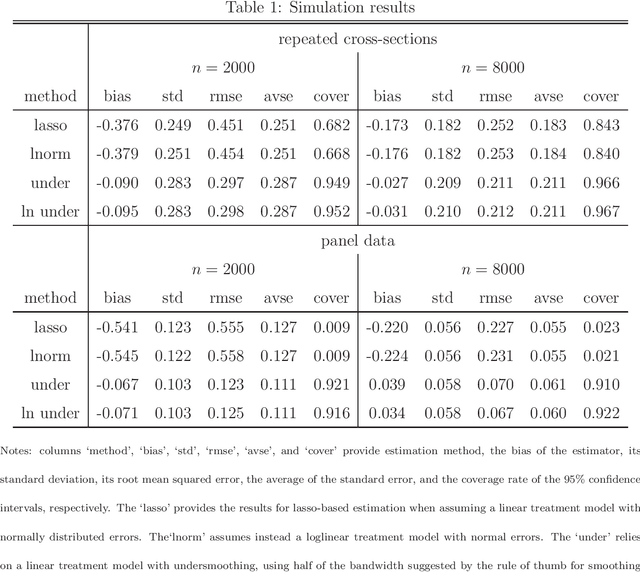
We propose a difference-in-differences (DiD) method for a time-varying continuous treatment and multiple time periods. Our framework assesses the average treatment effect on the treated (ATET) when comparing two non-zero treatment doses. The identification is based on a conditional parallel trend assumption imposed on the mean potential outcome under the lower dose, given observed covariates and past treatment histories. We employ kernel-based ATET estimators for repeated cross-sections and panel data adopting the double/debiased machine learning framework to control for covariates and past treatment histories in a data-adaptive manner. We also demonstrate the asymptotic normality of our estimation approach under specific regularity conditions. In a simulation study, we find a compelling finite sample performance of undersmoothed versions of our estimators in setups with several thousand observations.