 Add to Chrome
 Add to Firefox
 Add to Edge
Teaching LLMs Program Semantics via Symbolic Execution Traces
May 07, 2026
We introduce an evaluation framework of 500 C verification tasks across five property types (memory safety, overflow, termination, reachability, data races) built on SV-COMP 2025, and evaluate 14 models across six families. We find that high overall accuracy masks a critical weakness: while most models reliably confirm properties hold, violation detection varies widely and degrades sharply with program length. To close this gap, we train on formal verification artifacts: running the Soteria symbolic execution engine on generic open-source C code and using the resulting traces for continued pretraining of Qwen3-8B. Just ${\sim}$3,000 bug traces combined with chain-of-thought reasoning at inference time improve violation detection by over 17 percentage points, producing one of the most balanced accuracy profiles among evaluated models. On violation detection, the trained 8B model outperforms the 4$\times$ larger Qwen3-32B without thinking and approaches it in overall accuracy. The interaction between trace training and chain-of-thought is superadditive: neither alone provides meaningful gains, but their combination does. Improvements transfer across all five property types, including ones the training traces do not target. Our 28 configurations confirm the gains stem from trace semantics, not code volume, and that trace curation and format matter.

A Neurosymbolic Approach to Natural Language Formalization and Verification
Nov 12, 2025Large Language Models perform well at natural language interpretation and reasoning, but their inherent stochasticity limits their adoption in regulated industries like finance and healthcare that operate under strict policies. To address this limitation, we present a two-stage neurosymbolic framework that (1) uses LLMs with optional human guidance to formalize natural language policies, allowing fine-grained control of the formalization process, and (2) uses inference-time autoformalization to validate logical correctness of natural language statements against those policies. When correctness is paramount, we perform multiple redundant formalization steps at inference time, cross checking the formalizations for semantic equivalence. Our benchmarks demonstrate that our approach exceeds 99% soundness, indicating a near-zero false positive rate in identifying logical validity. Our approach produces auditable logical artifacts that substantiate the verification outcomes and can be used to improve the original text.
Neural Model Checking
Oct 31, 2024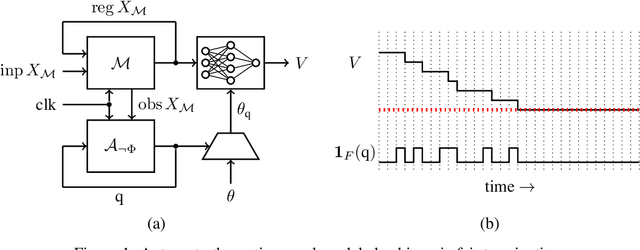
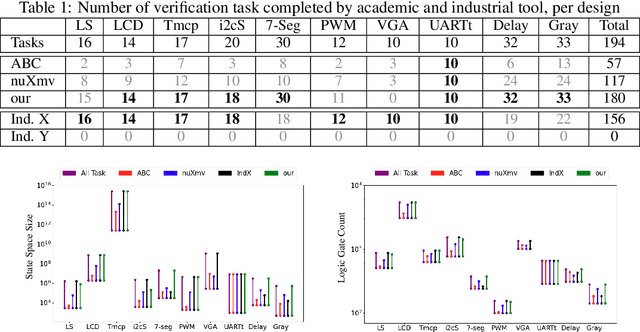

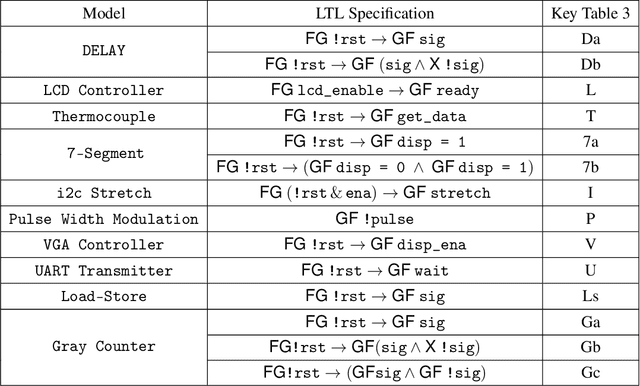
We introduce a machine learning approach to model checking temporal logic, with application to formal hardware verification. Model checking answers the question of whether every execution of a given system satisfies a desired temporal logic specification. Unlike testing, model checking provides formal guarantees. Its application is expected standard in silicon design and the EDA industry has invested decades into the development of performant symbolic model checking algorithms. Our new approach combines machine learning and symbolic reasoning by using neural networks as formal proof certificates for linear temporal logic. We train our neural certificates from randomly generated executions of the system and we then symbolically check their validity using satisfiability solving which, upon the affirmative answer, establishes that the system provably satisfies the specification. We leverage the expressive power of neural networks to represent proof certificates as well as the fact that checking a certificate is much simpler than finding one. As a result, our machine learning procedure for model checking is entirely unsupervised, formally sound, and practically effective. We experimentally demonstrate that our method outperforms the state-of-the-art academic and commercial model checkers on a set of standard hardware designs written in SystemVerilog.