 Add to Chrome
 Add to Firefox
 Add to Edge
CLARE: Classification-based Regression for Electron Temperature Prediction
Mar 12, 2026
Electron temperature (Te) is an important parameter governing space weather in the upper atmosphere, but has historically been underexplored in the space weather machine learning literature. We present CLARE, a machine learning model for predicting electron temperature in the Earth's plasmasphere trained on AKEBONO (EXOS-D) satellite measurements as well as solar and geomagnetic indices. CLARE uses a classification-based regression architecture that transforms the continuous Te output space into 150 discrete classification intervals. Training the model on a classification task improves prediction accuracy by 6.46% relative compared to a traditional regression model while also outputting uncertainty estimation information on its predictions. On a held out test set from the AKEBONO data, the model's Te predictions achieve 69.67% accuracy within 10% of the ground truth and 46.17% on a known geomagnetic storm period from January 30th to February 7th, 1991. We show that machine learning can be used to produce high-accuracy Te models on publicly available data.

Anatomy of Industrial Scale Multilingual ASR
Apr 16, 2024


This paper describes AssemblyAI's industrial-scale automatic speech recognition (ASR) system, designed to meet the requirements of large-scale, multilingual ASR serving various application needs. Our system leverages a diverse training dataset comprising unsupervised (12.5M hours), supervised (188k hours), and pseudo-labeled (1.6M hours) data across four languages. We provide a detailed description of our model architecture, consisting of a full-context 600M-parameter Conformer encoder pre-trained with BEST-RQ and an RNN-T decoder fine-tuned jointly with the encoder. Our extensive evaluation demonstrates competitive word error rates (WERs) against larger and more computationally expensive models, such as Whisper large and Canary-1B. Furthermore, our architectural choices yield several key advantages, including an improved code-switching capability, a 5x inference speedup compared to an optimized Whisper baseline, a 30% reduction in hallucination rate on speech data, and a 90% reduction in ambient noise compared to Whisper, along with significantly improved time-stamp accuracy. Throughout this work, we adopt a system-centric approach to analyzing various aspects of fully-fledged ASR models to gain practically relevant insights useful for real-world services operating at scale.
Conformer-1: Robust ASR via Large-Scale Semisupervised Bootstrapping
Apr 12, 2024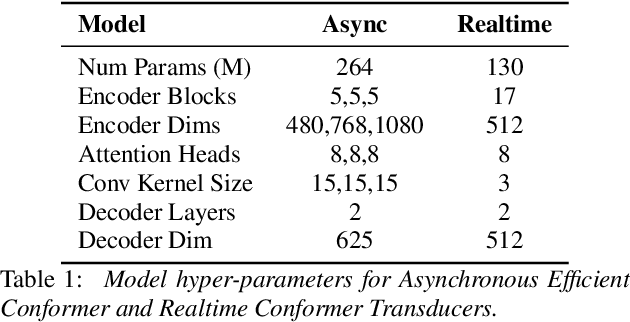

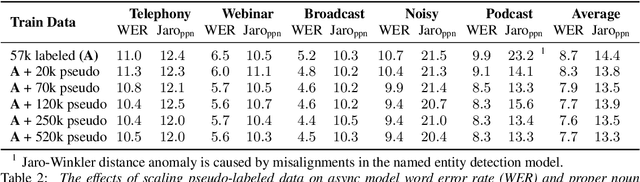
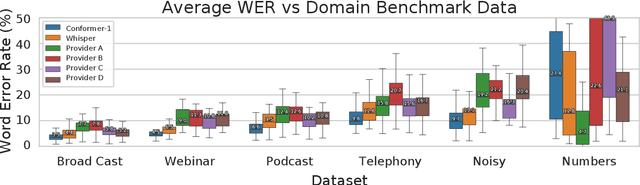
This paper presents Conformer-1, an end-to-end Automatic Speech Recognition (ASR) model trained on an extensive dataset of 570k hours of speech audio data, 91% of which was acquired from publicly available sources. To achieve this, we perform Noisy Student Training after generating pseudo-labels for the unlabeled public data using a strong Conformer RNN-T baseline model. The addition of these pseudo-labeled data results in remarkable improvements in relative Word Error Rate (WER) by 11.5% and 24.3% for our asynchronous and realtime models, respectively. Additionally, the model is more robust to background noise owing to the addition of these data. The results obtained in this study demonstrate that the incorporation of pseudo-labeled publicly available data is a highly effective strategy for improving ASR accuracy and noise robustness.