 Add to Chrome
 Add to Firefox
 Add to Edge
CLARE: Classification-based Regression for Electron Temperature Prediction
Mar 12, 2026
Electron temperature (Te) is an important parameter governing space weather in the upper atmosphere, but has historically been underexplored in the space weather machine learning literature. We present CLARE, a machine learning model for predicting electron temperature in the Earth's plasmasphere trained on AKEBONO (EXOS-D) satellite measurements as well as solar and geomagnetic indices. CLARE uses a classification-based regression architecture that transforms the continuous Te output space into 150 discrete classification intervals. Training the model on a classification task improves prediction accuracy by 6.46% relative compared to a traditional regression model while also outputting uncertainty estimation information on its predictions. On a held out test set from the AKEBONO data, the model's Te predictions achieve 69.67% accuracy within 10% of the ground truth and 46.17% on a known geomagnetic storm period from January 30th to February 7th, 1991. We show that machine learning can be used to produce high-accuracy Te models on publicly available data.

MeshRIR: A Dataset of Room Impulse Responses on Meshed Grid Points For Evaluating Sound Field Analysis and Synthesis Methods
Jun 21, 2021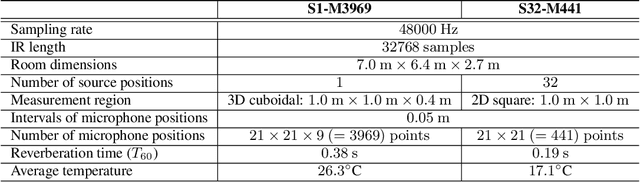
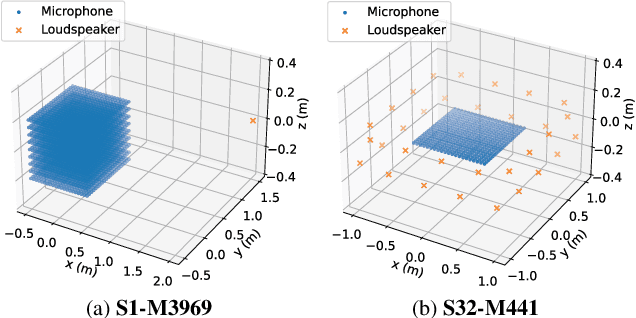
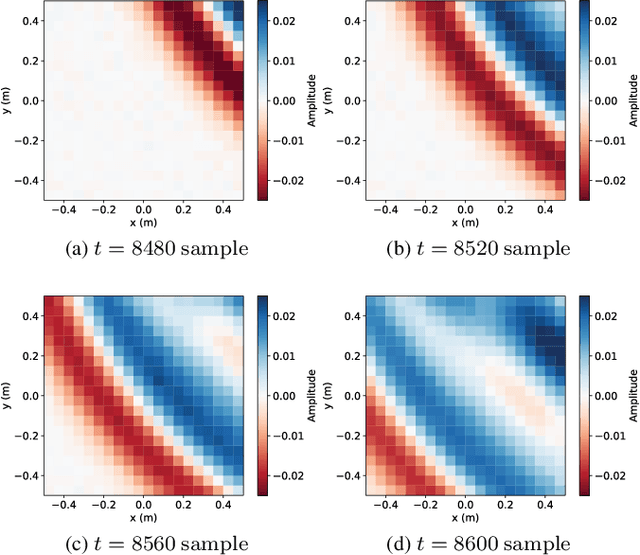
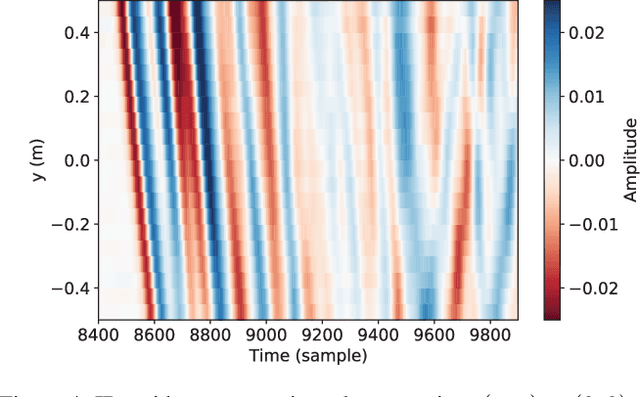
A new impulse response (IR) dataset called "MeshRIR" is introduced. Currently available datasets usually include IRs at an array of microphones from several source positions under various room conditions, which are basically designed for evaluating speech enhancement and distant speech recognition methods. On the other hand, methods of estimating or controlling spatial sound fields have been extensively investigated in recent years; however, the current IR datasets are not applicable to validating and comparing these methods because of the low spatial resolution of measurement points. MeshRIR consists of IRs measured at positions obtained by finely discretizing a spatial region. Two subdatasets are currently available: one consists of IRs in a three-dimensional cuboidal region from a single source, and the other consists of IRs in a two-dimensional square region from an array of 32 sources. Therefore, MeshRIR is suitable for evaluating sound field analysis and synthesis methods. This dataset is freely available at \url{https://sh01k.github.io/MeshRIR/} with some codes of sample applications.