 Add to Chrome
 Add to Firefox
 Add to Edge
AILive Mixer: A Deep Learning based Zero Latency Automatic Music Mixer for Live Music Performances
Mar 16, 2026
In this work, we present a deep learning-based automatic multitrack music mixing system catered towards live performances. In a live performance, channels are often corrupted with acoustic bleeds of co-located instruments. Moreover, audio-visual synchronization is of critical importance thus putting a tight constraint on the audio latency. In this work we primarily tackle these two challenges of handling bleeds in the input channels to produce the music mix with zero latency. Although there have been several developments in the field of automatic music mixing in recent times, most or all previous works focus on offline production for isolated instrument signals and to the best of our knowledge, this is the first end-to-end deep learning system developed for live music performances. Our proposed system currently predicts mono gains for a multitrack input, but its design along with the precedent set in past works, allows for easy adaptation to future work of predicting other relevant music mixing parameters.

A Recurrent Neural Network Approach to Roll Estimation for Needle Steering
Jan 13, 2021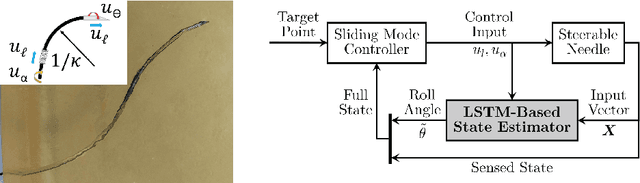
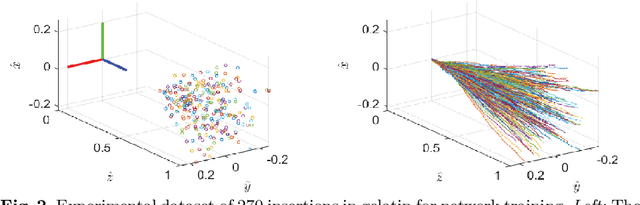
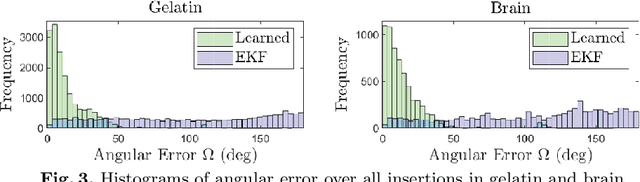
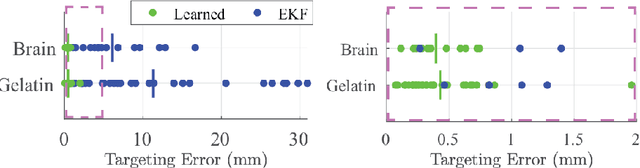
Steerable needles are a promising technology for delivering targeted therapies in the body in a minimally-invasive fashion, as they can curve around anatomical obstacles and hone in on anatomical targets. In order to accurately steer them, controllers must have full knowledge of the needle tip's orientation. However, current sensors either do not provide full orientation information or interfere with the needle's ability to deliver therapy. Further, torsional dynamics can vary and depend on many parameters making steerable needles difficult to accurately model, limiting the effectiveness of traditional observer methods. To overcome these limitations, we propose a model-free, learned-method that leverages LSTM neural networks to estimate the needle tip's orientation online. We validate our method by integrating it into a sliding-mode controller and steering the needle to targets in gelatin and ex vivo ovine brain tissue. We compare our method's performance against an Extended Kalman Filter, a model-based observer, achieving significantly lower targeting errors.