 Add to Chrome
 Add to Firefox
 Add to Edge
TetraJet-v2: Accurate NVFP4 Training for Large Language Models with Oscillation Suppression and Outlier Control
Oct 31, 2025
Large Language Models (LLMs) training is prohibitively expensive, driving interest in low-precision fully-quantized training (FQT). While novel 4-bit formats like NVFP4 offer substantial efficiency gains, achieving near-lossless training at such low precision remains challenging. We introduce TetraJet-v2, an end-to-end 4-bit FQT method that leverages NVFP4 for activations, weights, and gradients in all linear layers. We identify two critical issues hindering low-precision LLM training: weight oscillation and outliers. To address these, we propose: 1) an unbiased double-block quantization method for NVFP4 linear layers, 2) OsciReset, an algorithm to suppress weight oscillation, and 3) OutControl, an algorithm to retain outlier accuracy. TetraJet-v2 consistently outperforms prior FP4 training methods on pre-training LLMs across varying model sizes up to 370M and data sizes up to 200B tokens, reducing the performance gap to full-precision training by an average of 51.3%.

Fault Injectors for TensorFlow: Evaluation of the Impact of Random Hardware Faults on Deep CNNs
Dec 13, 2020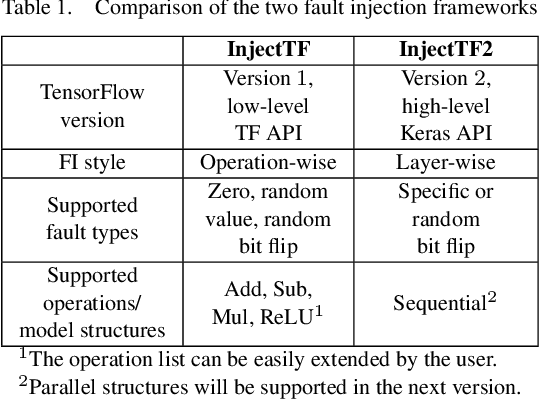
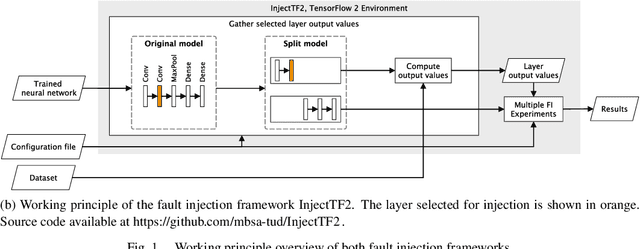
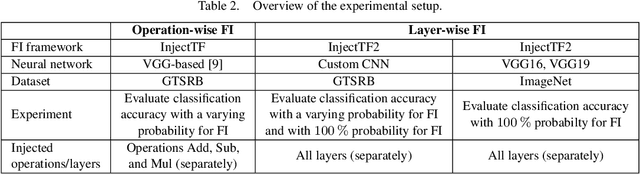
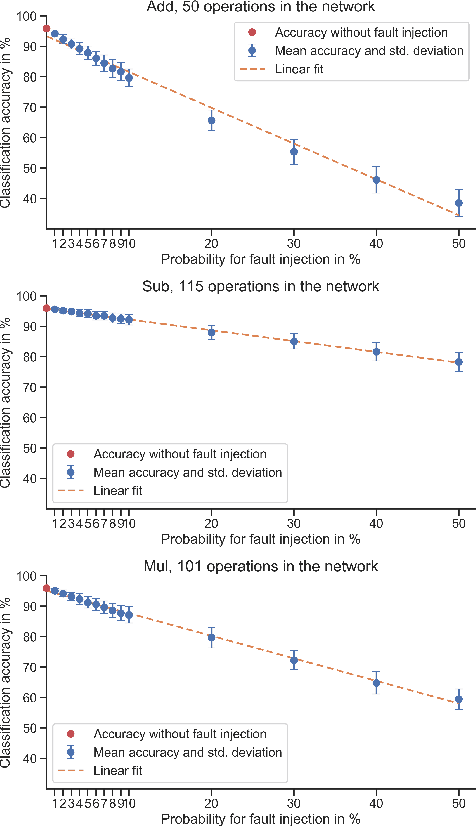
Today, Deep Learning (DL) enhances almost every industrial sector, including safety-critical areas. The next generation of safety standards will define appropriate verification techniques for DL-based applications and propose adequate fault tolerance mechanisms. DL-based applications, like any other software, are susceptible to common random hardware faults such as bit flips, which occur in RAM and CPU registers. Such faults can lead to silent data corruption. Therefore, it is crucial to develop methods and tools that help to evaluate how DL components operate under the presence of such faults. In this paper, we introduce two new Fault Injection (FI) frameworks InjectTF and InjectTF2 for TensorFlow 1 and TensorFlow 2, respectively. Both frameworks are available on GitHub and allow the configurable injection of random faults into Neural Networks (NN). In order to demonstrate the feasibility of the frameworks, we also present the results of FI experiments conducted on four VGG-based Convolutional NNs using two image sets. The results demonstrate how random bit flips in the output of particular mathematical operations and layers of NNs affect the classification accuracy. These results help to identify the most critical operations and layers, compare the reliability characteristics of functionally similar NNs, and introduce selective fault tolerance mechanisms.