 Add to Chrome
 Add to Firefox
 Add to Edge
WHAR Arena: Benchmarking the State of the Art in Efficient Wearable Human Activity Recognition
Jun 11, 2026
Deep learning has become the dominant paradigm in Wearable Human Activity Recognition (WHAR), yet progress is obscured by a comparability crisis. Results are often reported using inconsistent datasets, custom data processing, and varying evaluation protocols, making state-of-the-art claims fragile. We address this with a large-scale, open-source benchmark that integrates 30 diverse datasets under standardized processing, unified model interfaces, and a shared cross-subject evaluation protocol. Evaluating 17 representative architectures across 4760 training runs, we jointly measure predictive performance alongside on-device latency, peak memory, and model size on an Android reference device. Our results reveal that the WHAR state of the art is distributed rather than dominated by a single architecture. While CNN-HAR achieves the highest mean macro-F1, top-performing models cluster tightly, indicating contemporary architectures have converged near a predictive performance ceiling. When accounting for deployment efficiency, compact neural models, such as TinierHAR, and classical Random Forests define the practically relevant Pareto frontier, whereas larger recurrent and hybrid models incur high hardware costs without corresponding performance gains. Consequently, while predictive performance has plateaued, substantial potential for future progress remains in optimizing deployment efficiency and improving adaptation to domain shifts. We release our full framework to support transparent reuse and extension.

Uncertainty-Aware (Un)Supervised Few-Shot User Adaptation for On-Device Personalized Human Activity Recognition
Jun 03, 2026Sensor-based Human Activity Recognition (HAR) models often degrade on unseen users due to domain shifts caused by individual movement patterns and sensor placement. Practical wearable HAR systems therefore require personalization methods that are lightweight, applicable whether calibration data is labeled, unlabeled, or unavailable, and robust under limited calibration. We present a gradient-free framework that repurposes pretrained HAR classifiers as Prototypical Networks using using prior prototypes, which preserve zero-shot performance and regularize adaptation. For labeled calibration, we introduce closed-form Bayesian prototype estimation and extend the same principle to unlabeled calibration. With only 3 seconds of calibration data per activity (one shot), supervised adaptation improves macro-F1 by +2.76 to +33.44 percentage points across four datasets, while unsupervised adaptation improves by +0.56 to +32.13 points. Since adaptation requires only closed-form prototype updates, the framework enables efficient and robust on-device personalization of preexisting HAR classifiers.
pcbGPT: Automatic PCB Schematic Synthesis from Natural Language Requirements
May 31, 2026Translating natural-language hardware requirements into correct printed circuit board (PCB) schematics remains difficult in embedded, IoT, and wearable development. Designers must choose compatible components, interpret datasheets, add support circuitry, and expose correct interfaces before layout and prototyping can begin, while many such circuits cannot be validated through straightforward simulation. We present pcbGPT, a grounded system for generating editable KiCad schematics from natural-language specifications. pcbGPT represents circuits in a Python DSL and combines tool-augmented synthesis with component-library search, datasheet-grounded design knowledge, execution-based checking, structural and semantic validation, and an interactive web workflow that supports iterative refinement and synchronization with KiCad projects. We evaluate the system on 20 embedded schematic-generation tasks with reference implementations, required components, and interface constraints that enable automatic comparison. The best model reaches overall pass@1 of 0.90 and pass@5 of 1.00; pass@1 is 1.00 on basic and easy tasks, 0.91 on medium tasks, and 0.72 on hard tasks. These results, together with failure analysis, show that pcbGPT can already generate useful, reviewable first-draft schematics for early prototyping, but is not yet reliable enough to replace expert review.
Feasibility of In-Ear Single-Channel ExG for Wearable Sleep~Monitoring in Real-World Settings
Sep 09, 2025Automatic sleep staging typically relies on gold-standard EEG setups, which are accurate but obtrusive and impractical for everyday use outside sleep laboratories. This limits applicability in real-world settings, such as home environments, where continuous, long-term monitoring is needed. Detecting sleep onset is particularly relevant, enabling consumer applications (e.g. automatically pausing media playback when the user falls asleep). Recent research has shown correlations between in-ear EEG and full-scalp EEG for various phenomena, suggesting wearable, in-ear devices could allow unobtrusive sleep monitoring. We investigated the feasibility of using single-channel in-ear electrophysiological (ExG) signals for automatic sleep staging in a wearable device by conducting a sleep study with 11~participants (mean age: 24), using a custom earpiece with a dry eartip electrode (D\"atwyler SoftPulse) as a measurement electrode in one ear and a reference in the other. Ground truth sleep stages were obtained from an Apple Watch Ultra, validated for sleep staging. Our system achieved 90.5% accuracy for binary sleep detection (Awake vs. Asleep) and 65.1% accuracy for four-class staging (Awake, REM, Core, Deep) using leave-one-subject-out validation. These findings demonstrate the potential of in-ear electrodes as a low-effort, comfortable approach to sleep monitoring, with applications such as stopping podcasts when users fall asleep.
Explainable Deep Learning Framework for Human Activity Recognition
Aug 21, 2024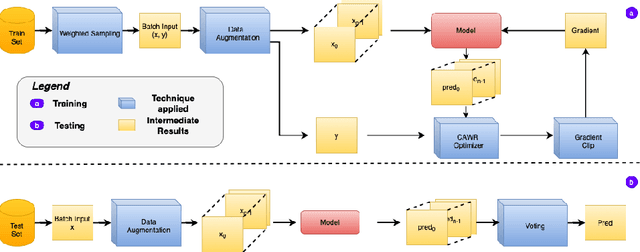
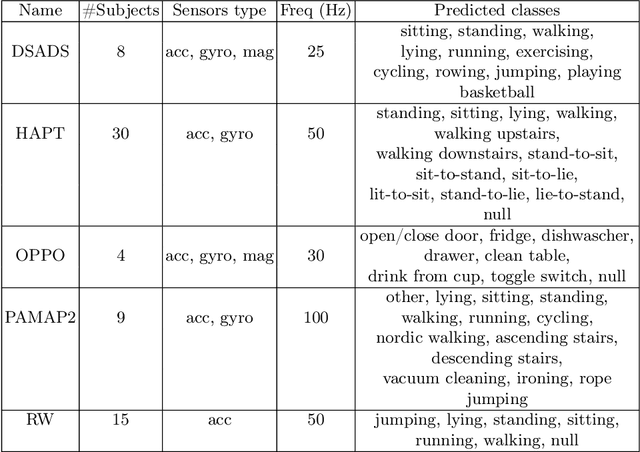
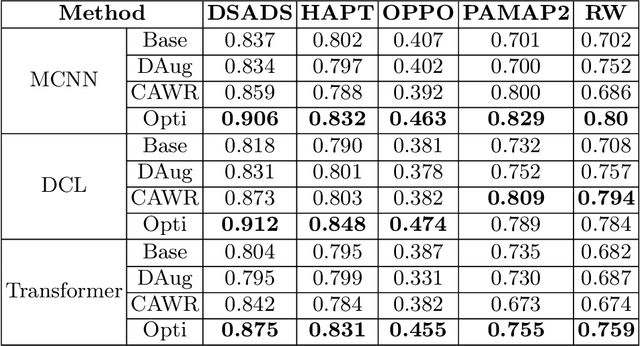
In the realm of human activity recognition (HAR), the integration of explainable Artificial Intelligence (XAI) emerges as a critical necessity to elucidate the decision-making processes of complex models, fostering transparency and trust. Traditional explanatory methods like Class Activation Mapping (CAM) and attention mechanisms, although effective in highlighting regions vital for decisions in various contexts, prove inadequate for HAR. This inadequacy stems from the inherently abstract nature of HAR data, rendering these explanations obscure. In contrast, state-of-th-art post-hoc interpretation techniques for time series can explain the model from other perspectives. However, this requires extra effort. It usually takes 10 to 20 seconds to generate an explanation. To overcome these challenges, we proposes a novel, model-agnostic framework that enhances both the interpretability and efficacy of HAR models through the strategic use of competitive data augmentation. This innovative approach does not rely on any particular model architecture, thereby broadening its applicability across various HAR models. By implementing competitive data augmentation, our framework provides intuitive and accessible explanations of model decisions, thereby significantly advancing the interpretability of HAR systems without compromising on performance.
SciEx: Benchmarking Large Language Models on Scientific Exams with Human Expert Grading and Automatic Grading
Jun 14, 2024
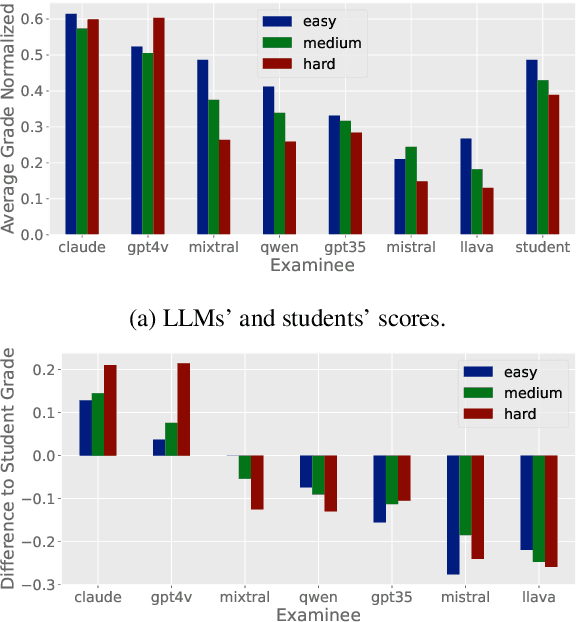

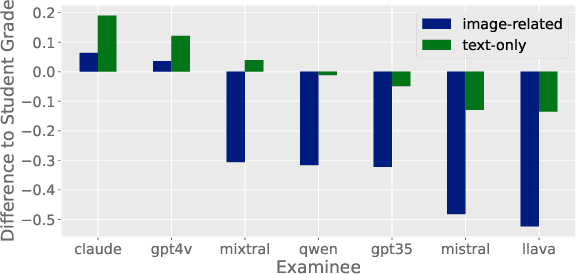
With the rapid development of Large Language Models (LLMs), it is crucial to have benchmarks which can evaluate the ability of LLMs on different domains. One common use of LLMs is performing tasks on scientific topics, such as writing algorithms, querying databases or giving mathematical proofs. Inspired by the way university students are evaluated on such tasks, in this paper, we propose SciEx - a benchmark consisting of university computer science exam questions, to evaluate LLMs ability on solving scientific tasks. SciEx is (1) multilingual, containing both English and German exams, and (2) multi-modal, containing questions that involve images, and (3) contains various types of freeform questions with different difficulty levels, due to the nature of university exams. We evaluate the performance of various state-of-the-art LLMs on our new benchmark. Since SciEx questions are freeform, it is not straightforward to evaluate LLM performance. Therefore, we provide human expert grading of the LLM outputs on SciEx. We show that the free-form exams in SciEx remain challenging for the current LLMs, where the best LLM only achieves 59.4\% exam grade on average. We also provide detailed comparisons between LLM performance and student performance on SciEx. To enable future evaluation of new LLMs, we propose using LLM-as-a-judge to grade the LLM answers on SciEx. Our experiments show that, although they do not perform perfectly on solving the exams, LLMs are decent as graders, achieving 0.948 Pearson correlation with expert grading.
Standardizing Your Training Process for Human Activity Recognition Models: A Comprehensive Review in the Tunable Factors
Jan 10, 2024In recent years, deep learning has emerged as a potent tool across a multitude of domains, leading to a surge in research pertaining to its application in the wearable human activity recognition (WHAR) domain. Despite the rapid development, concerns have been raised about the lack of standardization and consistency in the procedures used for experimental model training, which may affect the reproducibility and reliability of research results. In this paper, we provide an exhaustive review of contemporary deep learning research in the field of WHAR and collate information pertaining to the training procedure employed in various studies. Our findings suggest that a major trend is the lack of detail provided by model training protocols. Besides, to gain a clearer understanding of the impact of missing descriptions, we utilize a control variables approach to assess the impact of key tunable components (e.g., optimization techniques and early stopping criteria) on the inter-subject generalization capabilities of HAR models. With insights from the analyses, we define a novel integrated training procedure tailored to the WHAR model. Empirical results derived using five well-known \ac{whar} benchmark datasets and three classical HAR model architectures demonstrate the effectiveness of our proposed methodology: in particular, there is a significant improvement in macro F1 leave one subject out cross-validation performance.
MicroNAS: Memory and Latency Constrained Hardware-Aware Neural Architecture Search for Time Series Classification on Microcontrollers
Oct 27, 2023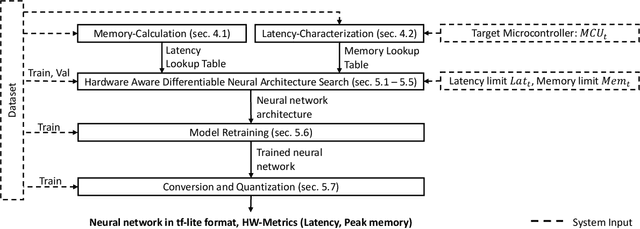
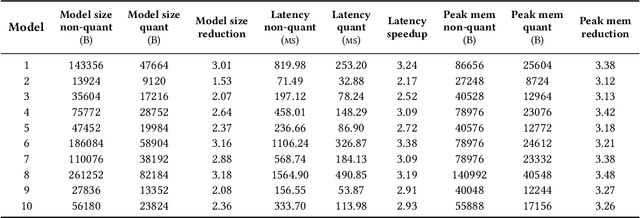
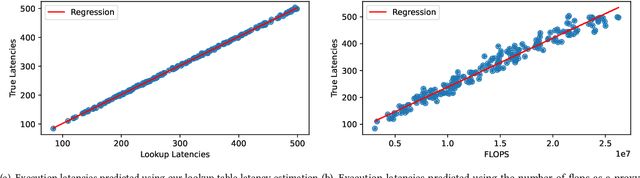
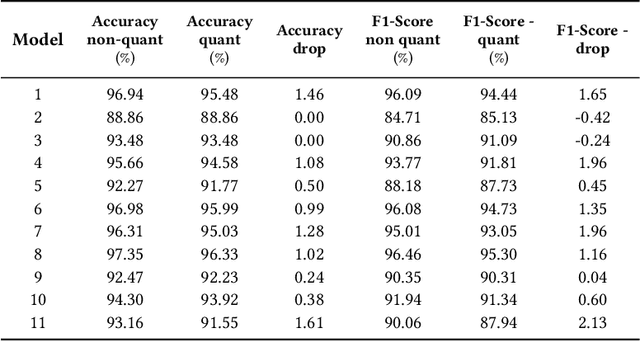
This paper presents MicroNAS, a system designed to automatically search and generate neural network architectures capable of classifying time series data on resource-constrained microcontrollers (MCUs) and generating standard tf-lite ML models. MicroNAS takes into account user-defined constraints on execution latency and peak memory consumption on a target MCU. This approach ensures that the resulting neural network architectures are optimised for the specific constraints and requirements of the MCU on which they are implemented. To achieve this, MicroNAS uses a look-up table estimation approach for accurate execution latency calculations, with a minimum error of only 1.02ms. This accurate latency estimation on MCUs sets it apart from other hardware-aware neural architecture search (HW-NAS) methods that use less accurate estimation techniques. Finally, MicroNAS delivers performance close to that of state-of-the-art models running on desktop computers, achieving high classification accuracies on recognised datasets (93.93% on UCI-HAR and 96.33% on SkodaR) while running on a Cortex-M4 MCU.
randomHAR: Improving Ensemble Deep Learners for Human Activity Recognition with Sensor Selection and Reinforcement Learning
Jul 15, 2023Deep learning has proven to be an effective approach in the field of Human activity recognition (HAR), outperforming other architectures that require manual feature engineering. Despite recent advancements, challenges inherent to HAR data, such as noisy data, intra-class variability and inter-class similarity, remain. To address these challenges, we propose an ensemble method, called randomHAR. The general idea behind randomHAR is training a series of deep learning models with the same architecture on randomly selected sensor data from the given dataset. Besides, an agent is trained with the reinforcement learning algorithm to identify the optimal subset of the trained models that are utilized for runtime prediction. In contrast to existing work, this approach optimizes the ensemble process rather than the architecture of the constituent models. To assess the performance of the approach, we compare it against two HAR algorithms, including the current state of the art, on six HAR benchmark datasets. The result of the experiment demonstrates that the proposed approach outperforms the state-of-the-art method, ensembleLSTM.
Universal Distributional Decision-based Black-box Adversarial Attack with Reinforcement Learning
Nov 15, 2022
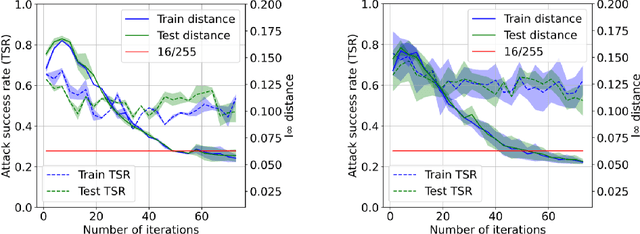
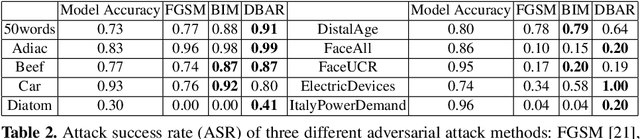
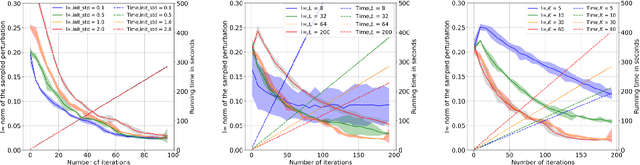
The vulnerability of the high-performance machine learning models implies a security risk in applications with real-world consequences. Research on adversarial attacks is beneficial in guiding the development of machine learning models on the one hand and finding targeted defenses on the other. However, most of the adversarial attacks today leverage the gradient or logit information from the models to generate adversarial perturbation. Works in the more realistic domain: decision-based attacks, which generate adversarial perturbation solely based on observing the output label of the targeted model, are still relatively rare and mostly use gradient-estimation strategies. In this work, we propose a pixel-wise decision-based attack algorithm that finds a distribution of adversarial perturbation through a reinforcement learning algorithm. We call this method Decision-based Black-box Attack with Reinforcement learning (DBAR). Experiments show that the proposed approach outperforms state-of-the-art decision-based attacks with a higher attack success rate and greater transferability.