 Add to Chrome
 Add to Firefox
 Add to Edge
It's All Just Vectorization: einx, a Universal Notation for Tensor Operations
Jul 30, 2026
Tensor operations represent a cornerstone of modern scientific computing. However, the Numpy-like notation adopted by predominant tensor frameworks is often difficult to read and write and prone to so-called shape errors, i.a., due to following inconsistent rules across a large, complex collection of operations. Alternatives like einsum and einops have gained popularity, but are inherently restricted to few operations and lack the generality required for a universal model of tensor programming. To derive a better paradigm, we revisit vectorization as a function for transforming tensor operations, and use it to both lift lower-order operations to higher-order operations, and conceptually decompose higher-order operations to lower-order operations and their vectorization. Building on the universal nature of vectorization, we introduce einx, a universal notation for tensor operations. It uses declarative, pointful expressions that are defined by analogy with loop notation and represent the vectorization of tensor operations. The notation reduces the large APIs of existing frameworks to a small set of elementary operations, applies consistent rules across all operations, and enables a clean, readable and writable representation in code. We provide an implementation of einx that is embedded in Python and integrates seamlessly with existing tensor frameworks: https://github.com/fferflo/einx

Structured Adversarial Camouflage via Voronoi Diagrams
Jun 16, 2026Pixel-wise adversarial patches are computationally heavy and often visually detectable, limiting utility in security-critical systems. We present adversarial Voronoi camouflage that optimizes only seed-point locations under fixed, printable palettes using a soft assignment, producing structured, splinter camouflage-like patterns without additional regularization. Evaluated on person detection with COCO-style AP@[.5:.95], naive placement (Inria -> COCO) performs comparably bad, while garment-level application via segmentation mask (3DPeople) results in a significant AP drop. The attack transfers to out-of-domain backgrounds and across detector families (YOLOv9/10/11/12), indicating robustness in black-box settings. Repainting with different palettes largely nullifies the effect, and single-color tweaks show limited tolerance (<=0.17), highlighting a structure-palette coupling. The parameter-efficient, palette-constrained design improves visual plausibility while degrading real-time detector performance. Physical validation and color calibration are left for future work. Code: https://github.com/JensBayer/Voronoi This paper was originally presented at the International Conference on Military Communication and Information Systems (ICMCIS), organized by the Information Systems Technology (IST) Scientific and Technical Committee, IST-224-RSY - the ICMCIS, held in Bath, United Kingdom, 12-13 May 2026.
Augmentation techniques for video surveillance in the visible and thermal spectral range
Jun 11, 2026In intelligent video surveillance, cameras record image sequences during day and night. Commonly, this demands different sensors. To achieve a better performance it is not unusual to combine them. We focus on the case that a long-wave infrared camera records continuously and in addition to this, another camera records in the visible spectral range during daytime and an intelligent algorithm supervises the picked up imagery. More accurate, our task is multispectral CNN-based object detection. At first glance, images originating from the visible spectral range differ between thermal infrared ones in the presence of color and distinct texture information on the one hand and in not containing information about thermal radiation that emits from objects on the other hand. Although color can provide valuable information for classification tasks, effects such as varying illumination and specialties of different sensors still represent significant problems. Anyway, obtaining sufficient and practical thermal infrared datasets for training a deep neural network poses still a challenge. That is the reason why training with the help of data from the visible spectral range could be advantageous, particularly if the data, which has to be evaluated contains both visible and infrared data. However, there is no clear evidence of how strongly variations in thermal radiation, shape, or color information influence classification accuracy. To gain deeper insight into how Convolutional Neural Networks make decisions and what they learn from different sensor input data, we investigate the suitability and robustness of different augmentation techniques...
* 8 pages
RPC-GS: Gaussian Splatting with native RPC Rendering for Satellite Imagery
Jun 04, 2026We present RPC-GS, the first Gaussian Splatting framework for satellite imagery that operates natively with Rational Polynomial Camera (RPC) models. The RPC model is the de facto standard for representing the complex imaging geometry of modern pushbroom satellite sensors. To simplify rendering, prior satellite Gaussian Splatting methods replace the RPC model with perspective or affine camera approximations, leading to geometric errors during reconstruction. RPC-GS avoids these approximations by projecting Gaussian means and covariances directly through the RPC model during the splatting process. We embed the RPC model in a chain of carefully selected geo-coordinate transformations representing a mapping from splatting-suitable scene coordinates to image coordinates. To map the Gaussian covariance matrices, we derive a numerically robust Jacobian-based covariance projection for the (partially nonlinear) coordinate transformations. Since RPCs lack an explicit notion of camera depth, we integrate a metric ray-based depth formulation. We benchmark RPC, perspective, and affine camera models in a unified framework, with our native RPC renderer consistently achieving the lowest reconstruction error on leading satellite benchmark datasets, improving mean altitude error over perspective and affine approximations by 29.6% and 63.8% on DFC2019, and by 9.9% and 37.9% on IARPA2016. We release our code to support future research of Gaussian Splatting in the satellite imaging domain.
Evaluating Explainability in Safety-Critical ATR Systems: Limitations of Post-Hoc Methods and Paths Toward Robust XAI
May 07, 2026Explainable Artificial Intelligence (XAI) is increasingly rec ognized as essential for deploying machine learning systems in safety critical environments. In Automatic Target Recognition (ATR), where models operate on image, video, radar, and multisensor data, high pre dictive performance alone is insufficient. Model decisions must also be interpretable, reliable, and suitable for validation. This paper presents a structured evaluation of explainability methods in the context of safety-critical ATR systems: We identify major XAI paradigms, including saliency-based, attention-based, and surrogate ap proaches, as well as recent detection-aware extensions. Based on this, we formalize explainability as an assurance-oriented assessment problem, introduce a taxonomy, and assess these methods with respect to four key dimensions: interpretability, robustness, vulnerability to manipula tion, and suitability for validation and verification. The analysis identifies systematic limitations of current post-hoc explanation methods. In par ticular, we derive critical failure modes such as spurious explanations, instability under perturbations, and overtrust induced by visually con vincing outputs. These findings indicate that widely used XAI techniques may be insufficient for safety-critical deployment. Finally, we discuss implications for ATR systems and outline directions toward more robust, causally grounded, and physically informed explain ability methods. Our results emphasize the need to move beyond visually plausible explanations toward approaches that support reliable decision making and system-level assurance.
SatGeo-NeRF: Geometrically Regularized NeRF for Satellite Imagery
Mar 23, 2026We present SatGeo-NeRF, a geometrically regularized NeRF for satellite imagery that mitigates overfitting-induced geometric artifacts observed in current state-of-the-art models using three model-agnostic regularizers. Gravity-Aligned Planarity Regularization aligns depth-inferred, approximated surface normals with the gravity axis to promote local planarity, coupling adjacent rays via a corresponding surface approximation to facilitate cross-ray gradient flow. Granularity Regularization enforces a coarse-to-fine geometry-learning scheme, and Depth-Supervised Regularization stabilizes early training for improved geometric accuracy. On the DFC2019 satellite reconstruction benchmark, SatGeo-NeRF improves the Mean Altitude Error by 13.9% and 11.7% relative to state-of-the-art baselines such as EO-NeRF and EO-GS.
Higher-Order Adversarial Patches for Real-Time Object Detectors
Jan 08, 2026Higher-order adversarial attacks can directly be considered the result of a cat-and-mouse game -- an elaborate action involving constant pursuit, near captures, and repeated escapes. This idiom describes the enduring circular training of adversarial attack patterns and adversarial training the best. The following work investigates the impact of higher-order adversarial attacks on object detectors by successively training attack patterns and hardening object detectors with adversarial training. The YOLOv10 object detector is chosen as a representative, and adversarial patches are used in an evasion attack manner. Our results indicate that higher-order adversarial patches are not only affecting the object detector directly trained on but rather provide a stronger generalization capacity compared to lower-order adversarial patches. Moreover, the results highlight that solely adversarial training is not sufficient to harden an object detector efficiently against this kind of adversarial attack. Code: https://github.com/JensBayer/HigherOrder
Semantic Neural Radiance Fields for Multi-Date Satellite Data
Feb 24, 2025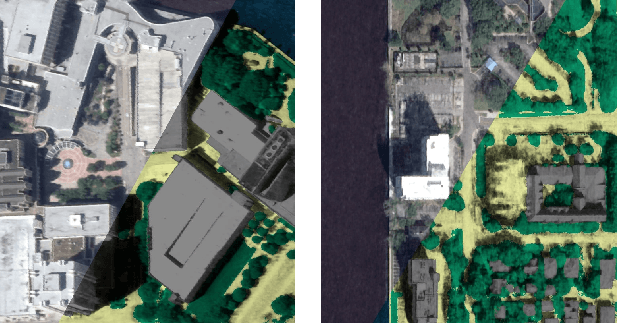
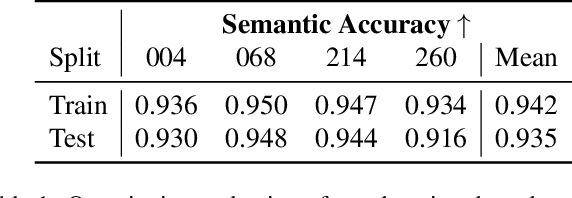
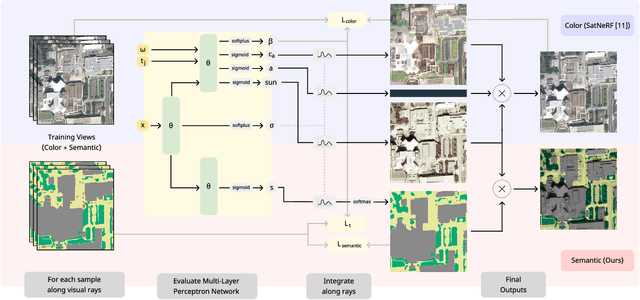
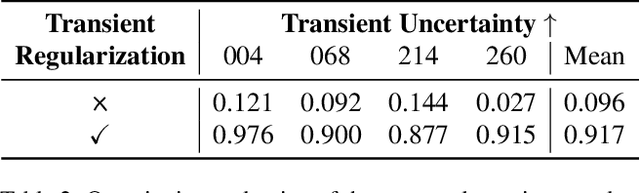
In this work we propose a satellite specific Neural Radiance Fields (NeRF) model capable to obtain a three-dimensional semantic representation (neural semantic field) of the scene. The model derives the output from a set of multi-date satellite images with corresponding pixel-wise semantic labels. We demonstrate the robustness of our approach and its capability to improve noisy input labels. We enhance the color prediction by utilizing the semantic information to address temporal image inconsistencies caused by non-stationary categories such as vehicles. To facilitate further research in this domain, we present a dataset comprising manually generated labels for popular multi-view satellite images. Our code and dataset are available at https://github.com/wagnva/semantic-nerf-for-satellite-data.
Traversing the Subspace of Adversarial Patches
Dec 02, 2024Despite ongoing research on the topic of adversarial examples in deep learning for computer vision, some fundamentals of the nature of these attacks remain unclear. As the manifold hypothesis posits, high-dimensional data tends to be part of a low-dimensional manifold. To verify the thesis with adversarial patches, this paper provides an analysis of a set of adversarial patches and investigates the reconstruction abilities of three different dimensionality reduction methods. Quantitatively, the performance of reconstructed patches in an attack setting is measured and the impact of sampled patches from the latent space during adversarial training is investigated. The evaluation is performed on two publicly available datasets for person detection. The results indicate that more sophisticated dimensionality reduction methods offer no advantages over a simple principal component analysis.
Statewide Visual Geolocalization in the Wild
Sep 25, 2024This work presents a method that is able to predict the geolocation of a street-view photo taken in the wild within a state-sized search region by matching against a database of aerial reference imagery. We partition the search region into geographical cells and train a model to map cells and corresponding photos into a joint embedding space that is used to perform retrieval at test time. The model utilizes aerial images for each cell at multiple levels-of-detail to provide sufficient information about the surrounding scene. We propose a novel layout of the search region with consistent cell resolutions that allows scaling to large geographical regions. Experiments demonstrate that the method successfully localizes 60.6% of all non-panoramic street-view photos uploaded to the crowd-sourcing platform Mapillary in the state of Massachusetts to within 50m of their ground-truth location. Source code is available at https://github.com/fferflo/statewide-visual-geolocalization.