 Add to Chrome
 Add to Firefox
 Add to Edge
Personalized to Persuade: The Effects of Contextualization and Warmth on Trust and Reliance in Conversational AI
May 29, 2026
Artificial Intelligence (AI) agents personalize their responses by tailoring explanations to users' backgrounds, interests, and prior interactions, referred to as contextualization. Personalization has been identified as a persuasive strategy in politics or in marketing. However, the persuasive effect of contextualization in everyday tasks, where users often lack prior knowledge, remains unclear. We conducted a $2\times2$ between-subjects experiment ($N = 380$) examining how contextualization, combined with conversational warmth, shapes reliance and persuasiveness of an AI assistant arguing against expert recommendations. Our findings reveal that contextualization reduces the persuasive power of AI, but its combination with warmth restores persuasiveness through a crossover interaction. Reliance on AI is present across conditions and is invariant to the conversational design. Trust strongly predicts both persuasion and reliance, yet neither contextualization nor warmth operates through trust. AI literacy decouples trust from behavior: more literate users report lower trust in the assistant, yet are more persuaded and more reliant on its advice. These results suggest that users are prone to deferring to AI agents over human expert judgment; however, interface-level conversational design choices have a limited role in shaping the behavior.

The Decision to Verify: How Warmth and User Characteristics Shape Reliance on Conversational Agents for Information Search
May 27, 2026Conversational artificial intelligence (AI) provides an efficient and convenient gateway to information access. However, it can cause overreliance when users blindly trust AI and accept its answers without fact-checking. Information search increasingly follows a hybrid interaction paradigm that combines conversational AI with web search, making fact-checking easier. In this paper, we examine whether this interaction paradigm is effective in curbing reliance. We further investigate the underlying factors (e.g., digital literacy and conversation warmth) that drive users to verify AI answers. We conduct a mixed-subjects question-answering experiment where participants interact with either a warm or a neutral chatbot. Our findings reveal that reliance persists despite users having access to both conversational and web search. The decision to verify is driven primarily by existing user perceptions (e.g., prior trust in chatbots) rather than answer properties, with some users fact-checking regardless of the context and others trusting chatbots by default. Warm conversational style has an indirect yet critical influence on reliance by increasing agreement with the chatbot when it is incorrect. Consulting additional AI sources predicts higher accuracy, while traditional web search does not. Our study extends overreliance research by: (a) demonstrating its persistence despite access to fact-checking, (b) identifying verification behavior as user-dependent, and (c) revealing conversational warmth's indirect effect on overreliance with implications for designing trustworthy conversational search systems.
From Chatbots to Confidants: A Cross-Cultural Study of LLM Adoption for Emotional Support
Apr 28, 2026Large Language Models (LLMs) are increasingly used not only for instrumental tasks, but as always-available and non-judgmental confidants for emotional support. Yet what drives adoption and how users perceive emotional support interactions across countries remains unknown. To address this gap, we present the first large-scale cross-cultural study of LLM use for emotional support, surveying 4,641 participants across seven countries (USA, UK, Germany, France, Spain, Italy, and The Netherlands). Our results show that adoption rates vary dramatically across countries (from 20% to 59%). Using mixed models that separate cultural effects from demographic composition, we find that: Being aged 25-44, religious, married, and of higher socioeconomic status are predictors of positive perceptions (trust, usage, perceived benefits), with socioeconomic status being the strongest. English-speaking countries consistently show more positive perceptions than Continental European countries. We further collect a corpus of 731 real multilingual prompts from user interactions, showing that users mainly seek help for loneliness, stress, relationship conflicts, and mental health struggles. Our findings reveal that LLM emotional support use is shaped by a complex sociotechnical landscape and call for a broader research agenda examining how these systems can be developed, deployed, and governed to ensure safe and informed access.
Personality over Precision: Exploring the Influence of Human-Likeness on ChatGPT Use for Search
Nov 09, 2025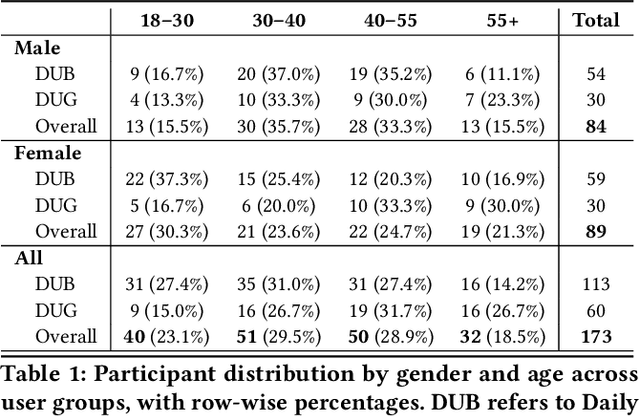
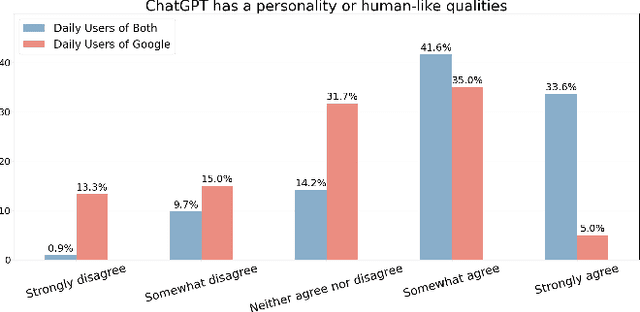
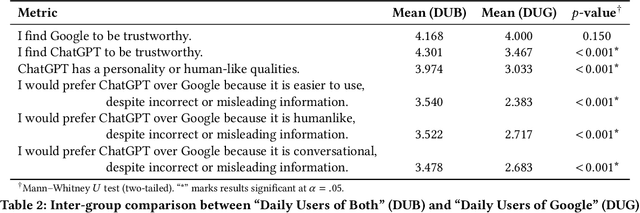
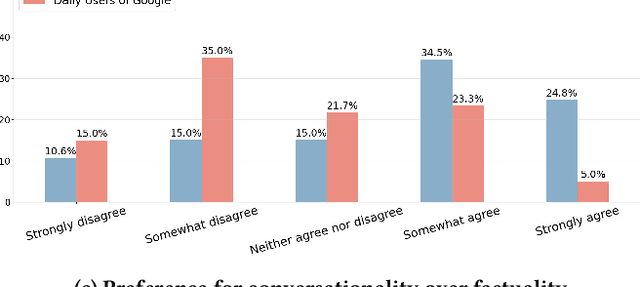
Conversational search interfaces, like ChatGPT, offer an interactive, personalized, and engaging user experience compared to traditional search. On the downside, they are prone to cause overtrust issues where users rely on their responses even when they are incorrect. What aspects of the conversational interaction paradigm drive people to adopt it, and how it creates personalized experiences that lead to overtrust, is not clear. To understand the factors influencing the adoption of conversational interfaces, we conducted a survey with 173 participants. We examined user perceptions regarding trust, human-likeness (anthropomorphism), and design preferences between ChatGPT and Google. To better understand the overtrust phenomenon, we asked users about their willingness to trade off factuality for constructs like ease of use or human-likeness. Our analysis identified two distinct user groups: those who use both ChatGPT and Google daily (DUB), and those who primarily rely on Google (DUG). The DUB group exhibited higher trust in ChatGPT, perceiving it as more human-like, and expressed greater willingness to trade factual accuracy for enhanced personalization and conversational flow. Conversely, the DUG group showed lower trust toward ChatGPT but still appreciated aspects like ad-free experiences and responsive interactions. Demographic analysis further revealed nuanced patterns, with middle-aged adults using ChatGPT less frequently yet trusting it more, suggesting potential vulnerability to misinformation. Our findings contribute to understanding user segmentation, emphasizing the critical roles of personalization and human-likeness in conversational IR systems, and reveal important implications regarding users' willingness to compromise factual accuracy for more engaging interactions.
The Impact of Quantization on Retrieval-Augmented Generation: An Analysis of Small LLMs
Jun 10, 2024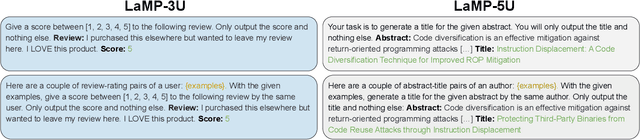
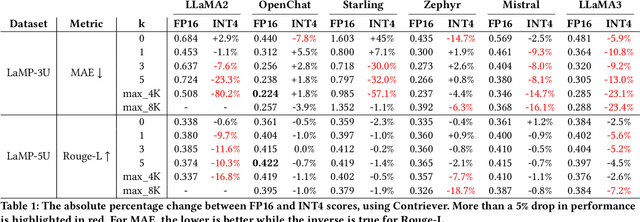
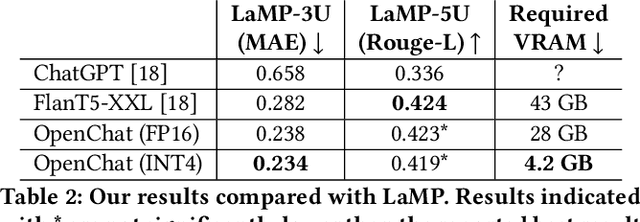
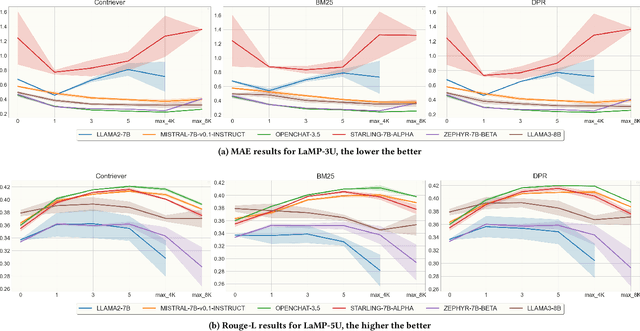
Post-training quantization reduces the computational demand of Large Language Models (LLMs) but can weaken some of their capabilities. Since LLM abilities emerge with scale, smaller LLMs are more sensitive to quantization. In this paper, we explore how quantization affects smaller LLMs' ability to perform retrieval-augmented generation (RAG), specifically in longer contexts. We chose personalization for evaluation because it is a challenging domain to perform using RAG as it requires long-context reasoning over multiple documents. We compare the original FP16 and the quantized INT4 performance of multiple 7B and 8B LLMs on two tasks while progressively increasing the number of retrieved documents to test how quantized models fare against longer contexts. To better understand the effect of retrieval, we evaluate three retrieval models in our experiments. Our findings reveal that if a 7B LLM performs the task well, quantization does not impair its performance and long-context reasoning capabilities. We conclude that it is possible to utilize RAG with quantized smaller LLMs.