 Add to Chrome
 Add to Firefox
 Add to Edge
Structure-aware Riemannian Growth Fields for 4D Plant Modeling
Aug 13, 2026
In this paper, we introduce a novel framework for 4D plant growth modeling that reconstructs the continuous geometric and topological evolution of plants from sparse temporal observations. Existing methods mainly rely on dense registration, yet reliable dense sequences are hard to obtain due to scanning constraints and self-occlusions, leaving these approaches struggling under large temporal gaps where rapid organ emergence violates local rigidity. To overcome this, we bridge these gaps by formulating plant morphogenesis as a continuous procedural process on a structure-aware Riemannian growth field; this jointly models topology evolution and geometric deformation, preserving botanical hierarchies and stable spatio-temporal correspondences across distant timepoints. Our key idea is to ground symbolic growth rules within a continuous geodesic flow, where organ development follows biologically modulated trajectories that preserve structural coherence under topological changes. We further contribute a 10-day dual-species dataset with dense geometric and semantic annotations. Experiments demonstrate that our method accurately tracks individual organ growth over time and significantly outperforms state-of-the-art baselines in both geometric accuracy and correspondence consistency.

MMHOI: Modeling Complex 3D Multi-Human Multi-Object Interactions
Oct 09, 2025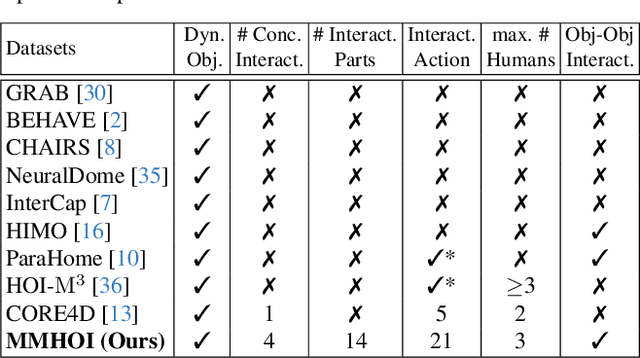
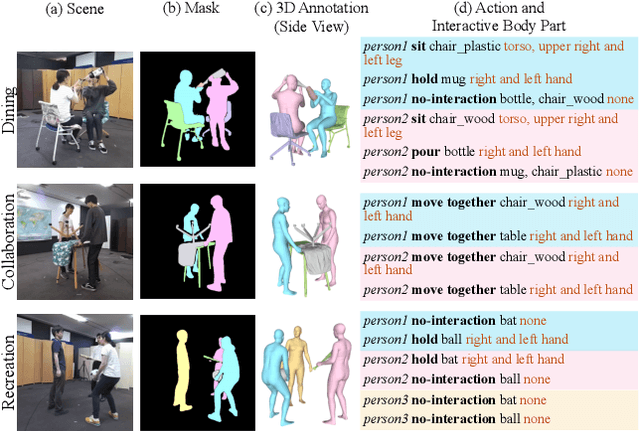
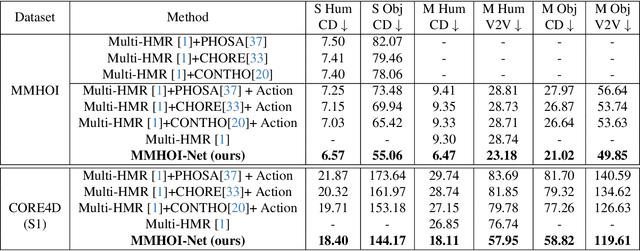
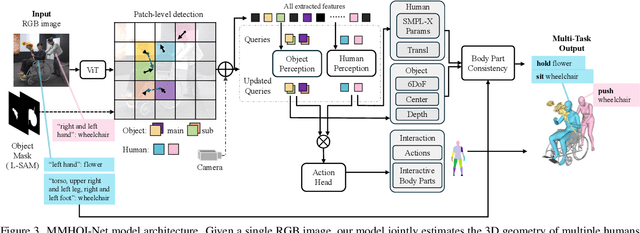
Real-world scenes often feature multiple humans interacting with multiple objects in ways that are causal, goal-oriented, or cooperative. Yet existing 3D human-object interaction (HOI) benchmarks consider only a fraction of these complex interactions. To close this gap, we present MMHOI -- a large-scale, Multi-human Multi-object Interaction dataset consisting of images from 12 everyday scenarios. MMHOI offers complete 3D shape and pose annotations for every person and object, along with labels for 78 action categories and 14 interaction-specific body parts, providing a comprehensive testbed for next-generation HOI research. Building on MMHOI, we present MMHOI-Net, an end-to-end transformer-based neural network for jointly estimating human-object 3D geometries, their interactions, and associated actions. A key innovation in our framework is a structured dual-patch representation for modeling objects and their interactions, combined with action recognition to enhance the interaction prediction. Experiments on MMHOI and the recently proposed CORE4D datasets demonstrate that our approach achieves state-of-the-art performance in multi-HOI modeling, excelling in both accuracy and reconstruction quality.