 Add to Chrome
 Add to Firefox
 Add to Edge
Energy-Arena: A Dynamic Benchmark for Operational Energy Forecasting
Apr 27, 2026
Energy forecasting research faces a persistent comparability gap that makes it difficult to measure consistent progress over time. Reported accuracy gains are often not directly comparable because models are evaluated under study-specific datasets, time periods, information sets, and scoring setups, while widely used benchmarks and competition datasets are typically tied to fixed historical windows. This paper introduces the Energy-Arena, a dynamic benchmarking platform for operational energy time series forecasting that provides a continuously updated reference point as energy systems evolve. The platform operates as an open, API-based submission system and standardizes challenge definitions and submission deadlines aligned with operational constraints. Performance is reported on rolling evaluation windows via persistent leaderboards. By moving from retrospective backtesting to forward-looking benchmarking, the Energy-Arena enforces standardized ex-ante submission and ex-post evaluation, thereby improving transparency by preventing information leakage and retroactive tuning. The platform is publicly available at Energy-Arena.org.

Estimation of spatio-temporal extremes via generative neural networks
Jul 11, 2024Recent methods in modeling spatial extreme events have focused on utilizing parametric max-stable processes and their underlying dependence structure. In this work, we provide a unified approach for analyzing spatial extremes with little available data by estimating the distribution of model parameters or the spatial dependence directly. By employing recent developments in generative neural networks we predict a full sample-based distribution, allowing for direct assessment of uncertainty regarding model parameters or other parameter dependent functionals. We validate our method by fitting several simulated max-stable processes, showing a high accuracy of the approach, regarding parameter estimation, as well as uncertainty quantification. Additional robustness checks highlight the generalization and extrapolation capabilities of the model, while an application to precipitation extremes across Western Germany demonstrates the usability of our approach in real-world scenarios.
Evaluating Effects of Tuition Fees: Lasso for the Case of Germany
Sep 18, 2019


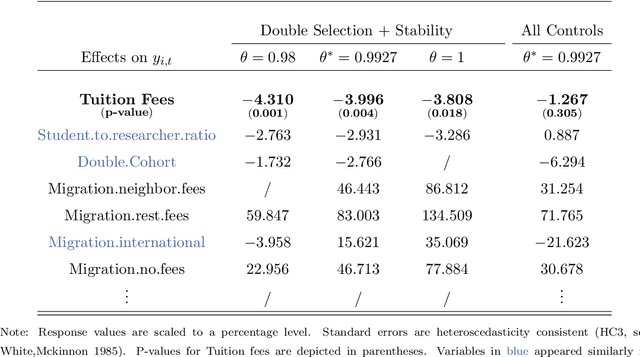
We study the effect of the introduction of university tuition fees on the enrollment behavior of students in Germany. For this, an appropriate Lasso-technique is crucial in order to identify the magnitude and significance of the effect due to potentially many relevant controlling factors and only a short time frame where fees existed. We show that a post-double selection strategy combined with stability selection determines a significant negative impact of fees on student enrollment and identifies relevant variables. This is in contrast to previous empirical studies and a plain linear panel regression which cannot detect any effect of tuition fees in this case. In our study, we explicitly deal with data challenges in the response variable in a transparent way and provide respective robust results. Moreover, we control for spatial cross-effects capturing the heterogeneity in the introduction scheme of fees across federal states ("Bundesl\"ander"), which can set their own educational policy. We also confirm the validity of our Lasso approach in a comprehensive simulation study.