 Add to Chrome
 Add to Firefox
 Add to Edge
Detect Early, Escalate Rarely: Anytime Detection of AI-Generated Video from the Compressed Bitstream
Jul 21, 2026
Detectors for AI-generated video are evaluated offline. A clip is decoded to pixels and scored once, increasingly by a large vision-language model. Detection, however, is deployed online. We recast the task as streaming perception and score the motion field the codec already wrote into the bitstream. Reading that field is a parse, not a pixel-domain forward pass. Because the running aggregate is monotone, one end-calibrated threshold is anytime-valid at the data-dependent decision time. Recalibrating at each prefix is not. Escalation is priced in closed form. A compute budget maps to a deferral window, on a frontier monotone exactly where the deferral condition holds. On matched GenVidBench the codec stage reaches full-length AUC 0.64 at five orders of magnitude less compute than a pixel CNN, on CPU. Its gate holds the stopping-time false-positive rate at target while the real data match its calibration, and drifts above it under distribution shift. Deferring 15% of clips lifts accuracy from 0.75 to 0.78 at $7\times$ less compute (paired: McNemar $p<10^{-6}$). The stage-1 ordering replicates on AIGVDBench. We introduce no new detector. The contribution is the reframing, two guarantees, and the measured frontiers. Code, configurations, and evaluation splits: https://github.com/KurbanIntelligenceLab/streamdet.

The Spectrum Is Not Enough: When Context Helps Time-Series Forecasting
Jul 14, 2026A growing family of indices scores how predictable a series is from its spectrum. Practitioners increasingly read these scores as answering a different question: whether \emph{adding context}, a longer lookback, a retrieval plug-in, or a pretrained model, will help. These are not the same question. The value of context is a property of the operating point, not of the series. Any index built from the power spectrum is invariant under phase randomization, whereas the beyond-second-order value that retrieval and foundation models supply is not, because a phase-randomized series is asymptotically Gaussian. We state this as an impossibility result and isolate it with surrogate pairs that fix the spectrum and the marginal by construction. We then give a label-free, configuration-level diagnostic, the coverage deficit, whose principal term measures beyond-spectrum structure as the gain of analog over linear prediction. On seven benchmarks the prediction holds: window-keyed retrieval's value collapses across surrogate pairs (ECL median $+33\%\!\to\!-35\%$, $p{<}10^{-40}$) while every spectral index stays frozen; a foundation model's value splits into a surviving second-order part and a small beyond-linear margin that collapses; a longer linear window's value survives. Leave-one-dataset-out, the structure term predicts the sign of beyond-spectrum value where the spectral indices trail it, and the reverse holds for the second-order mechanism. We introduce no new forecaster; the contribution is the distinction, a controlled comparison, and a diagnostic for the deployment decision. Code: https://anonymous.4open.science/r/SINE.
Auditing Generalization in AI-Generated Video Detection: A Six-Control Protocol and the VidAudit Toolkit
Jun 30, 2026AI-generated video detection benchmarks such as GenVidBench and AIGVDBench are the de facto leaderboards, yet most evaluation protocols leave uncontrolled confounds that can inflate reported generalization. As an existence proof, a three-feature clip-length classifier reaches a leave-one-generator-out (LOGO) AUC of 0.998 on GenVidBench under unaudited evaluation, while measuring nothing about motion. A 20-paper survey finds none applying all six standard controls that would catch this, so we combine them into an audited protocol and apply it to six representative feature sources (three published detectors and three repurposed signal sources), re-running it cross-dataset on AIGVDBench. The audit both debunks and certifies: the trivial classifier collapses to near chance (0.529), a CLIP baseline is caught carrying dataset identity, and the 2025 forensic detector WaveRep clears the floor at out-of-distribution LOGO AUC 0.996 with chance-level real-vs-real coherence. At a deployable FPR of 0.1%, multiple high-AUC methods fall to single-digit recall and the leaderboard order changes, so we recommend an audited tuple (AUC, above-floor margin, operating-point recall, and calibration) over a single number. As a white-box positive control, we add TemporalSpec (codec motion vectors); via cross-substrate feature fusion (XSFF), a second substrate adds genuine complementarity that survives the audit. We release VidAudit, to our knowledge the largest unified and audited detector collection for this task, providing 14 detectors behind one plugin API, a leaderboard, and Croissant metadata, available at https://github.com/KurbanIntelligenceLab/vidaudit. Together, the protocol and toolkit move evaluation from leaderboard rank toward whether a result measures what it claims.
LGQ: Learning Discretization Geometry for Scalable and Stable Image Tokenization
Feb 17, 2026Discrete image tokenization is a key bottleneck for scalable visual generation: a tokenizer must remain compact for efficient latent-space priors while preserving semantic structure and using discrete capacity effectively. Existing quantizers face a trade-off: vector-quantized tokenizers learn flexible geometries but often suffer from biased straight-through optimization, codebook under-utilization, and representation collapse at large vocabularies. Structured scalar or implicit tokenizers ensure stable, near-complete utilization by design, yet rely on fixed discretization geometries that may allocate capacity inefficiently under heterogeneous latent statistics. We introduce Learnable Geometric Quantization (LGQ), a discrete image tokenizer that learns discretization geometry end-to-end. LGQ replaces hard nearest-neighbor lookup with temperature-controlled soft assignments, enabling fully differentiable training while recovering hard assignments at inference. The assignments correspond to posterior responsibilities of an isotropic Gaussian mixture and minimize a variational free-energy objective, provably converging to nearest-neighbor quantization in the low-temperature limit. LGQ combines a token-level peakedness regularizer with a global usage regularizer to encourage confident yet balanced code utilization without imposing rigid grids. Under a controlled VQGAN-style backbone on ImageNet across multiple vocabulary sizes, LGQ achieves stable optimization and balanced utilization. At 16K codebook size, LGQ improves rFID by 11.88% over FSQ while using 49.96% fewer active codes, and improves rFID by 6.06% over SimVQ with 49.45% lower effective representation rate, achieving comparable fidelity with substantially fewer active entries. Our GitHub repository is available at: https://github.com/KurbanIntelligenceLab/LGQ
Temporal Realism Evaluation of Generated Videos Using Compressed-Domain Motion Vectors
Nov 17, 2025Temporal realism remains a central weakness of current generative video models, as most evaluation metrics prioritize spatial appearance and offer limited sensitivity to motion. We introduce a scalable, model-agnostic framework that assesses temporal behavior using motion vectors (MVs) extracted directly from compressed video streams. Codec-generated MVs from standards such as H.264 and HEVC provide lightweight, resolution-consistent descriptors of motion dynamics. We quantify realism by computing Kullback-Leibler, Jensen-Shannon, and Wasserstein divergences between MV statistics of real and generated videos. Experiments on the GenVidBench dataset containing videos from eight state-of-the-art generators reveal systematic discrepancies from real motion: entropy-based divergences rank Pika and SVD as closest to real videos, MV-sum statistics favor VC2 and Text2Video-Zero, and CogVideo shows the largest deviations across both measures. Visualizations of MV fields and class-conditional motion heatmaps further reveal center bias, sparse and piecewise constant flows, and grid-like artifacts that frame-level metrics do not capture. Beyond evaluation, we investigate MV-RGB fusion through channel concatenation, cross-attention, joint embedding, and a motion-aware fusion module. Incorporating MVs improves downstream classification across ResNet, I3D, and TSN backbones, with ResNet-18 and ResNet-34 reaching up to 97.4% accuracy and I3D achieving 99.0% accuracy on real-versus-generated discrimination. These findings demonstrate that compressed-domain MVs provide an effective temporal signal for diagnosing motion defects in generative videos and for strengthening temporal reasoning in discriminative models. The implementation is available at: https://github.com/KurbanIntelligenceLab/Motion-Vector-Learning
Geometric-k-means: A Bound Free Approach to Fast and Eco-Friendly k-means
Aug 08, 2025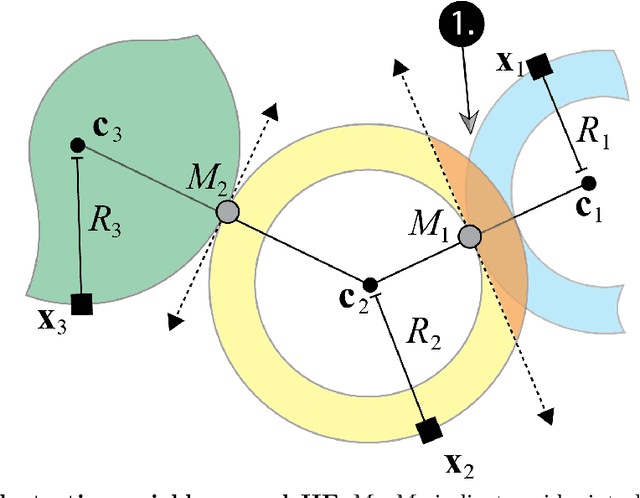
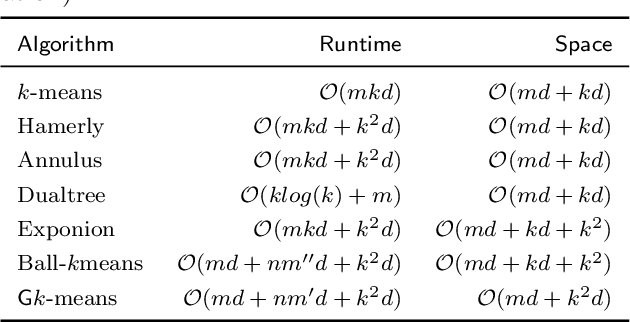
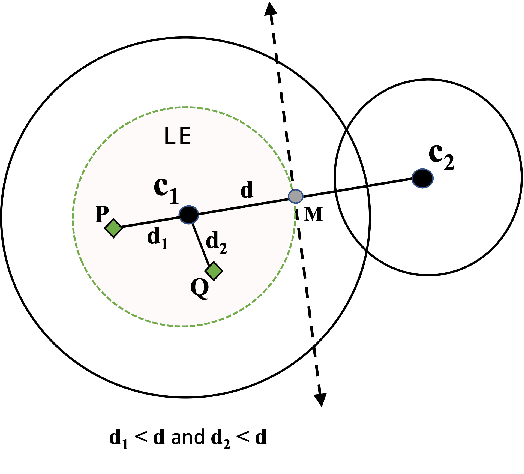

This paper introduces Geometric-k-means (or Gk-means for short), a novel approach that significantly enhances the efficiency and energy economy of the widely utilized k-means algorithm, which, despite its inception over five decades ago, remains a cornerstone in machine learning applications. The essence of Gk-means lies in its active utilization of geometric principles, specifically scalar projection, to significantly accelerate the algorithm without sacrificing solution quality. This geometric strategy enables a more discerning focus on data points that are most likely to influence cluster updates, which we call as high expressive data (HE). In contrast, low expressive data (LE), does not impact clustering outcome, is effectively bypassed, leading to considerable reductions in computational overhead. Experiments spanning synthetic, real-world and high-dimensional datasets, demonstrate Gk-means is significantly better than traditional and state of the art (SOTA) k-means variants in runtime and distance computations (DC). Moreover, Gk-means exhibits better resource efficiency, as evidenced by its reduced energy footprint, placing it as more sustainable alternative.
Multivariate de Bruijn Graphs: A Symbolic Graph Framework for Time Series Forecasting
May 28, 2025Time series forecasting remains a challenging task for foundation models due to temporal heterogeneity, high dimensionality, and the lack of inherent symbolic structure. In this work, we propose DRAGON (Discrete Representation and Augmented Graph encoding Over deBruijN Graphs), a novel encoder that introduces Multivariate de Bruijn Graphs (MdBGs) to bridge the gap between symbolic representations and neural modeling. DRAGON discretizes continuous input sequences and maps them onto a fixed graph structure, enabling dynamic context recovery via graph-based attention. Integrated as an auxiliary module within a dual-branch architecture, DRAGON augments conventional CNN-based encoders with symbolic, structure-aware representations. All code developed for this study is available at: https://github.com/KurbanIntelligenceLab/MultdBG-Time-Series-Library