 Add to Chrome
 Add to Firefox
 Add to Edge
An Interpretable Latency Model for Speculative Decoding in LLM Serving
May 14, 2026
Speculative decoding (SD) accelerates large language model (LLM) inference by using a smaller draft model to propose multiple tokens that are verified by a larger target model in parallel. While prior work demonstrates substantial speedups in isolated or fixed-batch settings, the behavior of SD in production serving systems remains poorly understood: request load varies over time, and effective batch size emerges from the serving system rather than being directly controlled or observed. In this work, we develop a simple and interpretable latency model for SD in LLM serving. We infer effective batch size from request rate using Little's Law and decompose per-request demand into load-independent and load-dependent components for prefill, drafting, and verification. We validate our model using extensive measurements from vLLM across verifier and drafter model sizes, prefill and decode lengths, request rates, draft lengths, and acceptance probabilities. The model accurately describes observed latency, explains why speedups often diminish as server load increases, and characterizes how draft length, acceptance rate, and verifier-drafter size shape latency across serving conditions, with implications for configuring SD in deployed systems. We further show how the framework extends to mixture of experts models, where sparse expert activation changes the effective service costs across load regimes. Together, our results provide a structured framework for understanding SD in real LLM serving systems.

STAT: Shrinking Transformers After Training
May 29, 2024

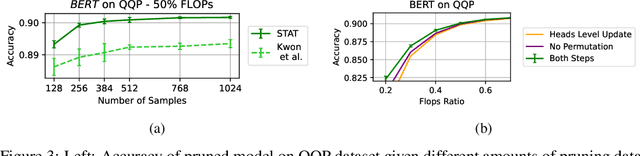

We present STAT: a simple algorithm to prune transformer models without any fine-tuning. STAT eliminates both attention heads and neurons from the network, while preserving accuracy by calculating a correction to the weights of the next layer. Each layer block in the network is compressed using a series of principled matrix factorizations that preserve the network structure. Our entire algorithm takes minutes to compress BERT, and less than three hours to compress models with 7B parameters using a single GPU. Using only several hundred data examples, STAT preserves the output of the network and improves upon existing gradient-free pruning methods. It is even competitive with methods that include significant fine-tuning. We demonstrate our method on both encoder and decoder architectures, including BERT, DistilBERT, and Llama-2 using benchmarks such as GLUE, Squad, WikiText2.