 Add to Chrome
 Add to Firefox
 Add to Edge
BnBERT-iPET: Sparse Few-Shot Language Modeling for Bengali via Lottery Ticket Pruning
Aug 05, 2026
Deep neural networks have shown impressive success in NLP tasks owing to their complex structure and huge number of edges. Achieving state-of-the-art performance in natural language processing with a large pre-trained model such as BERT is expensive and time-consuming, carries a large carbon footprint, and is difficult to realize on machines with minimal computational capability. This creates a barrier to training complex models for resource-constrained languages such as Bengali. However, in a complex neural model, not all edges are equally impactful, and the contributions of some of them can be neglected. Pruning promises to reduce the memory footprint of regular networks, shorten the training time of ever-growing networks, and increase inference efficiency without sacrificing comparable performance. In this work, we introduce BnBERT-iPET, a sparse few-shot language modeling approach for Bengali, and experimentally show that a lightweight few-shot-learned language model retaining only 10% of the edges of an initial model such as BERT can perform neck and neck with much larger models on challenging tasks for a resource-constrained language such as Bengali. By learning from few shots through iterative pattern exploiting training and achieving 90% sparsity with the Lottery Ticket Hypothesis pruning technique, our pruned BnBERT-iPET model proves to be a tough competitor to state-of-the-art language models such as Bangla Electra, Indic-BERT, and XLM-RoBERTa on downstream tasks over standard benchmark datasets of the Bengali language.

BanLemma: A Word Formation Dependent Rule and Dictionary Based Bangla Lemmatizer
Nov 06, 2023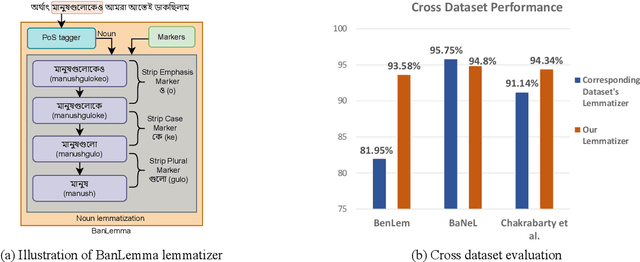
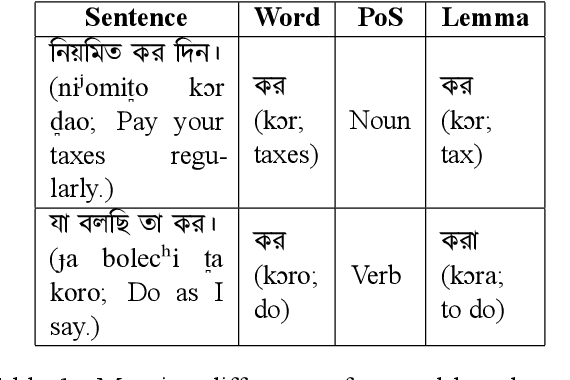
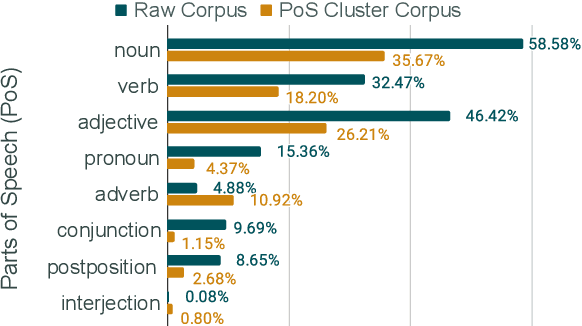
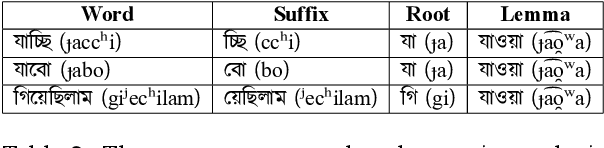
Lemmatization holds significance in both natural language processing (NLP) and linguistics, as it effectively decreases data density and aids in comprehending contextual meaning. However, due to the highly inflected nature and morphological richness, lemmatization in Bangla text poses a complex challenge. In this study, we propose linguistic rules for lemmatization and utilize a dictionary along with the rules to design a lemmatizer specifically for Bangla. Our system aims to lemmatize words based on their parts of speech class within a given sentence. Unlike previous rule-based approaches, we analyzed the suffix marker occurrence according to the morpho-syntactic values and then utilized sequences of suffix markers instead of entire suffixes. To develop our rules, we analyze a large corpus of Bangla text from various domains, sources, and time periods to observe the word formation of inflected words. The lemmatizer achieves an accuracy of 96.36% when tested against a manually annotated test dataset by trained linguists and demonstrates competitive performance on three previously published Bangla lemmatization datasets. We are making the code and datasets publicly available at https://github.com/eblict-gigatech/BanLemma in order to contribute to the further advancement of Bangla NLP.