 Add to Chrome
 Add to Firefox
 Add to Edge
VendorBench-100: A Unified Cross-Paradigm Benchmark for Deepfake Image Detection
Jul 07, 2026
Deepfake image detection is currently served by three fundamentally different paradigms: commercial APIs, zero-shot vision-language models (LLMs), and open-source detectors. Despite their widespread use, these paradigms are rarely evaluated under a common protocol, making direct comparison difficult. We introduce VendorBench-100, a cross-paradigm benchmark that evaluates 36 representative models using a single adversarial 100-image corpus, a unified output schema, and a common evaluation framework. To ensure reliable assessment under the corpus's intentional class imbalance, models are ranked primarily by the Matthews correlation coefficient (MCC), with ROC-AUC reported as a threshold-independent measure of ranking ability. Rather than maximizing dataset size, VendorBench-100 emphasizes challenging real-world scenarios through a curated taxonomy of eight edge-case families, including face swaps, text-to-video stills, AI photo edits, avatar compositing, opaque-provenance images, and compressed research frames. Our evaluation shows that commercial APIs achieve the strongest median performance, followed by vision LLMs and open-source detectors. However, individual open-source models remain competitive with the best vision LLMs. More importantly, we identify a consistent divergence between ranking ability (ROC-AUC) and operating-point quality (MCC), demonstrating that strong score discrimination does not necessarily produce reliable default-threshold decisions. This metric disagreement, rather than any single leaderboard ranking, is the central finding of the benchmark. We release the complete evaluation framework and benchmark results to support reproducible future research. The source code and data are available at: https://github.com/sharayu-20/vendorbench-100

VReID-XFD: Video-based Person Re-identification at Extreme Far Distance Challenge Results
Jan 04, 2026Person re-identification (ReID) across aerial and ground views at extreme far distances introduces a distinct operating regime where severe resolution degradation, extreme viewpoint changes, unstable motion cues, and clothing variation jointly undermine the appearance-based assumptions of existing ReID systems. To study this regime, we introduce VReID-XFD, a video-based benchmark and community challenge for extreme far-distance (XFD) aerial-to-ground person re-identification. VReID-XFD is derived from the DetReIDX dataset and comprises 371 identities, 11,288 tracklets, and 11.75 million frames, captured across altitudes from 5.8 m to 120 m, viewing angles from oblique (30 degrees) to nadir (90 degrees), and horizontal distances up to 120 m. The benchmark supports aerial-to-aerial, aerial-to-ground, and ground-to-aerial evaluation under strict identity-disjoint splits, with rich physical metadata. The VReID-XFD-25 Challenge attracted 10 teams with hundreds of submissions. Systematic analysis reveals monotonic performance degradation with altitude and distance, a universal disadvantage of nadir views, and a trade-off between peak performance and robustness. Even the best-performing SAS-PReID method achieves only 43.93 percent mAP in the aerial-to-ground setting. The dataset, annotations, and official evaluation protocols are publicly available at https://www.it.ubi.pt/DetReIDX/ .
Causality and "In-the-Wild" Video-Based Person Re-ID: A Survey
May 28, 2025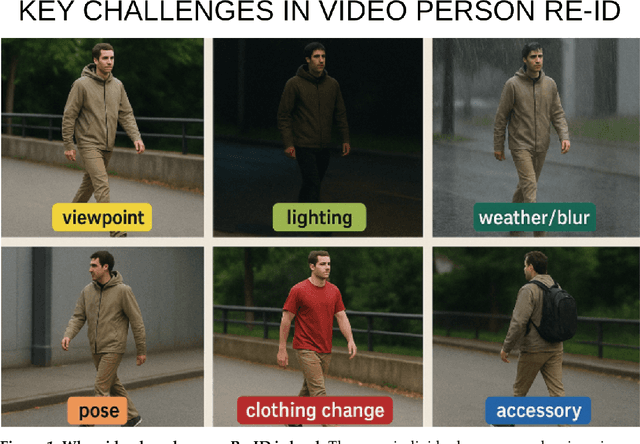
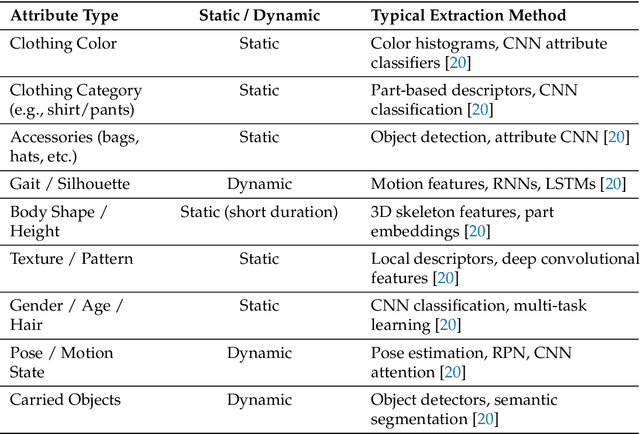
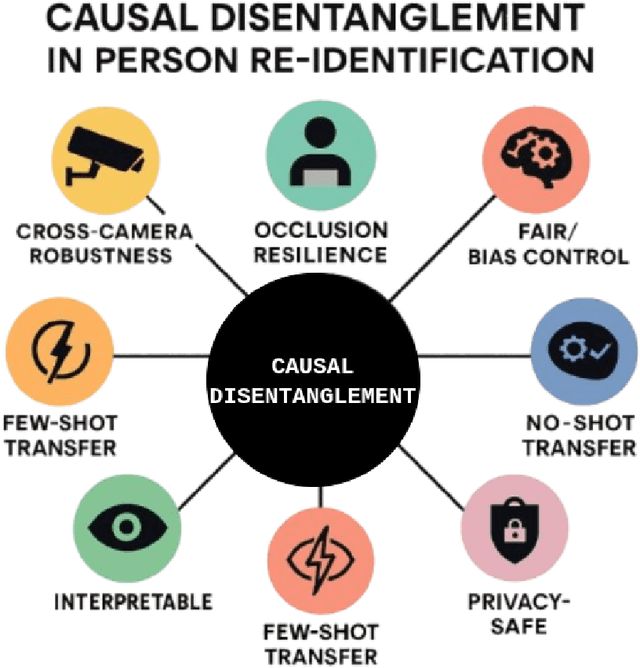
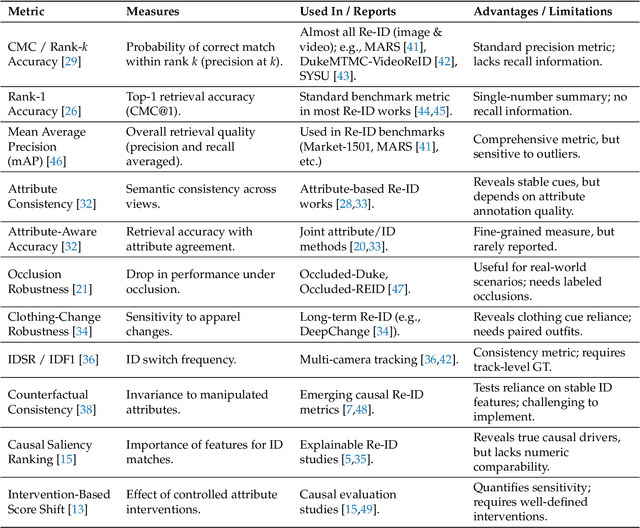
Video-based person re-identification (Re-ID) remains brittle in real-world deployments despite impressive benchmark performance. Most existing models rely on superficial correlations such as clothing, background, or lighting that fail to generalize across domains, viewpoints, and temporal variations. This survey examines the emerging role of causal reasoning as a principled alternative to traditional correlation-based approaches in video-based Re-ID. We provide a structured and critical analysis of methods that leverage structural causal models, interventions, and counterfactual reasoning to isolate identity-specific features from confounding factors. The survey is organized around a novel taxonomy of causal Re-ID methods that spans generative disentanglement, domain-invariant modeling, and causal transformers. We review current evaluation metrics and introduce causal-specific robustness measures. In addition, we assess practical challenges of scalability, fairness, interpretability, and privacy that must be addressed for real-world adoption. Finally, we identify open problems and outline future research directions that integrate causal modeling with efficient architectures and self-supervised learning. This survey aims to establish a coherent foundation for causal video-based person Re-ID and to catalyze the next phase of research in this rapidly evolving domain.