 Add to Chrome
 Add to Firefox
 Add to Edge
BanglaForge: LLM Collaboration with Self-Refinement for Bangla Code Generation
Dec 22, 2025
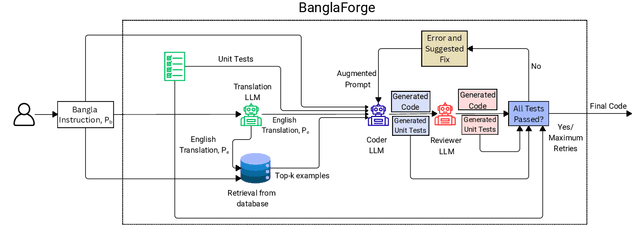
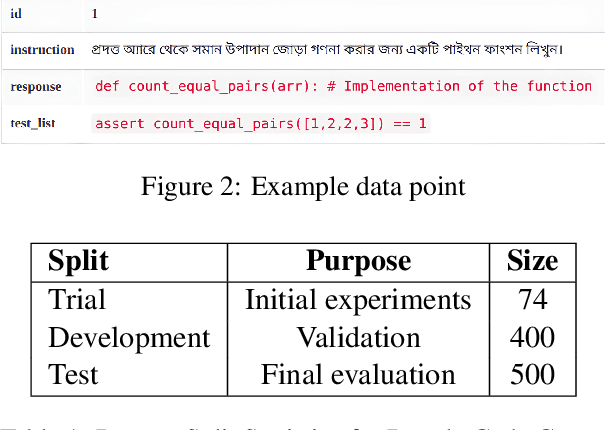
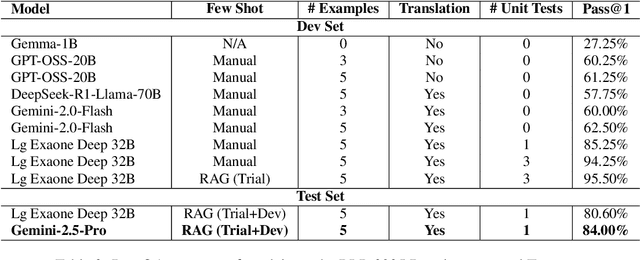
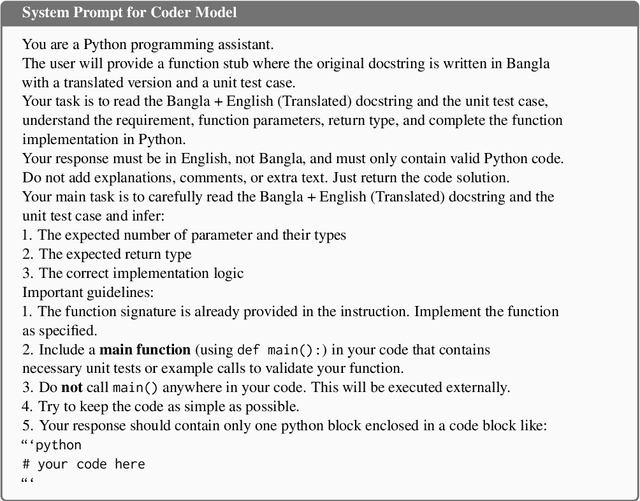
Bangla is a low-resource language for code generation, lacking large-scale annotated datasets and tools to transform natural language specifications into executable programs. This makes Bangla-to-code generation a challenging task requiring innovative solutions. To address this, we introduce BanglaForge, a novel framework for generating code from Bangla function descriptions. BanglaForge leverages a retrieval-augmented dual-model collaboration paradigm with self-refinement, combining in-context learning, llm-based translation, systematic prompt engineering, and iterative self-refinement based on execution feedback, where a coder generates initial solutions and a reviewer enhances them for robustness. On the BLP-2025 Bangla Code Generation benchmark, BanglaForge achieves a competitive Pass@1 accuracy of 84.00%, demonstrating the effectiveness of retrieval, model collaboration, and self-refinement for low-resource Bangla code generation.

BrainRotViT: Transformer-ResNet Hybrid for Explainable Modeling of Brain Aging from 3D sMRI
Nov 19, 2025Accurate brain age estimation from structural MRI is a valuable biomarker for studying aging and neurodegeneration. Traditional regression and CNN-based methods face limitations such as manual feature engineering, limited receptive fields, and overfitting on heterogeneous data. Pure transformer models, while effective, require large datasets and high computational cost. We propose Brain ResNet over trained Vision Transformer (BrainRotViT), a hybrid architecture that combines the global context modeling of vision transformers (ViT) with the local refinement of residual CNNs. A ViT encoder is first trained on an auxiliary age and sex classification task to learn slice-level features. The frozen encoder is then applied to all sagittal slices to generate a 2D matrix of embedding vectors, which is fed into a residual CNN regressor that incorporates subject sex at the final fully-connected layer to estimate continuous brain age. Our method achieves an MAE of 3.34 years (Pearson $r=0.98$, Spearman $ρ=0.97$, $R^2=0.95$) on validation across 11 MRI datasets encompassing more than 130 acquisition sites, outperforming baseline and state-of-the-art models. It also generalizes well across 4 independent cohorts with MAEs between 3.77 and 5.04 years. Analyses on the brain age gap (the difference between the predicted age and actual age) show that aging patterns are associated with Alzheimer's disease, cognitive impairment, and autism spectrum disorder. Model attention maps highlight aging-associated regions of the brain, notably the cerebellar vermis, precentral and postcentral gyri, temporal lobes, and medial superior frontal gyrus. Our results demonstrate that this method provides an efficient, interpretable, and generalizable framework for brain-age prediction, bridging the gap between CNN- and transformer-based approaches while opening new avenues for aging and neurodegeneration research.