 Add to Chrome
 Add to Firefox
 Add to Edge
Vision-Reasoning-Guided Occlusion Removal from Light Fields
Jun 18, 2026
Occlusion-robust scene recovery remains a major challenge in computational imaging, particularly in natural environments where dense foreground vegetation severely limits visibility. We propose a vision-reasoning-guided light field occlusion removal framework that combines the visibility recovery capability of light field integration (LFI) with the semantic reasoning capacity of vision-language models (VLMs). Multi-view observations are first integrated via LFI to suppress foreground occlusions and produce an initial visibility-enhanced representation. A VLM is then incorporated as a conditional semantic prior to restore degraded structures and recover fine details, guided by the observed measurements. To improve recovery consistency and reduce hallucination artifacts, we introduce a multi-sample fusion strategy that aggregates multiple generated hypotheses into a unified estimate. Experimental results on synthetic and real-world datasets demonstrate state-of-the-art performance, achieving the highest average SSIM across four synthetic light field benchmark scenes (4-Syn) and strong generalization across structured and unstructured acquisition settings. These results highlight the effectiveness of combining physical imaging constraints with vision-language reasoning for robust perception under severe occlusion, with applicability to search-and-rescue and exploratory robotic navigation.

Ontology-Guided Diffusion for Zero-Shot Visual Sim2Real Transfer
Mar 19, 2026Bridging the simulation-to-reality (sim2real) gap remains challenging as labelled real-world data is scarce. Existing diffusion-based approaches rely on unstructured prompts or statistical alignment, which do not capture the structured factors that make images look real. We introduce Ontology- Guided Diffusion (OGD), a neuro-symbolic zero-shot sim2real image translation framework that represents realism as structured knowledge. OGD decomposes realism into an ontology of interpretable traits -- such as lighting and material properties -- and encodes their relationships in a knowledge graph. From a synthetic image, OGD infers trait activations and uses a graph neural network to produce a global embedding. In parallel, a symbolic planner uses the ontology traits to compute a consistent sequence of visual edits needed to narrow the realism gap. The graph embedding conditions a pretrained instruction-guided diffusion model via cross-attention, while the planned edits are converted into a structured instruction prompt. Across benchmarks, our graph-based embeddings better distinguish real from synthetic imagery than baselines, and OGD outperforms state-of-the-art diffusion methods in sim2real image translations. Overall, OGD shows that explicitly encoding realism structure enables interpretable, data-efficient, and generalisable zero-shot sim2real transfer.
Through-Foliage Surface-Temperature Reconstruction for early Wildfire Detection
Nov 16, 2025We introduce a novel method for reconstructing surface temperatures through occluding forest vegetation by combining signal processing and machine learning. Our goal is to enable fully automated aerial wildfire monitoring using autonomous drones, allowing for the early detection of ground fires before smoke or flames are visible. While synthetic aperture (SA) sensing mitigates occlusion from the canopy and sunlight, it introduces thermal blur that obscures the actual surface temperatures. To address this, we train a visual state space model to recover the subtle thermal signals of partially occluded soil and fire hotspots from this blurred data. A key challenge was the scarcity of real-world training data. We overcome this by integrating a latent diffusion model into a vector quantized to generated a large volume of realistic surface temperature simulations from real wildfire recordings, which we further expanded through temperature augmentation and procedural thermal forest simulation. On simulated data across varied ambient and surface temperatures, forest densities, and sunlight conditions, our method reduced the RMSE by a factor of 2 to 2.5 compared to conventional thermal and uncorrected SA imaging. In field experiments focused on high-temperature hotspots, the improvement was even more significant, with a 12.8-fold RMSE gain over conventional thermal and a 2.6-fold gain over uncorrected SA images. We also demonstrate our model's generalization to other thermal signals, such as human signatures for search and rescue. Since simple thresholding is frequently inadequate for detecting subtle thermal signals, the morphological characteristics are equally essential for accurate classification. Our experiments demonstrated another clear advantage: we reconstructed the complete morphology of fire and human signatures, whereas conventional imaging is defeated by partial occlusion.
DeepForest: Sensing Into Self-Occluding Volumes of Vegetation With Aerial Imaging
Feb 04, 2025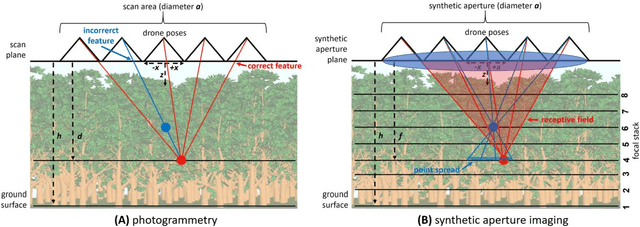
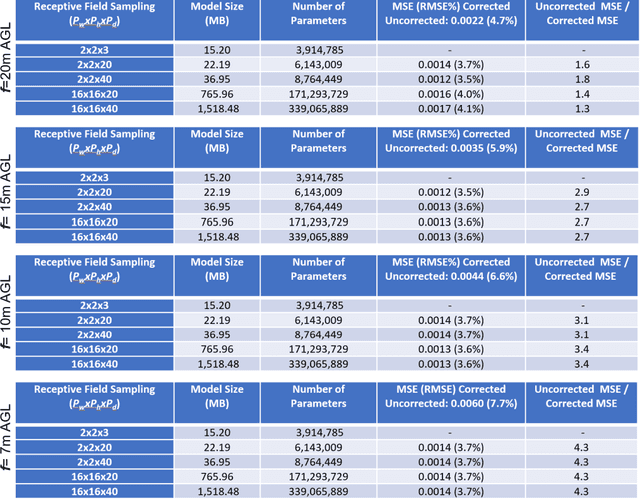
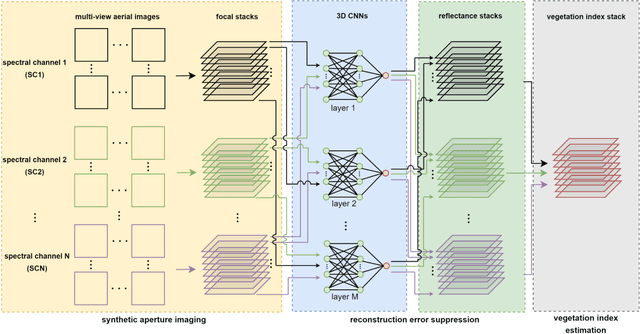
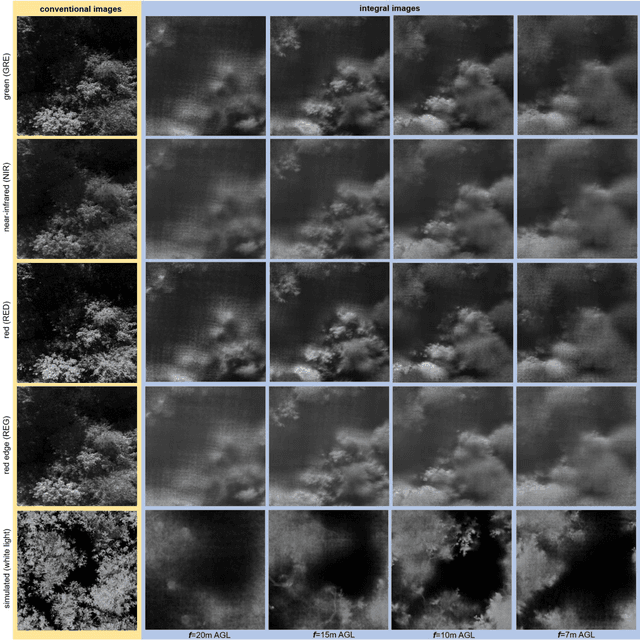
Access to below-canopy volumetric vegetation data is crucial for understanding ecosystem dynamics. We address the long-standing limitation of remote sensing to penetrate deep into dense canopy layers. LiDAR and radar are currently considered the primary options for measuring 3D vegetation structures, while cameras can only extract the reflectance and depth of top layers. Using conventional, high-resolution aerial images, our approach allows sensing deep into self-occluding vegetation volumes, such as forests. It is similar in spirit to the imaging process of wide-field microscopy, but can handle much larger scales and strong occlusion. We scan focal stacks by synthetic-aperture imaging with drones and reduce out-of-focus signal contributions using pre-trained 3D convolutional neural networks. The resulting volumetric reflectance stacks contain low-frequency representations of the vegetation volume. Combining multiple reflectance stacks from various spectral channels provides insights into plant health, growth, and environmental conditions throughout the entire vegetation volume.
Fusion of Single and Integral Multispectral Aerial Images
Nov 29, 2023

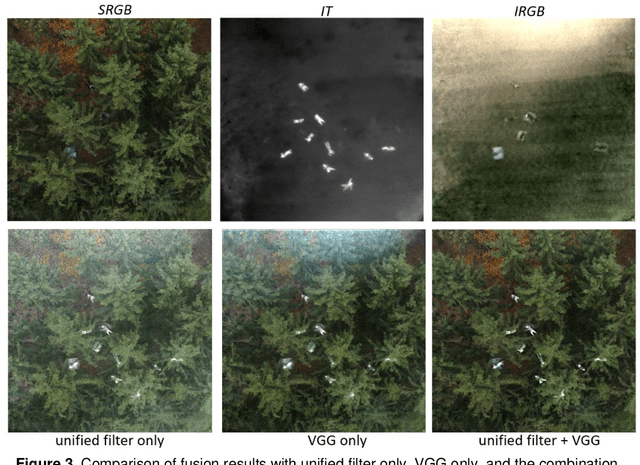

We present a novel hybrid (model- and learning-based) architecture for fusing the most significant features from conventional aerial images and integral aerial images that result from synthetic aperture sensing for removing occlusion caused by dense vegetation. It combines the environment's spatial references with features of unoccluded targets. Our method out-beats the state-of-the-art, does not require manually tuned parameters, can be extended to an arbitrary number and combinations of spectral channels, and is reconfigurable to address different use-cases.