 Add to Chrome
 Add to Firefox
 Add to Edge
ALIGN-FL: Architecture-independent Learning through Invariant Generative component sharing in Federated Learning
Dec 15, 2025
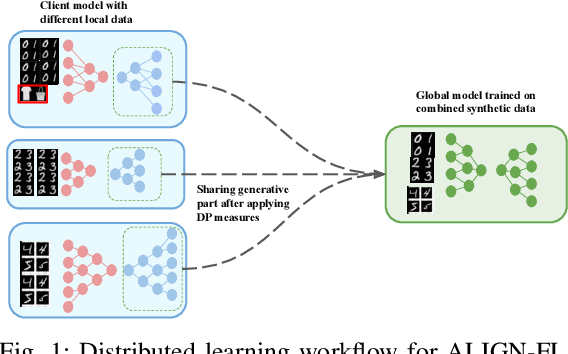
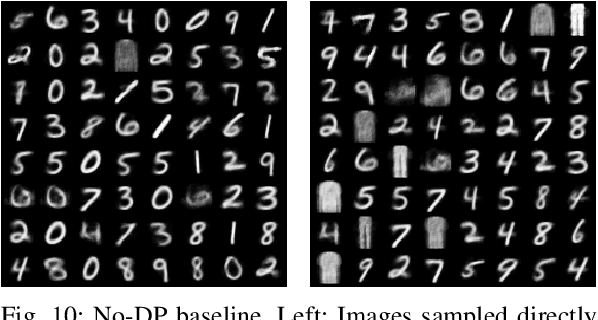
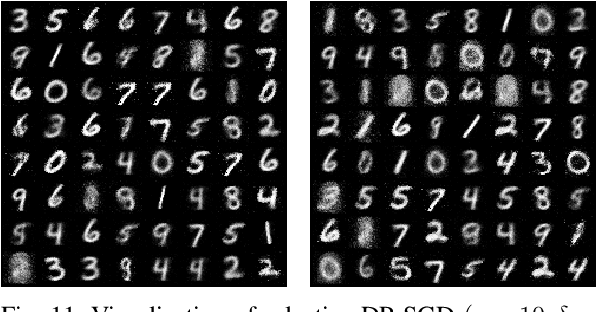
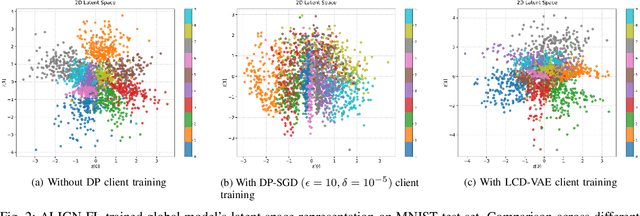
We present ALIGN-FL, a novel approach to distributed learning that addresses the challenge of learning from highly disjoint data distributions through selective sharing of generative components. Instead of exchanging full model parameters, our framework enables privacy-preserving learning by transferring only generative capabilities across clients, while the server performs global training using synthetic samples. Through complementary privacy mechanisms: DP-SGD with adaptive clipping and Lipschitz regularized VAE decoders and a stateful architecture supporting heterogeneous clients, we experimentally validate our approach on MNIST and Fashion-MNIST datasets with cross-domain outliers. Our analysis demonstrates that both privacy mechanisms effectively map sensitive outliers to typical data points while maintaining utility in extreme Non-IID scenarios typical of cross-silo collaborations. Index Terms: Client-invariant Learning, Federated Learning (FL), Privacy-preserving Generative Models, Non-Independent and Identically Distributed (Non-IID), Heterogeneous Architectures

Rethinking Explanation Evaluation under the Retraining Scheme
Nov 11, 2025
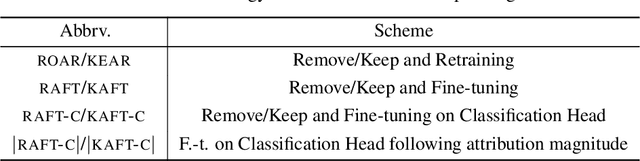
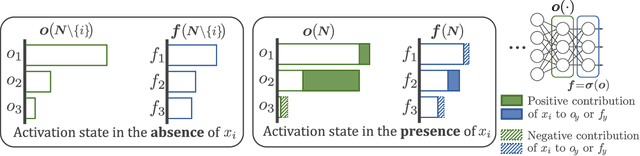
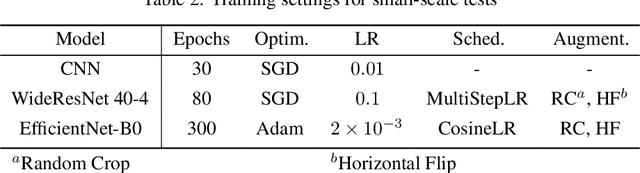
Feature attribution has gained prominence as a tool for explaining model decisions, yet evaluating explanation quality remains challenging due to the absence of ground-truth explanations. To circumvent this, explanation-guided input manipulation has emerged as an indirect evaluation strategy, measuring explanation effectiveness through the impact of input modifications on model outcomes during inference. Despite the widespread use, a major concern with inference-based schemes is the distribution shift caused by such manipulations, which undermines the reliability of their assessments. The retraining-based scheme ROAR overcomes this issue by adapting the model to the altered data distribution. However, its evaluation results often contradict the theoretical foundations of widely accepted explainers. This work investigates this misalignment between empirical observations and theoretical expectations. In particular, we identify the sign issue as a key factor responsible for residual information that ultimately distorts retraining-based evaluation. Based on the analysis, we show that a straightforward reframing of the evaluation process can effectively resolve the identified issue. Building on the existing framework, we further propose novel variants that jointly structure a comprehensive perspective on explanation evaluation. These variants largely improve evaluation efficiency over the standard retraining protocol, thereby enhancing practical applicability for explainer selection and benchmarking. Following our proposed schemes, empirical results across various data scales provide deeper insights into the performance of carefully selected explainers, revealing open challenges and future directions in explainability research.