 Add to Chrome
 Add to Firefox
 Add to Edge
Adaptive Nonlinear Data Assimilation through P-Spline Triangular Measure Transport
Mar 19, 2026
Non-Gaussian statistics are a challenge for data assimilation. Linear methods oversimplify the problem, yet fully nonlinear methods are often too expensive to use in practice. The best solution usually lies between these extremes. Triangular measure transport offers a flexible framework for nonlinear data assimilation. Its success, however, depends on how the map is parametrized. Too much flexibility leads to overfitting; too little misses important structure. To address this balance, we develop an adaptation algorithm that selects a parsimonious parametrization automatically. Our method uses P-spline basis functions and an information criterion as a continuous measure of model complexity. This formulation enables gradient descent and allows efficient, fine-scale adaptation in high-dimensional settings. The resulting algorithm requires no hyperparameter tuning. It adjusts the transport map to the appropriate level of complexity based on the system statistics and ensemble size. We demonstrate its performance in nonlinear, non-Gaussian problems, including a high-dimensional distributed groundwater model.

A friendly introduction to triangular transport
Mar 27, 2025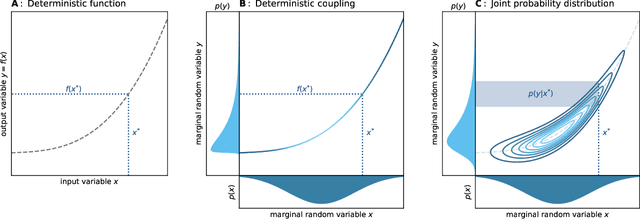
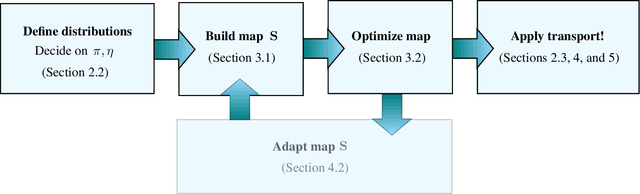
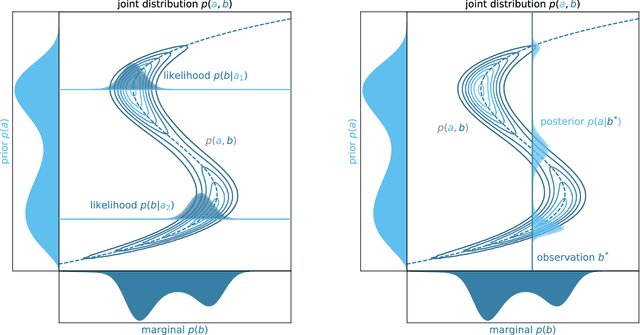
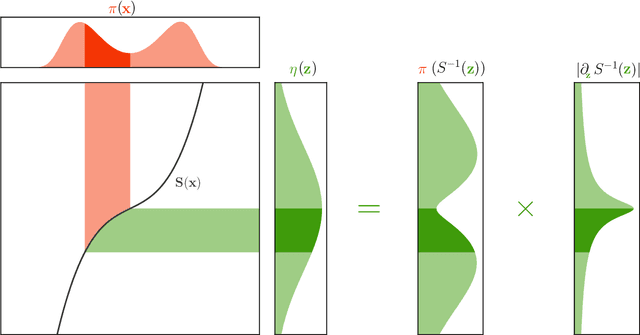
Decision making under uncertainty is a cross-cutting challenge in science and engineering. Most approaches to this challenge employ probabilistic representations of uncertainty. In complicated systems accessible only via data or black-box models, however, these representations are rarely known. We discuss how to characterize and manipulate such representations using triangular transport maps, which approximate any complex probability distribution as a transformation of a simple, well-understood distribution. The particular structure of triangular transport guarantees many desirable mathematical and computational properties that translate well into solving practical problems. Triangular maps are actively used for density estimation, (conditional) generative modelling, Bayesian inference, data assimilation, optimal experimental design, and related tasks. While there is ample literature on the development and theory of triangular transport methods, this manuscript provides a detailed introduction for scientists interested in employing measure transport without assuming a formal mathematical background. We build intuition for the key foundations of triangular transport, discuss many aspects of its practical implementation, and outline the frontiers of this field.
Ensemble transport smoothing -- Part 2: nonlinear updates
Oct 31, 2022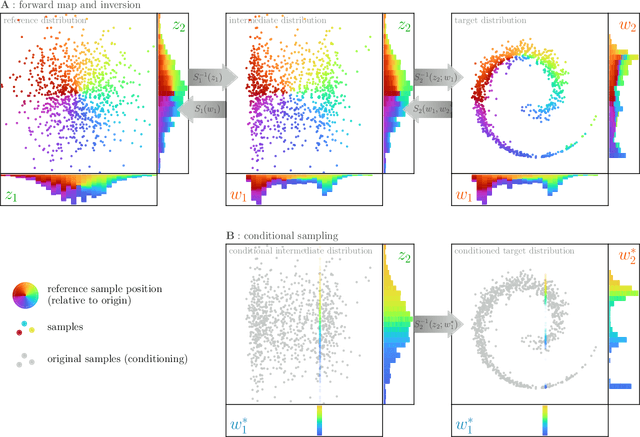
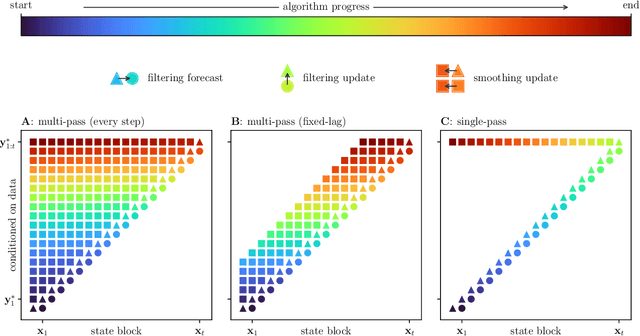
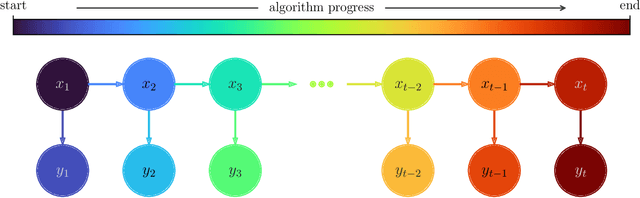
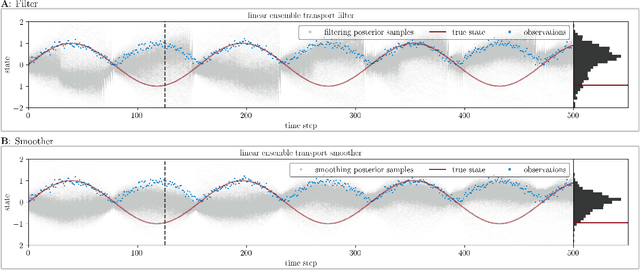
Smoothing is a specialized form of Bayesian inference for state-space models that characterizes the posterior distribution of a collection of states given an associated sequence of observations. Our companion manuscript proposes a general framework for transport-based ensemble smoothing, which includes linear Kalman-type smoothers as special cases. Here, we build on this foundation to realize and demonstrate nonlinear backward ensemble transport smoothers. We discuss parameterization and regularization of the associated transport maps, and then examine the performance of these smoothers for nonlinear and chaotic dynamical systems that exhibit non-Gaussian behavior. In these settings, our nonlinear transport smoothers yield lower estimation error than conventional linear smoothers and state-of-the-art iterative ensemble Kalman smoothers, for comparable numbers of model evaluations.
Ensemble transport smoothing -- Part 1: unified framework
Oct 31, 2022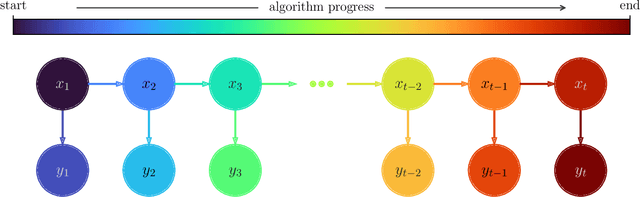
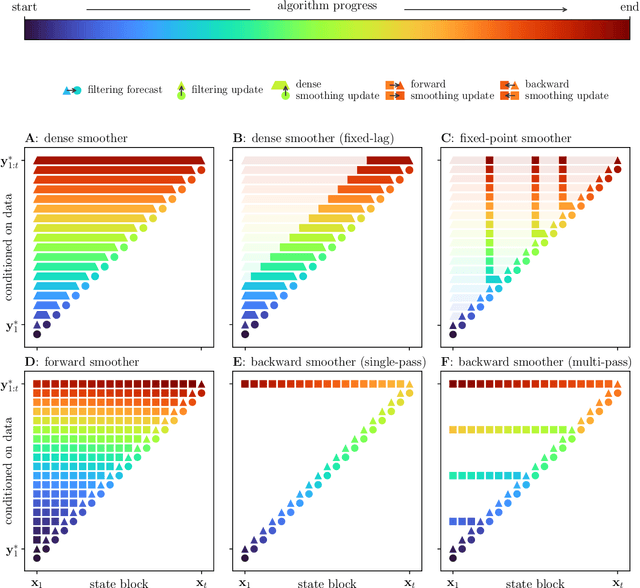
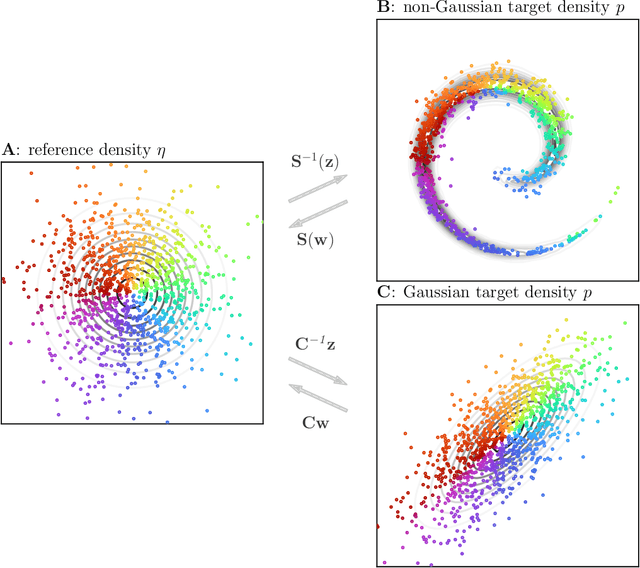
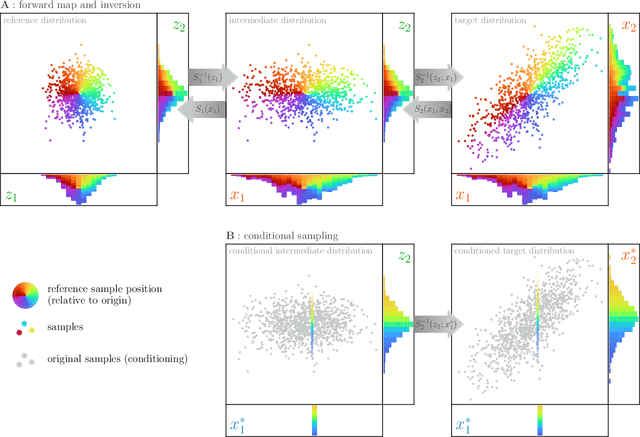
Smoothers are algorithms for Bayesian time series re-analysis. Most operational smoothers rely either on affine Kalman-type transformations or on sequential importance sampling. These strategies occupy opposite ends of a spectrum that trades computational efficiency and scalability for statistical generality and consistency: non-Gaussianity renders affine Kalman updates inconsistent with the true Bayesian solution, while the ensemble size required for successful importance sampling can be prohibitive. This paper revisits the smoothing problem from the perspective of measure transport, which offers the prospect of consistent prior-to-posterior transformations for Bayesian inference. We leverage this capacity by proposing a general ensemble framework for transport-based smoothing. Within this framework, we derive a comprehensive set of smoothing recursions based on nonlinear transport maps and detail how they exploit the structure of state-space models in fully non-Gaussian settings. We also describe how many standard Kalman-type smoothing algorithms emerge as special cases of our framework. A companion paper explores the implementation of nonlinear ensemble transport smoothers in greater depth.