 Add to Chrome
 Add to Firefox
 Add to Edge
Adaptive Nonlinear Data Assimilation through P-Spline Triangular Measure Transport
Mar 19, 2026
Non-Gaussian statistics are a challenge for data assimilation. Linear methods oversimplify the problem, yet fully nonlinear methods are often too expensive to use in practice. The best solution usually lies between these extremes. Triangular measure transport offers a flexible framework for nonlinear data assimilation. Its success, however, depends on how the map is parametrized. Too much flexibility leads to overfitting; too little misses important structure. To address this balance, we develop an adaptation algorithm that selects a parsimonious parametrization automatically. Our method uses P-spline basis functions and an information criterion as a continuous measure of model complexity. This formulation enables gradient descent and allows efficient, fine-scale adaptation in high-dimensional settings. The resulting algorithm requires no hyperparameter tuning. It adjusts the transport map to the appropriate level of complexity based on the system statistics and ensemble size. We demonstrate its performance in nonlinear, non-Gaussian problems, including a high-dimensional distributed groundwater model.

Stable Update of Regression Trees
Feb 21, 2024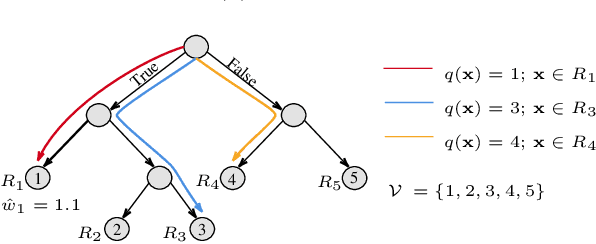
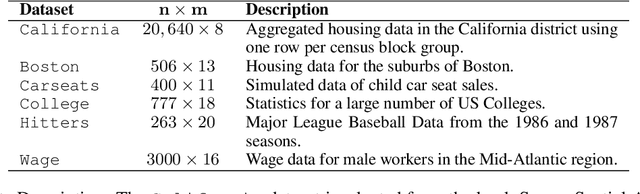
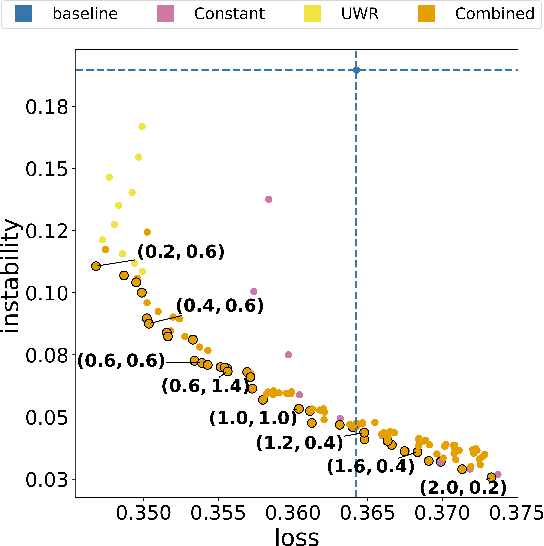
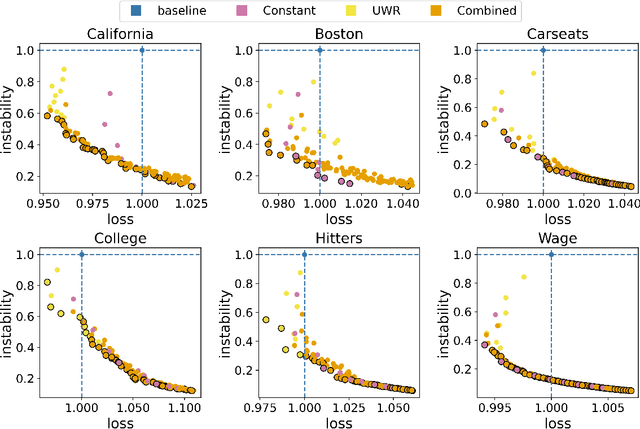
Updating machine learning models with new information usually improves their predictive performance, yet, in many applications, it is also desirable to avoid changing the model predictions too much. This property is called stability. In most cases when stability matters, so does explainability. We therefore focus on the stability of an inherently explainable machine learning method, namely regression trees. We aim to use the notion of empirical stability and design algorithms for updating regression trees that provide a way to balance between predictability and empirical stability. To achieve this, we propose a regularization method, where data points are weighted based on the uncertainty in the initial model. The balance between predictability and empirical stability can be adjusted through hyperparameters. This regularization method is evaluated in terms of loss and stability and assessed on a broad range of data characteristics. The results show that the proposed update method improves stability while achieving similar or better predictive performance. This shows that it is possible to achieve both predictive and stable results when updating regression trees.