 Add to Chrome
 Add to Firefox
 Add to Edge
To discretize continually: Mean shift interacting particle systems for Bayesian inference
May 13, 2026
Integration against a probability distribution given its unnormalized density is a central task in Bayesian inference and other fields. We introduce new methods for approximating such expectations with a small set of weighted samples -- i.e., a quadrature rule -- constructed via an interacting particle system that minimizes maximum mean discrepancy (MMD) to the target distribution. These methods extend the classical mean shift algorithm, as well as recent algorithms for optimal quantization of empirical distributions, to the case of continuous distributions. Crucially, our approach creates dynamics for MMD minimization that are invariant to the unknown normalizing constant; they also admit both gradient-free and gradient-informed implementations. The resulting mean shift interacting particle systems converge quickly, capture anisotropy and multi-modality, avoid mode collapse, and scale to high dimensions. We demonstrate their performance on a wide range of benchmark sampling problems, including multi-modal mixtures, Bayesian hierarchical models, PDE-constrained inverse problems, and beyond.

A friendly introduction to triangular transport
Mar 27, 2025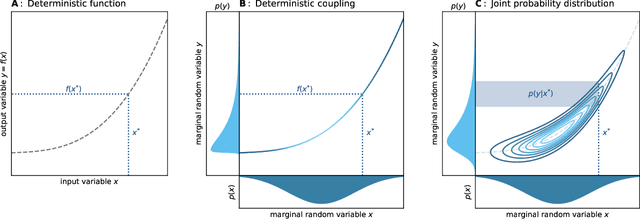
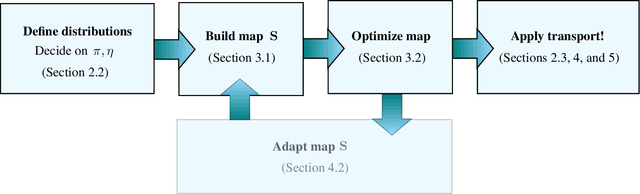
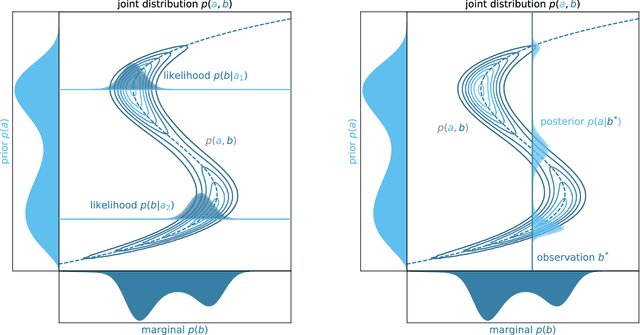
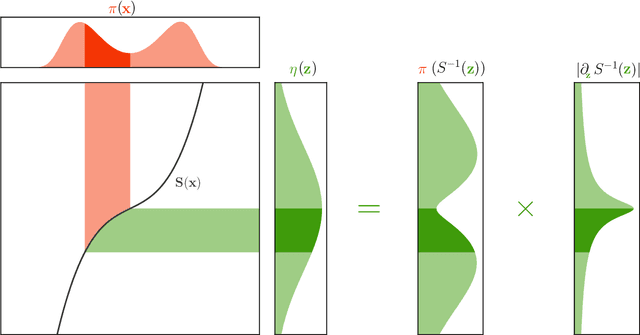
Decision making under uncertainty is a cross-cutting challenge in science and engineering. Most approaches to this challenge employ probabilistic representations of uncertainty. In complicated systems accessible only via data or black-box models, however, these representations are rarely known. We discuss how to characterize and manipulate such representations using triangular transport maps, which approximate any complex probability distribution as a transformation of a simple, well-understood distribution. The particular structure of triangular transport guarantees many desirable mathematical and computational properties that translate well into solving practical problems. Triangular maps are actively used for density estimation, (conditional) generative modelling, Bayesian inference, data assimilation, optimal experimental design, and related tasks. While there is ample literature on the development and theory of triangular transport methods, this manuscript provides a detailed introduction for scientists interested in employing measure transport without assuming a formal mathematical background. We build intuition for the key foundations of triangular transport, discuss many aspects of its practical implementation, and outline the frontiers of this field.