 Add to Chrome
 Add to Firefox
 Add to Edge
Reparameterization through Coverings and Topological Weight Priors
Apr 26, 2026
We generalise the reparameterization trick applied in variational autoencoders (VAEs) letting these have latent spaces of non-trivial topology - i.e. that of base manifolds covered with other ones, on which some technique for RT is available. That is possible since covering maps are measurable - moreover, in case of particular measure preservation property holding for the covering, one can establish an inequality on KL-divergence between pushforward (PF) densities on the base latent manifold, making the KL-term of VAE's ELBO analytically tractable, despite the topological non-triviality of the supporting latent manifold. Our development follows a route close but somewhat alternative to reparameterization on Lie groups, the latest proposal for which is to reparameterize PFs of normal densities from the Lie algebra - "through" the exponential map, seen by us as sometimes a particular case of what we propose to call reparameterization through a covering. Covering maps need not be global diffeomorphisms (although Lie-exp maps, in general, need not either, but, to date only smooth ones were considered in this context, to the best of our knowledge), which makes many non-trivial topologies tamable to our proposed technique, that we detail on a particular such example. We demonstrate the working of our approach by constructing a VAE with the latent space of Klein bottle (not a Lie group) topology, which we call KleinVAE, successfully learning an appropriate artificial dataset. We discuss potential applicability of such topology-informed generative models as weight priors in Bayesian learning, particularly for convolutional vision models, where said manifold was peculiarly shown to have some relevance.

ICML Topological Deep Learning Challenge 2024: Beyond the Graph Domain
Sep 08, 2024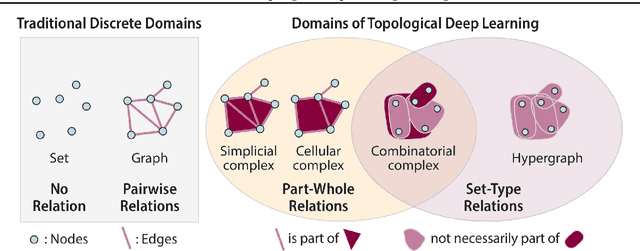
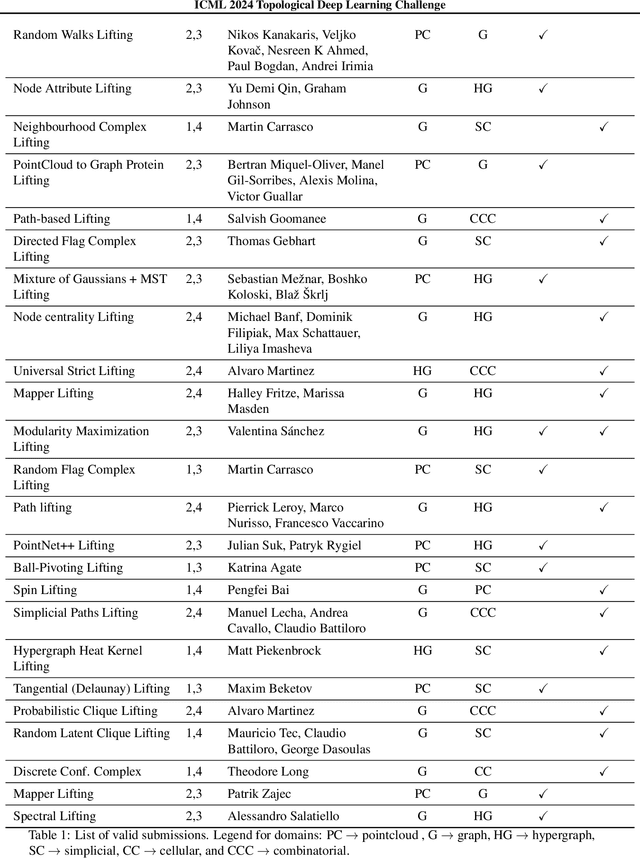
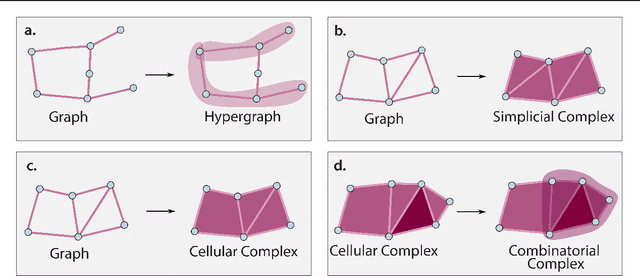
This paper describes the 2nd edition of the ICML Topological Deep Learning Challenge that was hosted within the ICML 2024 ELLIS Workshop on Geometry-grounded Representation Learning and Generative Modeling (GRaM). The challenge focused on the problem of representing data in different discrete topological domains in order to bridge the gap between Topological Deep Learning (TDL) and other types of structured datasets (e.g. point clouds, graphs). Specifically, participants were asked to design and implement topological liftings, i.e. mappings between different data structures and topological domains --like hypergraphs, or simplicial/cell/combinatorial complexes. The challenge received 52 submissions satisfying all the requirements. This paper introduces the main scope of the challenge, and summarizes the main results and findings.
Global cognitive graph properties dynamics of hippocampal formation
Aug 07, 2023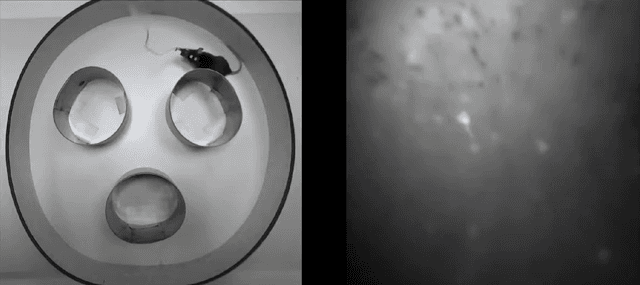
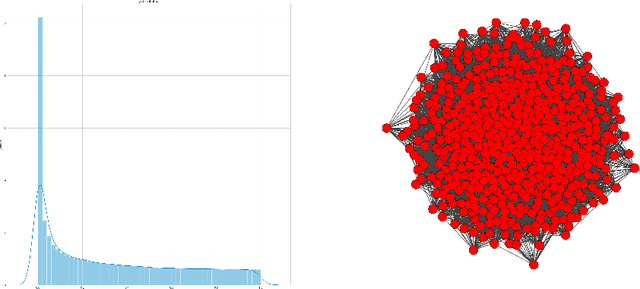
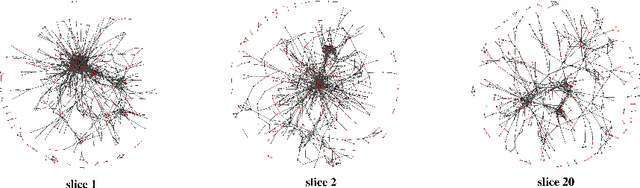
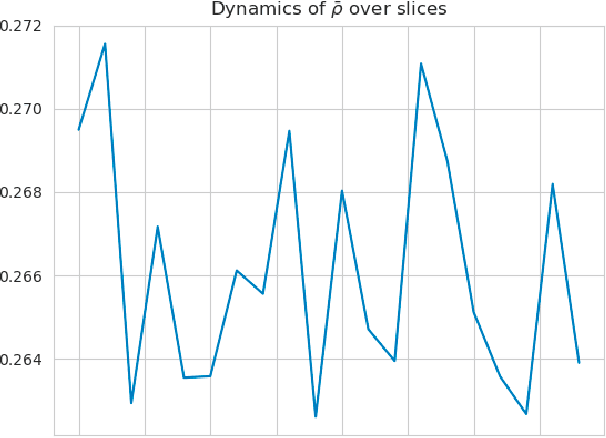
In the present study we have used a set of methods and metrics to build a graph of relative neural connections in a hippocampus of a rodent. A set of graphs was built on top of time-sequenced data and analyzed in terms of dynamics of a connection genesis. The analysis has shown that during the process of a rodent exploring a novel environment, the relations between neurons constantly change which indicates that globally memory is constantly updated even for known areas of space. Even if some neurons gain cognitive specialization, the global network though remains relatively stable. Additionally we suggest a set of methods for building a graph of cognitive neural network.
Topology of cognitive maps
Dec 05, 2022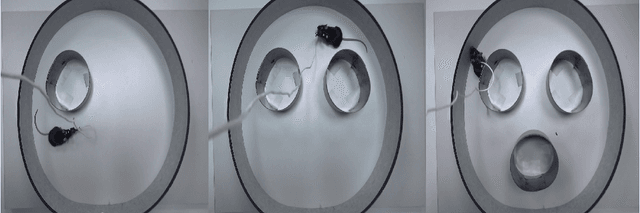
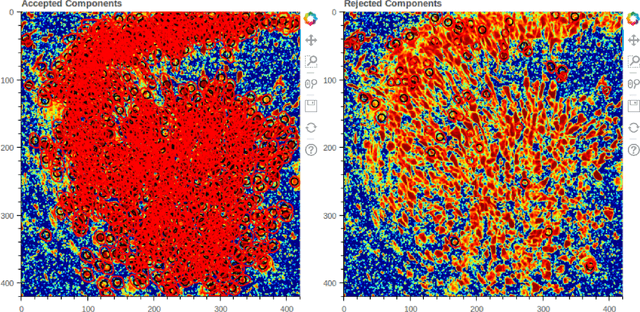
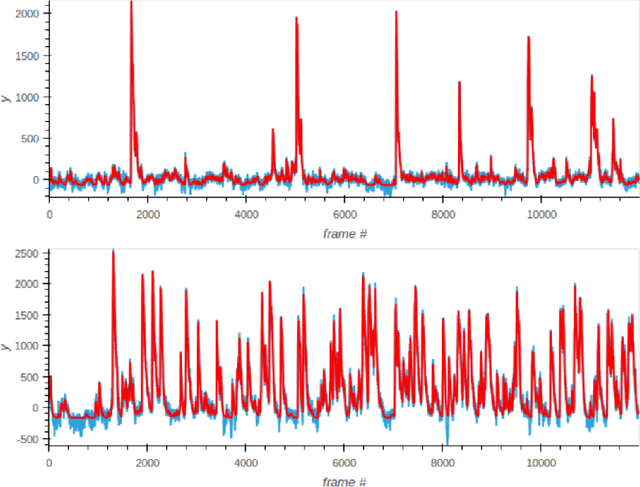
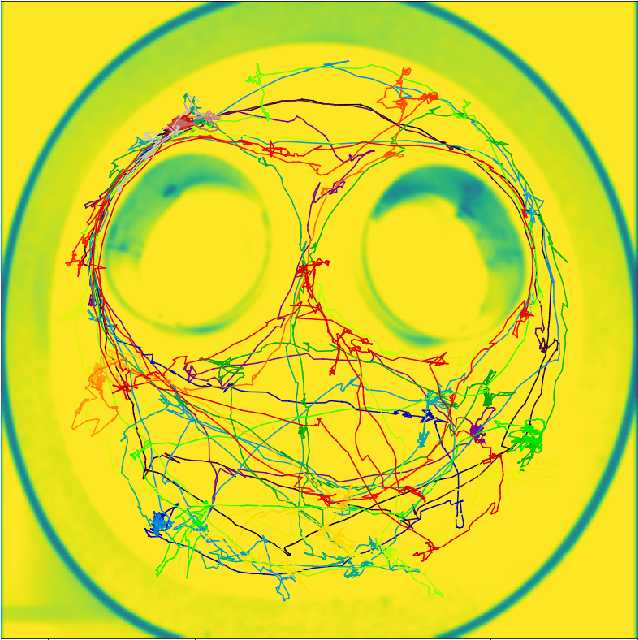
In present paper we discuss several approaches to reconstructing the topology of the physical space from neural activity data of CA1 fields in mice hippocampus, in particular, having Cognitome theory of brain function in mind. In our experiments, animals were placed in different new environments and discovered these moving freely while their physical and neural activity was recorded. We test possible approaches to identifying place cell groups out of the observed CA1 neurons. We also test and discuss various methods of dimension reduction and topology reconstruction. In particular, two main strategies we focus on are the Nerve theorem and point cloud-based methods. Conclusions on the results of reconstruction are supported with illustrations and mathematical background which is also briefly discussed.