 Add to Chrome
 Add to Firefox
 Add to Edge
A Decentralized Retrieval Augmented Generation System with Source Reliabilities Secured on Blockchain
Nov 10, 2025
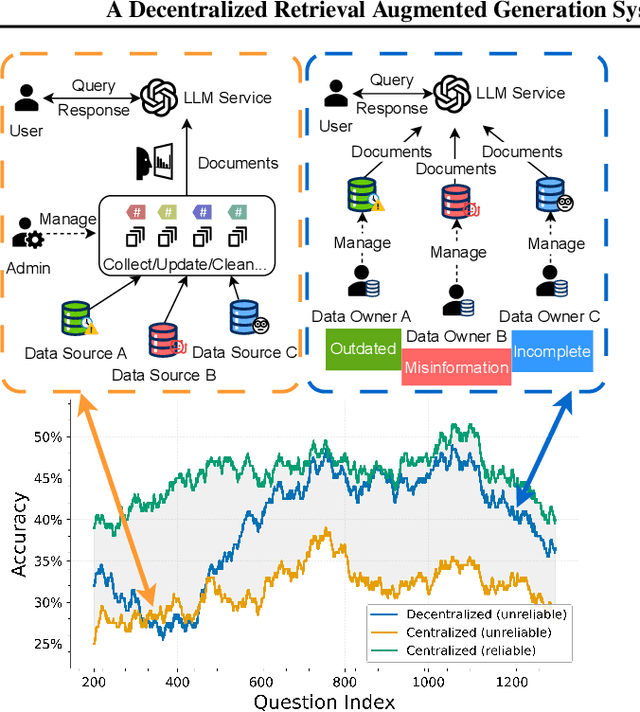
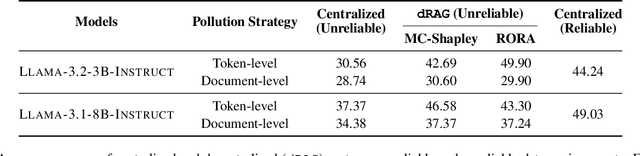
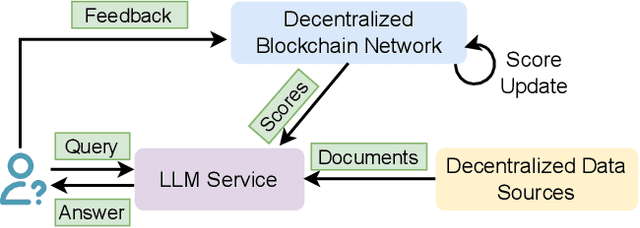
Existing retrieval-augmented generation (RAG) systems typically use a centralized architecture, causing a high cost of data collection, integration, and management, as well as privacy concerns. There is a great need for a decentralized RAG system that enables foundation models to utilize information directly from data owners who maintain full control over their sources. However, decentralization brings a challenge: the numerous independent data sources vary significantly in reliability, which can diminish retrieval accuracy and response quality. To address this, our decentralized RAG system has a novel reliability scoring mechanism that dynamically evaluates each source based on the quality of responses it contributes to generate and prioritizes high-quality sources during retrieval. To ensure transparency and trust, the scoring process is securely managed through blockchain-based smart contracts, creating verifiable and tamper-proof reliability records without relying on a central authority. We evaluate our decentralized system with two Llama models (3B and 8B) in two simulated environments where six data sources have different levels of reliability. Our system achieves a +10.7\% performance improvement over its centralized counterpart in the real world-like unreliable data environments. Notably, it approaches the upper-bound performance of centralized systems under ideally reliable data environments. The decentralized infrastructure enables secure and trustworthy scoring management, achieving approximately 56\% marginal cost savings through batched update operations. Our code and system are open-sourced at github.com/yining610/Reliable-dRAG.

GPT-4o System Card
Oct 25, 2024GPT-4o is an autoregressive omni model that accepts as input any combination of text, audio, image, and video, and generates any combination of text, audio, and image outputs. It's trained end-to-end across text, vision, and audio, meaning all inputs and outputs are processed by the same neural network. GPT-4o can respond to audio inputs in as little as 232 milliseconds, with an average of 320 milliseconds, which is similar to human response time in conversation. It matches GPT-4 Turbo performance on text in English and code, with significant improvement on text in non-English languages, while also being much faster and 50\% cheaper in the API. GPT-4o is especially better at vision and audio understanding compared to existing models. In line with our commitment to building AI safely and consistent with our voluntary commitments to the White House, we are sharing the GPT-4o System Card, which includes our Preparedness Framework evaluations. In this System Card, we provide a detailed look at GPT-4o's capabilities, limitations, and safety evaluations across multiple categories, focusing on speech-to-speech while also evaluating text and image capabilities, and measures we've implemented to ensure the model is safe and aligned. We also include third-party assessments on dangerous capabilities, as well as discussion of potential societal impacts of GPT-4o's text and vision capabilities.