 Add to Chrome
 Add to Firefox
 Add to Edge
Failure-Mechanism Transferability of Cumulative-Damage Features for Health State Estimation of SiC Power Modules
Aug 11, 2026
Data-driven health-state estimators for SiC (Silica-Carbide) power modules typically report their performance on a single accelerated-aging campaign, and how that performance transfers to a different failure mechanism is rarely tested. We benchmark five reference methods from the prognostics and condition-monitoring literature against a physics-informed NODE (Neural Ordinary Differential Equation) on two SiC power-cycling campaigns driven by structurally different failure mechanisms, solder-layer fatigue and wire-bond lift-off, under a per-module $k$-fold protocol. The NODE is evaluated under two input regimes that share the rest of the pipeline: the baseline electrical precursors and a set of cumulative thermoelectric features. Every reference method degrades on the wire-bond campaign, with average errors growing and precision decreasing with respect to their performance on the soldered campaign. The NODE fed with the cumulative features keeps its soldered-campaign metrics on both mechanisms, with differences inside the fold-to-fold variance, while the same architecture fed with the baseline precursors falls back to the reference-method cluster. The input representation contributes at least as much as the architecture to failure-mechanism transferability of a health-state estimator.

Physics-Informed Condition Monitoring of SiC Power Modules
Aug 11, 2026Silicon carbide (SiC) power modules are increasingly deployed in automotive traction inverters, where condition monitoring is essential to prevent in-service failures. Despite extensive qualification under AQG 324, no consolidated approach exists for in-field health state estimation: physics-of-failure lifetime models lack real-time applicability, purely data-driven architectures require large labeled datasets and generalize poorly, and physics-informed frameworks remain too demanding for embedded deployment. We address SiC MOSFET modules assembled with sintered packaging, which suppresses solder degradation and produces aging behavior distinct from previously studied devices. Instead of the smooth quasi-exponential drift of solder-based modules, the forward voltage drop $V_{DS}$ exhibits multi-regime profiles, with wirebond liftoff events introducing abrupt, non-monotonic perturbations. We propose a condition monitoring framework combining three elements. First, physics-informed features replace raw sensor signals with cumulative damage indicators derived from junction temperature swing, mean junction temperature and a Miner rule accumulator, encoding degradation history in an interpretable form. Second, a monotonicity constraint enforced by gradient penalty regularization embeds the expected degradation direction as a physics-guided prior. Third, a heavy-tailed output distribution replaces the point estimate, giving calibrated uncertainty robust to the out-of-distribution variance introduced by liftoff. On an industrial power cycling dataset from Infineon Technologies, several neural architectures are compared under a strict cross-validation protocol. The full configuration reduces mean absolute error by approximately 70% over purely data-driven baselines and stays stable across all folds, while remaining lightweight enough for embedded deployment.
Data-driven Power Loss Identification through Physics-Based Thermal Model Backpropagation
Mar 31, 2025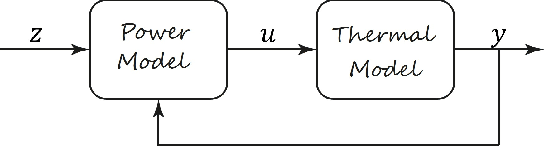
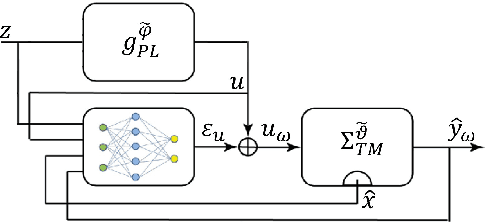

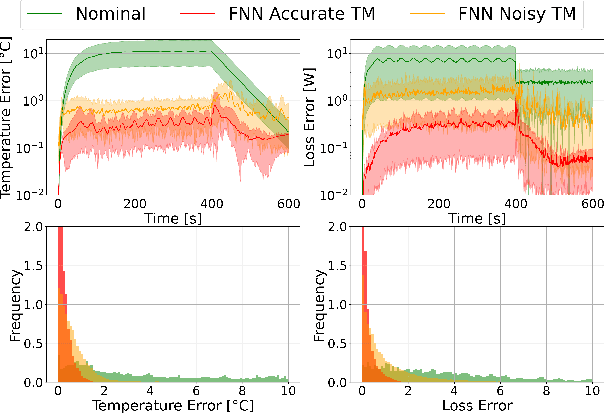
Digital twins for power electronics require accurate power losses whose direct measurements are often impractical or impossible in real-world applications. This paper presents a novel hybrid framework that combines physics-based thermal modeling with data-driven techniques to identify and correct power losses accurately using only temperature measurements. Our approach leverages a cascaded architecture where a neural network learns to correct the outputs of a nominal power loss model by backpropagating through a reduced-order thermal model. We explore two neural architectures, a bootstrapped feedforward network, and a recurrent neural network, demonstrating that the bootstrapped feedforward approach achieves superior performance while maintaining computational efficiency for real-time applications. Between the interconnection, we included normalization strategies and physics-guided training loss functions to preserve stability and ensure physical consistency. Experimental results show that our hybrid model reduces both temperature estimation errors (from 7.2+-6.8{\deg}C to 0.3+-0.3{\deg}C) and power loss prediction errors (from 5.4+-6.6W to 0.2+-0.3W) compared to traditional physics-based approaches, even in the presence of thermal model uncertainties. This methodology allows us to accurately estimate power losses without direct measurements, making it particularly helpful for real-time industrial applications where sensor placement is hindered by cost and physical limitations.