 Add to Chrome
 Add to Firefox
 Add to Edge
HMPCC: Human-Aware Model Predictive Coverage Control
Dec 14, 2025
We address the problem of coordinating a team of robots to cover an unknown environment while ensuring safe operation and avoiding collisions with non-cooperative agents. Traditional coverage strategies often rely on simplified assumptions, such as known or convex environments and static density functions, and struggle to adapt to real-world scenarios, especially when humans are involved. In this work, we propose a human-aware coverage framework based on Model Predictive Control (MPC), namely HMPCC, where human motion predictions are integrated into the planning process. By anticipating human trajectories within the MPC horizon, robots can proactively coordinate their actions %avoid redundant exploration, and adapt to dynamic conditions. The environment is modeled as a Gaussian Mixture Model (GMM), representing regions of interest. Team members operate in a fully decentralized manner, without relying on explicit communication, an essential feature in hostile or communication-limited scenarios. Our results show that human trajectory forecasting enables more efficient and adaptive coverage, improving coordination between human and robotic agents.

Robust Trajectory Generation and Control for Quadrotor Motion Planning with Field-of-View Control Barrier Certification
Feb 03, 2025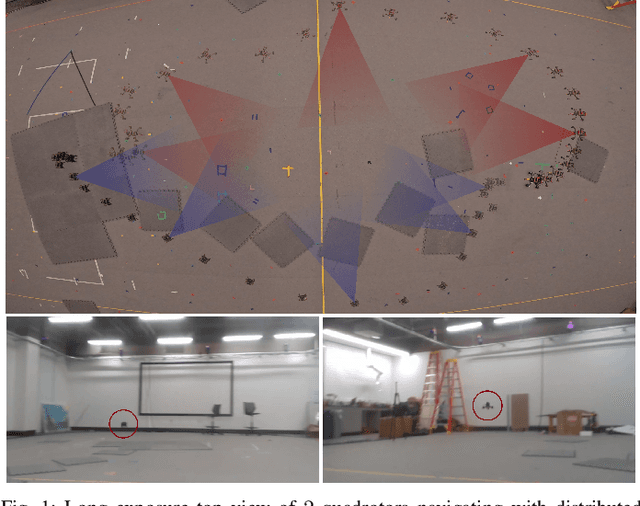
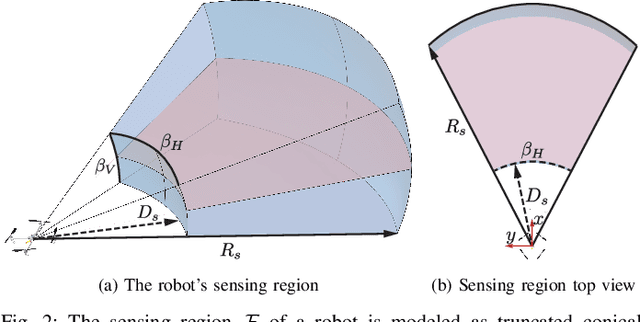
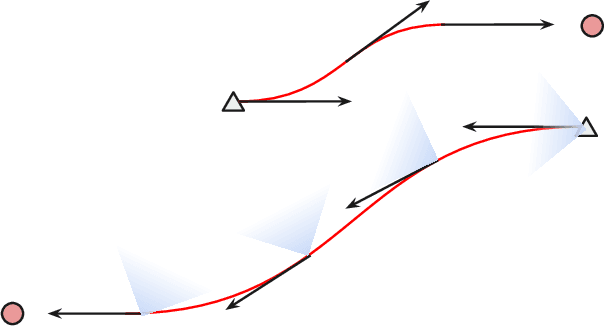
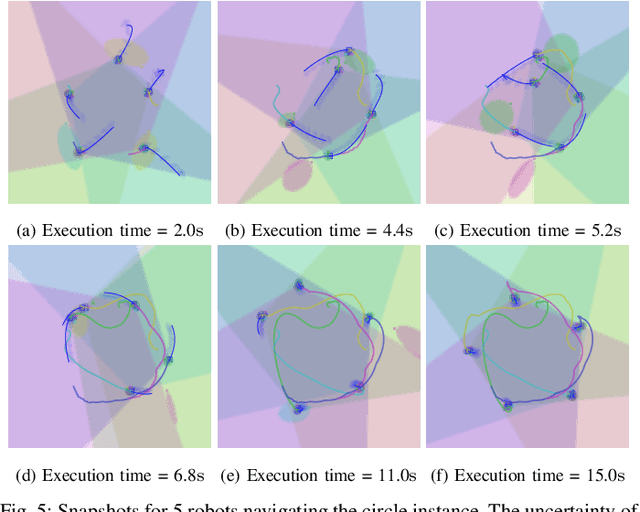
Many approaches to multi-robot coordination are susceptible to failure due to communication loss and uncertainty in estimation. We present a real-time communication-free distributed algorithm for navigating robots to their desired goals certified by control barrier functions, that model and control the onboard sensing behavior to keep neighbors in the limited field of view for position estimation. The approach is robust to temporary tracking loss and directly synthesizes control in real time to stabilize visual contact through control Lyapunov-barrier functions. The main contributions of this paper are a continuous-time robust trajectory generation and control method certified by control barrier functions for distributed multi-robot systems and a discrete optimization procedure, namely, MPC-CBF, to approximate the certified controller. In addition, we propose a linear surrogate of high-order control barrier function constraints and use sequential quadratic programming to solve MPC-CBF efficiently. We demonstrate results in simulation with 10 robots and physical experiments with 2 custom-built UAVs. To the best of our knowledge, this work is the first of its kind to generate a robust continuous-time trajectory and controller concurrently, certified by control barrier functions utilizing piecewise splines.