 Add to Chrome
 Add to Firefox
 Add to Edge
Contrastive Learning and Correlation Clustering for Sequences of Network Telescope Data
Jun 03, 2026
Understanding activities of Internet scanners is challenging; it often requires identifying relationships between sources, a task for which semantic annotations are scarce. This work investigates whether semantically meaningful pairwise relationships between sequences of network flow records can be estimated by contrastive learning, without pretraining and without annotations. To this end, we propose a transformer model that embeds minimally preprocessed sequences of network flow records and train it using contrastive learning. With the similarities obtained from this model, we state a correlation clustering problem and solve it locally. Experimentally, we show: Learned similarities are higher on average for sequences originating from the same source than for sequences originating from different sources, and this property generalizes to unseen sequences of unseen sources. Moreover, correlation clustering yields clusters consistent with scanner labels. The complete source code of the algorithms and for reproducing the experiments is publicly available.

Delay-Tolerant ICN and Its Application to LoRa
Sep 02, 2022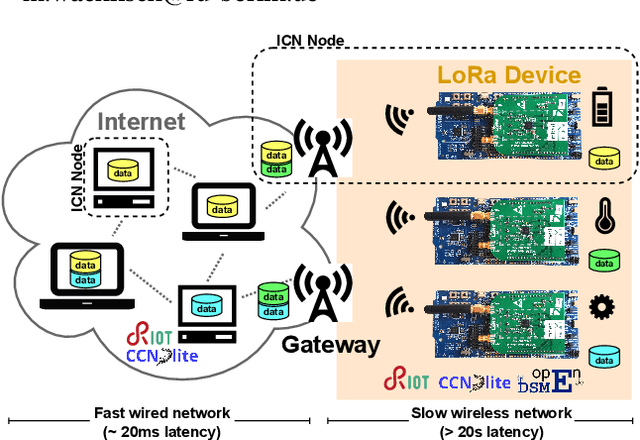
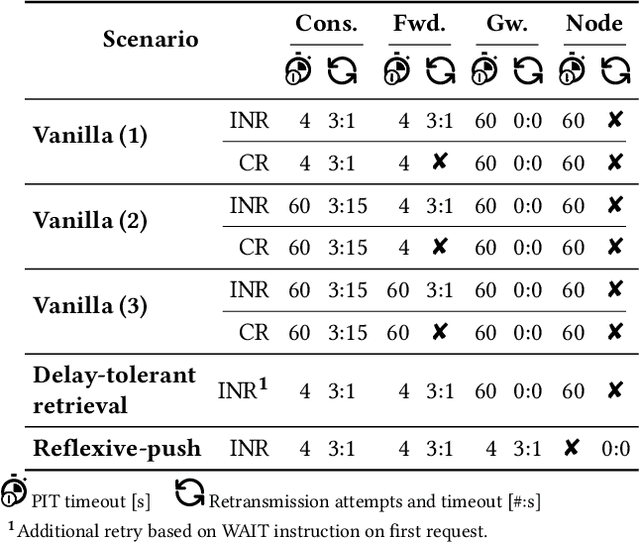
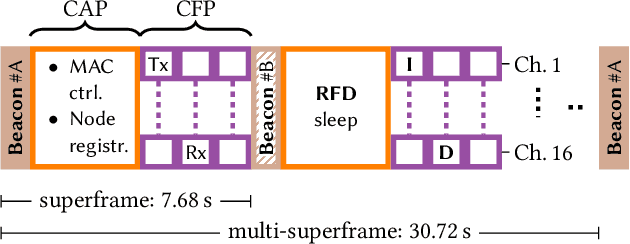
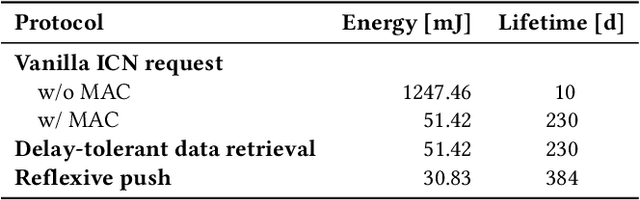
Connecting long-range wireless networks to the Internet imposes challenges due to vastly longer round-trip-times (RTTs). In this paper, we present an ICN protocol framework that enables robust and efficient delay-tolerant communication to edge networks. Our approach provides ICN-idiomatic communication between networks with vastly different RTTs. We applied this framework to LoRa, enabling end-to-end consumer-to-LoRa-producer interaction over an ICN-Internet and asynchronous data production in the LoRa edge. Instead of using LoRaWAN, we implemented an IEEE 802.15.4e DSME MAC layer on top of the LoRa PHY and ICN protocol mechanisms in RIOT OS. Executed on off-the-shelf IoT hardware, we provide a comparative evaluation for basic NDN-style ICN [60], RICE [31]-like pulling, and reflexive forwarding [46]. This is the first practical evaluation of ICN over LoRa using a reliable MAC. Our results show that periodic polling in NDN works inefficiently when facing long and differing RTTs. RICE reduces polling overhead and exploits gateway knowledge, without violating ICN principles. Reflexive forwarding reflects sporadic data generation naturally. Combined with a local data push, it operates efficiently and enables lifetimes of >1 year for battery powered LoRa-ICN nodes.