 Add to Chrome
 Add to Firefox
 Add to Edge
Partially deterministic sampling for compressed sensing with denoising guarantees
Apr 06, 2026
We study compressed sensing when the sampling vectors are chosen from the rows of a unitary matrix. In the literature, these sampling vectors are typically chosen randomly; the use of randomness has enabled major empirical and theoretical advances in the field. However, in practice there are often certain crucial sampling vectors, in which case practitioners will depart from the theory and sample such rows deterministically. In this work, we derive an optimized sampling scheme for Bernoulli selectors which naturally combines random and deterministic selection of rows, thus rigorously deciding which rows should be sampled deterministically. This sampling scheme provides measurable improvements in image compressed sensing for both generative and sparse priors when compared to with-replacement and without-replacement sampling schemes, as we show with theoretical results and numerical experiments. Additionally, our theoretical guarantees feature improved sample complexity bounds compared to previous works, and novel denoising guarantees in this setting.

Denoising guarantees for optimized sampling schemes in compressed sensing
Apr 01, 2025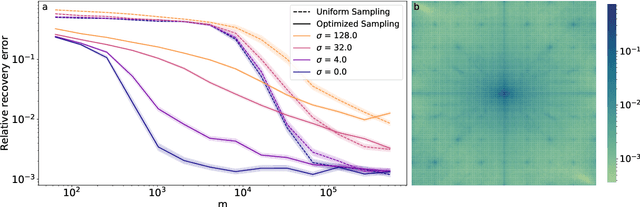
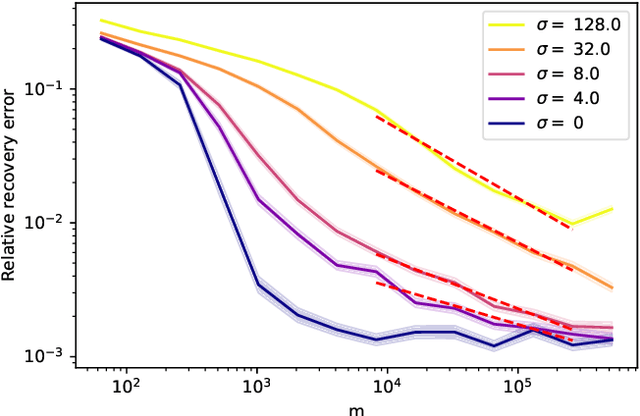
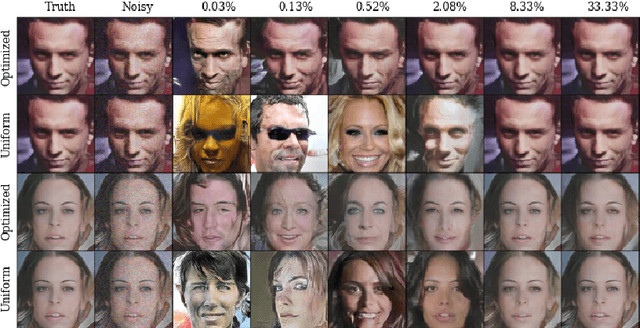
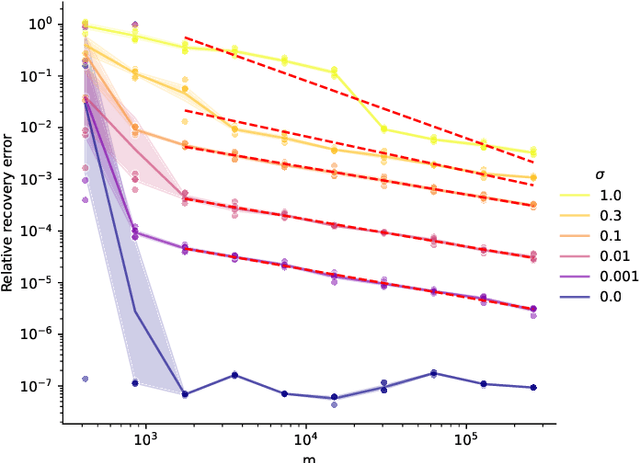
Compressed sensing with subsampled unitary matrices benefits from \emph{optimized} sampling schemes, which feature improved theoretical guarantees and empirical performance relative to uniform subsampling. We provide, in a first of its kind in compressed sensing, theoretical guarantees showing that the error caused by the measurement noise vanishes with an increasing number of measurements for optimized sampling schemes, assuming that the noise is Gaussian. We moreover provide similar guarantees for measurements sampled with-replacement with arbitrary probability weights. All our results hold on prior sets contained in a union of low-dimensional subspaces. Finally, we demonstrate that this denoising behavior appears in empirical experiments with a rate that closely matches our theoretical guarantees when the prior set is the range of a generative ReLU neural network and when it is the set of sparse vectors.