 Add to Chrome
 Add to Firefox
 Add to Edge
Lesion-Aware Adaptive Fourier Neural Operator for CT-to-PSMA PET Synthesis in Prostate Cancer
Aug 11, 2026
Deep learning models that synthesize PET from CT or MRI can reduce patient dose and scanner demand, but are typically optimized with global losses such as L1 or mean squared error (MSE) that treat all voxels similarly. In whole-body PSMA-PET, tumor voxels occupy only a small fraction of the volume, yet carry the clinically relevant activity signal; as a result, models can achieve high structural similarity index measure (SSIM) and peak signal-to-noise ratio (PSNR) while still underestimating lesion activity or failing to preserve tumor-specific structure. Radiomics provides biologically meaningful descriptors of tumor intensity and texture, but direct radiomics conditioning is time-consuming because it requires feature extraction from delineated lesion regions. We propose LAFNO, a Lesion-Aware Adaptive Fourier Neural Operator for CT-to-PSMA-PET synthesis that replaces high-dimensional radiomics conditioning with two efficient CT-derived proxy channels. Motivated by radiomics analysis of PSMA-avid tumor core and peritumoral regions, LAFNO uses a contrast proxy for local density variation and a disorder proxy for local texture heterogeneity, both injected into the model bottleneck. LAFNO combines whole-volume reconstruction with lesion-level total lesion activity (TLA), tumor-core contrast, and peritumoral supervision. We evaluated LAFNO against four baseline architectures on the TCIA PSMA-PET-CT-Lesions dataset. LAFNO remained competitive on whole-volume image quality, achieving SSIM of 0.960 and 0.938 for 18F- and 68Ga-PSMA, respectively, while reducing per-patient TLA error to 48.3% and 64.0% for 18F- and 68Ga-PSMA, respectively, and achieving the highest tumor-core radiomics reproducibility across all feature classes for both tracers. Peritumoral reproducibility remained tracer-dependent, indicating that biological fidelity in synthetic PSMA-PET remains challenging.

Automated radiotherapy treatment planning guided by GPT-4Vision
Jun 21, 2024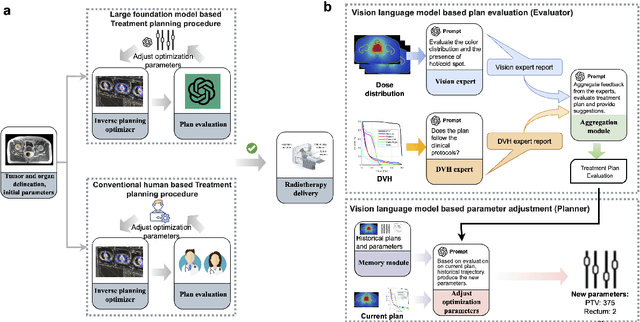
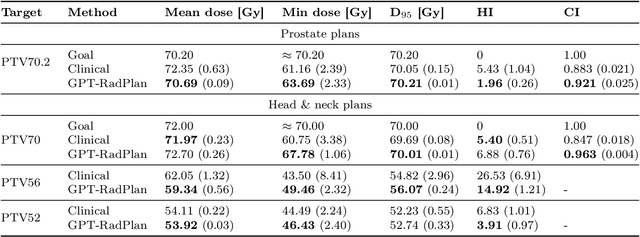
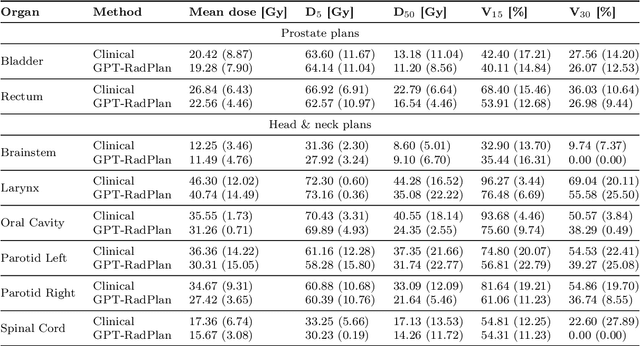
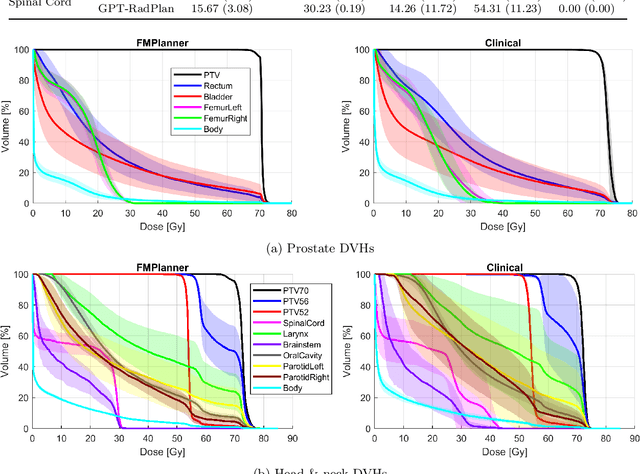
Radiotherapy treatment planning is a time-consuming and potentially subjective process that requires the iterative adjustment of model parameters to balance multiple conflicting objectives. Recent advancements in large foundation models offer promising avenues for addressing the challenges in planning and clinical decision-making. This study introduces GPT-RadPlan, a fully automated treatment planning framework that harnesses prior radiation oncology knowledge encoded in multi-modal large language models, such as GPT-4Vision (GPT-4V) from OpenAI. GPT-RadPlan is made aware of planning protocols as context and acts as an expert human planner, capable of guiding a treatment planning process. Via in-context learning, we incorporate clinical protocols for various disease sites as prompts to enable GPT-4V to acquire treatment planning domain knowledge. The resulting GPT-RadPlan agent is integrated into our in-house inverse treatment planning system through an API. The efficacy of the automated planning system is showcased using multiple prostate and head & neck cancer cases, where we compared GPT-RadPlan results to clinical plans. In all cases, GPT-RadPlan either outperformed or matched the clinical plans, demonstrating superior target coverage and organ-at-risk sparing. Consistently satisfying the dosimetric objectives in the clinical protocol, GPT-RadPlan represents the first multimodal large language model agent that mimics the behaviors of human planners in radiation oncology clinics, achieving remarkable results in automating the treatment planning process without the need for additional training.