 Add to Chrome
 Add to Firefox
 Add to Edge
AsyTO: Asymmetric Temporal Operator for Parameter-Efficient Multivariate Time Series Forecasting
Aug 17, 2026
Multivariate time-series forecasting faces a structural dilemma: sharing one temporal predictor across variables is parameter-efficient but forces heterogeneous variables through an identical history-to-future map, whereas learning an independent predictor per variable restores flexibility at a cost that grows with the product of variable count, context length, and horizon. We argue that this dilemma dissolves once the object being compressed is the forecasting operator rather than the observed series. Auditing per-variable linear history-to-future maps across standard benchmarks, we find that a phase-locked seasonal component paired with a compact residual operator outperforms a dense phase-blind reference in most audited settings. The residual transport is also directional: lag-invariant alternatives consistently underperform asymmetric history-to-future maps. Guided by this structure, we propose AsyTO, an Asymmetric Temporal Operator that factorizes the tensor of per-variable operators into shared but distinct history-reading and future-writing temporal modes with per-variable mode-wise gains, complemented by a low-rank periodic prototype and a cycle-separable factorization of the temporal modes. Each forecast reads only its own variable's history, so parameters and compute grow linearly in the number of variables. Across eleven benchmarks and multiple forecast horizons, AsyTO attains the best lightweight error in 30 of 44 dataset-horizon settings, locating at the accuracy-compute Pareto frontier.

TopoBrick: Agentic Topology Sampling of Exogenous Variables for Zero-Shot Building IoT Forecasting
Jul 07, 2026Building sensors are embedded in physical topology, spatial hierarchy, and operational context, yet existing forecasters often treat them as isolated time series or rely on fixed covariate sets. We present TopoBrick, a training-free framework for zero-shot building IoT (Internet-of-Things) forecasting. TopoBrick uses building knowledge graphs to construct a compact structural skeleton and employs an agentic topology sampler to select target-specific exogenous variables. The selected variables are organized by deployment-time availability, separating past-known sensor states from future-known calendar, schedule, and meteorological exogenous variables. Across three real-world buildings, TopoBrick outperforms strong zero-shot foundation-model baselines and remains competitive with fully trained building-specific models. Ablations show that topology-aware sampling is more reliable than random, ontology-only, or fixed-hop selection, especially for physically coupled HVAC and weather-driven sensing variables.
ThermoLLM: Thermodynamics-Aware HVAC Control with Spatial-Semantic Knowledge Graph
Jun 22, 2026Multi-zone HVAC control is a spatial decision problem in which indoor thermal evolution and control decisions depend not only on outdoor conditions and internal heat gains but also on zone layout, physical adjacency, and delayed thermal interactions across the building. Recent LLM-based HVAC controllers have shown that prompt-based control is feasible. However, these methods typically rely on task descriptions, observation values, short textual feedback, or unstructured retrieval, which limits their ability to reason about zone coupling, thermal response, and building dynamics. This paper presents a thermodynamics-aware LLM control framework for a five-zone EnergyPlus building simulation. The controller is grounded in a physics-informed spatial knowledge graph derived from Brick-style building semantics and linked with recent interaction history. At each control step, the model receives the current building state, graph-structured spatial context, and recent environment-controller history, enabling it to make decisions that reflect both building structure and short-term thermal evolution. We evaluate the framework against standard control baselines and several LLM-based alternatives. Results show that the proposed approach achieves the best overall energy-comfort trade-off and the lowest PMV violation while maintaining energy-efficient operation.
BTS: Building Timeseries Dataset: Empowering Large-Scale Building Analytics
Jun 18, 2024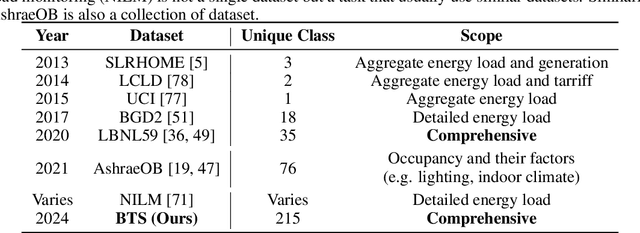
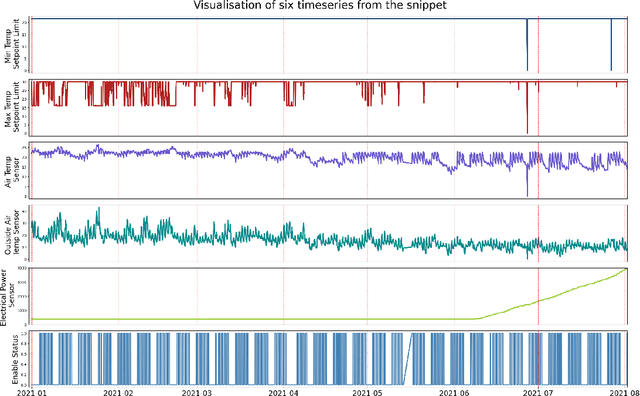
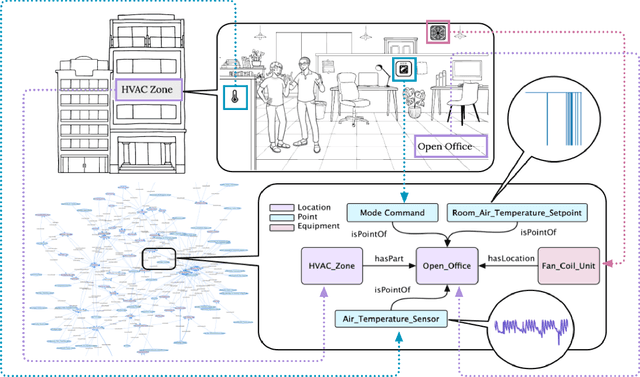
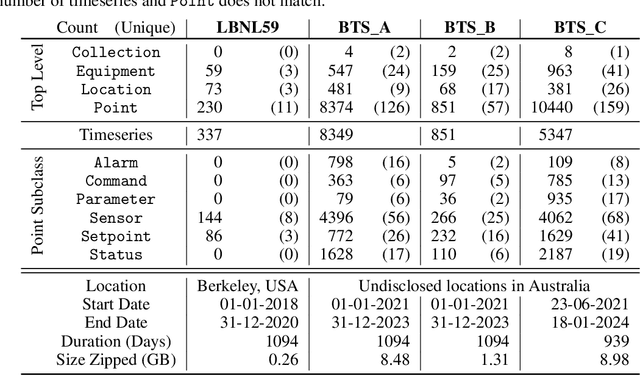
Buildings play a crucial role in human well-being, influencing occupant comfort, health, and safety. Additionally, they contribute significantly to global energy consumption, accounting for one-third of total energy usage, and carbon emissions. Optimizing building performance presents a vital opportunity to combat climate change and promote human flourishing. However, research in building analytics has been hampered by the lack of accessible, available, and comprehensive real-world datasets on multiple building operations. In this paper, we introduce the Building TimeSeries (BTS) dataset. Our dataset covers three buildings over a three-year period, comprising more than ten thousand timeseries data points with hundreds of unique ontologies. Moreover, the metadata is standardized using the Brick schema. To demonstrate the utility of this dataset, we performed benchmarks on two tasks: timeseries ontology classification and zero-shot forecasting. These tasks represent an essential initial step in addressing challenges related to interoperability in building analytics. Access to the dataset and the code used for benchmarking are available here: https://github.com/cruiseresearchgroup/DIEF_BTS .
A Gap in Time: The Challenge of Processing Heterogeneous IoT Point Data in Buildings
May 23, 2024The growing need for sustainable energy solutions has driven the integration of digitalized buildings into the power grid, utilizing Internet-of-Things technology to optimize building performance and energy efficiency. However, incorporating IoT point data within deep-learning frameworks for energy management presents a complex challenge, predominantly due to the inherent data heterogeneity. This paper comprehensively analyzes the multifaceted heterogeneity present in real-world building IoT data streams. We meticulously dissect the heterogeneity across multiple dimensions, encompassing ontology, etiology, temporal irregularity, spatial diversity, and their combined effects on the IoT point data distribution. In addition, experiments using state-of-the-art forecasting models are conducted to evaluate their impacts on the performance of deep-learning models for forecasting tasks. By charting the diversity along these dimensions, we illustrate the challenges and delineate pathways for future research to leverage this heterogeneity as a resource rather than a roadblock. This exploration sets the stage for advancing the predictive abilities of deep-learning algorithms and catalyzing the evolution of intelligent energy-efficient buildings.