 Add to Chrome
 Add to Firefox
 Add to Edge
ParalESN: Enabling parallel information processing in Reservoir Computing
Jan 29, 2026
Reservoir Computing (RC) has established itself as an efficient paradigm for temporal processing. However, its scalability remains severely constrained by (i) the necessity of processing temporal data sequentially and (ii) the prohibitive memory footprint of high-dimensional reservoirs. In this work, we revisit RC through the lens of structured operators and state space modeling to address these limitations, introducing Parallel Echo State Network (ParalESN). ParalESN enables the construction of high-dimensional and efficient reservoirs based on diagonal linear recurrence in the complex space, enabling parallel processing of temporal data. We provide a theoretical analysis demonstrating that ParalESN preserves the Echo State Property and the universality guarantees of traditional Echo State Networks while admitting an equivalent representation of arbitrary linear reservoirs in the complex diagonal form. Empirically, ParalESN matches the predictive accuracy of traditional RC on time series benchmarks, while delivering substantial computational savings. On 1-D pixel-level classification tasks, ParalESN achieves competitive accuracy with fully trainable neural networks while reducing computational costs and energy consumption by orders of magnitude. Overall, ParalESN offers a promising, scalable, and principled pathway for integrating RC within the deep learning landscape.

Deep Residual Echo State Networks: exploring residual orthogonal connections in untrained Recurrent Neural Networks
Aug 28, 2025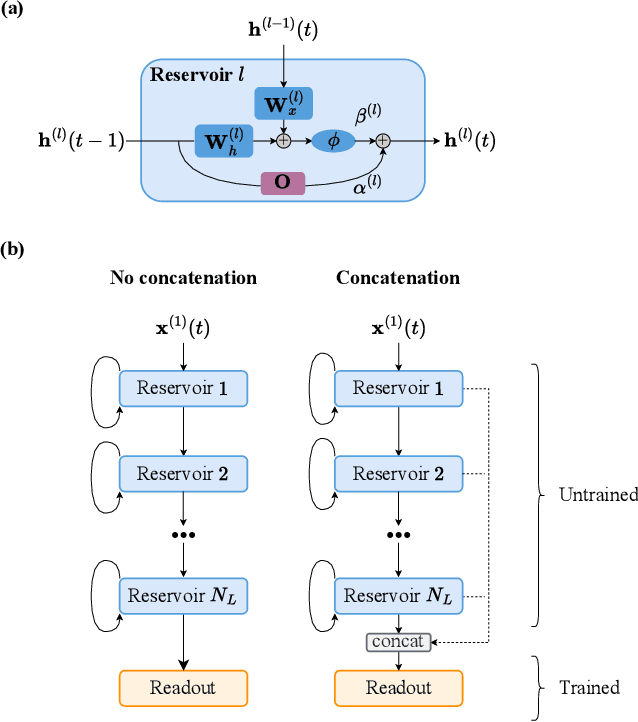
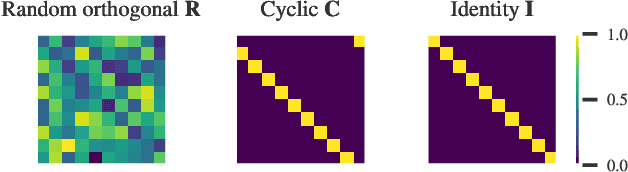
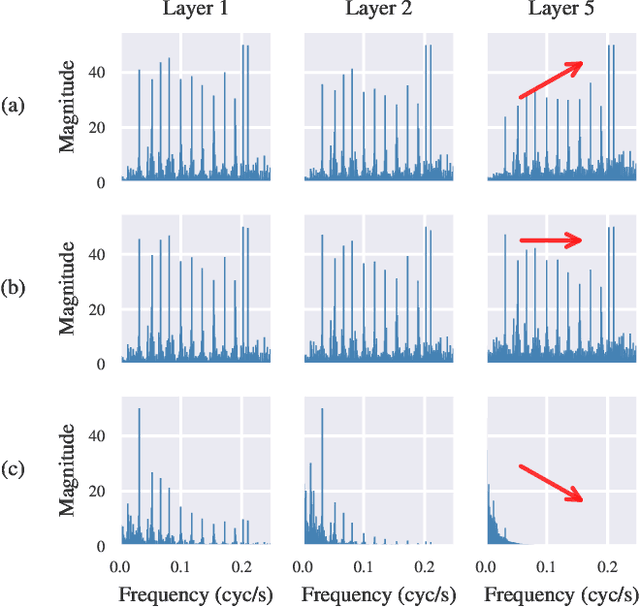
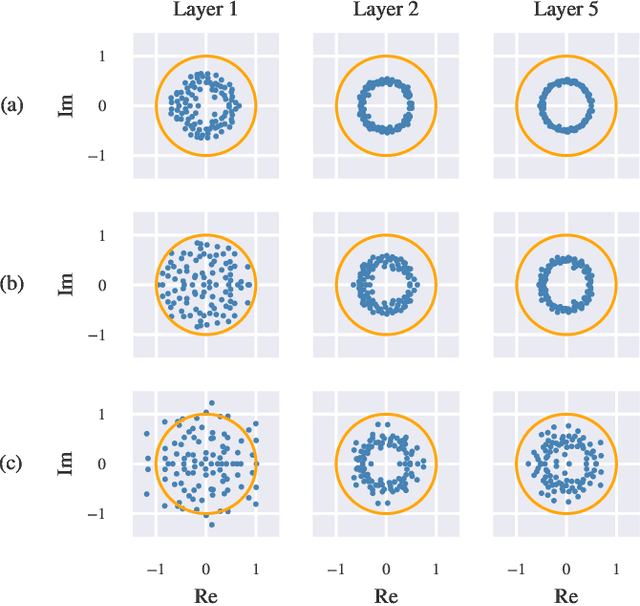
Echo State Networks (ESNs) are a particular type of untrained Recurrent Neural Networks (RNNs) within the Reservoir Computing (RC) framework, popular for their fast and efficient learning. However, traditional ESNs often struggle with long-term information processing. In this paper, we introduce a novel class of deep untrained RNNs based on temporal residual connections, called Deep Residual Echo State Networks (DeepResESNs). We show that leveraging a hierarchy of untrained residual recurrent layers significantly boosts memory capacity and long-term temporal modeling. For the temporal residual connections, we consider different orthogonal configurations, including randomly generated and fixed-structure configurations, and we study their effect on network dynamics. A thorough mathematical analysis outlines necessary and sufficient conditions to ensure stable dynamics within DeepResESN. Our experiments on a variety of time series tasks showcase the advantages of the proposed approach over traditional shallow and deep RC.
Residual Reservoir Memory Networks
Aug 13, 2025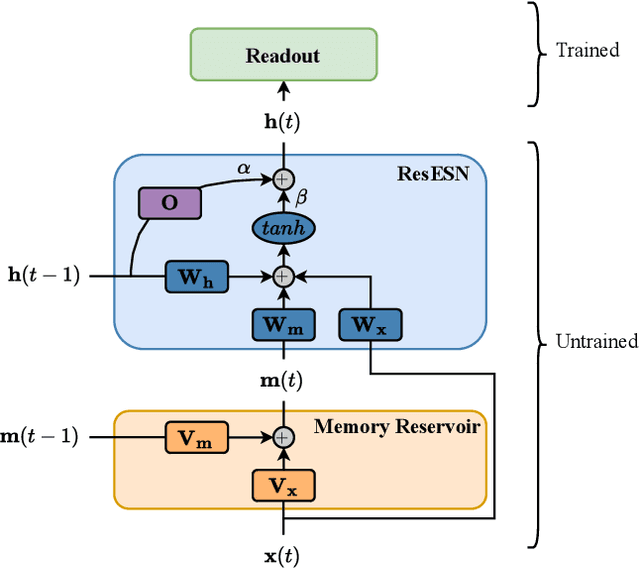
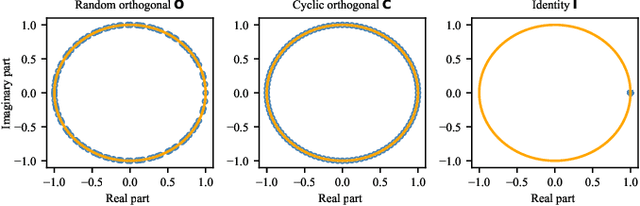
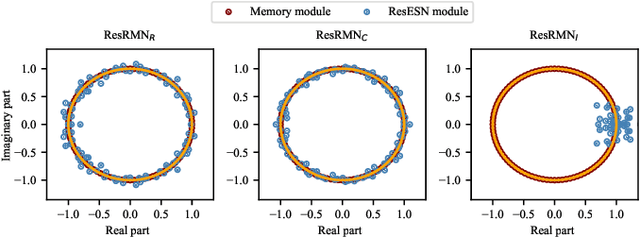
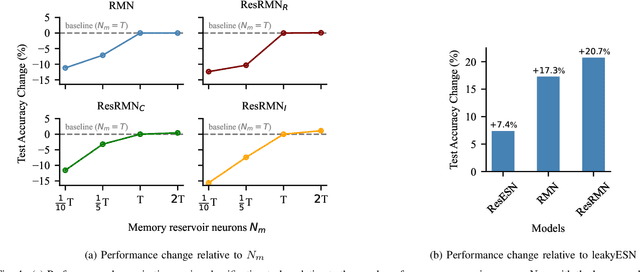
We introduce a novel class of untrained Recurrent Neural Networks (RNNs) within the Reservoir Computing (RC) paradigm, called Residual Reservoir Memory Networks (ResRMNs). ResRMN combines a linear memory reservoir with a non-linear reservoir, where the latter is based on residual orthogonal connections along the temporal dimension for enhanced long-term propagation of the input. The resulting reservoir state dynamics are studied through the lens of linear stability analysis, and we investigate diverse configurations for the temporal residual connections. The proposed approach is empirically assessed on time-series and pixel-level 1-D classification tasks. Our experimental results highlight the advantages of the proposed approach over other conventional RC models.