 Add to Chrome
 Add to Firefox
 Add to Edge
Grounding LTL Tasks in Sub-Symbolic RL Environments for Zero-Shot Generalization
Feb 10, 2026
In this work we address the problem of training a Reinforcement Learning agent to follow multiple temporally-extended instructions expressed in Linear Temporal Logic in sub-symbolic environments. Previous multi-task work has mostly relied on knowledge of the mapping between raw observations and symbols appearing in the formulae. We drop this unrealistic assumption by jointly training a multi-task policy and a symbol grounder with the same experience. The symbol grounder is trained only from raw observations and sparse rewards via Neural Reward Machines in a semi-supervised fashion. Experiments on vision-based environments show that our method achieves performance comparable to using the true symbol grounding and significantly outperforms state-of-the-art methods for sub-symbolic environments.

Enhancing Ground-to-Aerial Image Matching for Visual Misinformation Detection Using Semantic Segmentation
Feb 10, 2025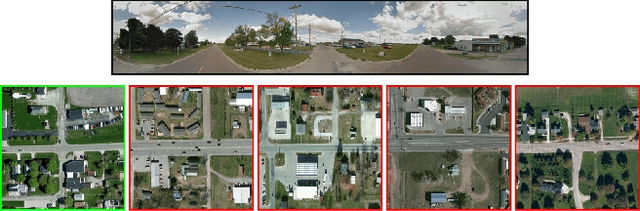

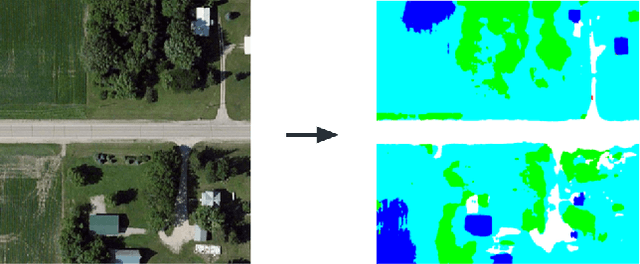

The recent advancements in generative AI techniques, which have significantly increased the online dissemination of altered images and videos, have raised serious concerns about the credibility of digital media available on the Internet and distributed through information channels and social networks. This issue particularly affects domains that rely heavily on trustworthy data, such as journalism, forensic analysis, and Earth observation. To address these concerns, the ability to geolocate a non-geo-tagged ground-view image without external information, such as GPS coordinates, has become increasingly critical. This study tackles the challenge of linking a ground-view image, potentially exhibiting varying fields of view (FoV), to its corresponding satellite image without the aid of GPS data. To achieve this, we propose a novel four-stream Siamese-like architecture, the Quadruple Semantic Align Net (SAN-QUAD), which extends previous state-of-the-art (SOTA) approaches by leveraging semantic segmentation applied to both ground and satellite imagery. Experimental results on a subset of the CVUSA dataset demonstrate significant improvements of up to 9.8\% over prior methods across various FoV settings.