 Add to Chrome
 Add to Firefox
 Add to Edge
StethoLM: Audio Language Model for Cardiopulmonary Analysis Across Clinical Tasks
Feb 27, 2026
Listening to heart and lung sounds - auscultation - is one of the first and most fundamental steps in a clinical examination. Despite being fast and non-invasive, it demands years of experience to interpret subtle audio cues. Recent deep learning methods have made progress in automating cardiopulmonary sound analysis, yet most are restricted to simple classification and offer little clinical interpretability or decision support. We present StethoLM, the first audio-language model specialized for cardiopulmonary auscultation, capable of performing instruction-driven clinical tasks across the full spectrum of auscultation analysis. StethoLM integrates audio encoding with a medical language model backbone and is trained on StethoBench, a comprehensive benchmark comprising 77,027 instruction-response pairs synthesized from 16,125 labeled cardiopulmonary recordings spanning seven clinical task categories: binary classification, detection, reporting, reasoning, differential diagnosis, comparison, and location-based analysis. Through multi-stage training that combines supervised fine-tuning and direct preference optimization, StethoLM achieves substantial gains in performance and robustness on out-of-distribution data. Our work establishes a foundation for instruction-following AI systems in clinical auscultation.

Helmsman: Autonomous Synthesis of Federated Learning Systems via Multi-Agent Collaboration
Oct 16, 2025Federated Learning (FL) offers a powerful paradigm for training models on decentralized data, but its promise is often undermined by the immense complexity of designing and deploying robust systems. The need to select, combine, and tune strategies for multifaceted challenges like data heterogeneity and system constraints has become a critical bottleneck, resulting in brittle, bespoke solutions. To address this, we introduce Helmsman, a novel multi-agent system that automates the end-to-end synthesis of federated learning systems from high-level user specifications. It emulates a principled research and development workflow through three collaborative phases: (1) interactive human-in-the-loop planning to formulate a sound research plan, (2) modular code generation by supervised agent teams, and (3) a closed-loop of autonomous evaluation and refinement in a sandboxed simulation environment. To facilitate rigorous evaluation, we also introduce AgentFL-Bench, a new benchmark comprising 16 diverse tasks designed to assess the system-level generation capabilities of agentic systems in FL. Extensive experiments demonstrate that our approach generates solutions competitive with, and often superior to, established hand-crafted baselines. Our work represents a significant step towards the automated engineering of complex decentralized AI systems.
Collaboratively Learning Federated Models from Noisy Decentralized Data
Sep 03, 2024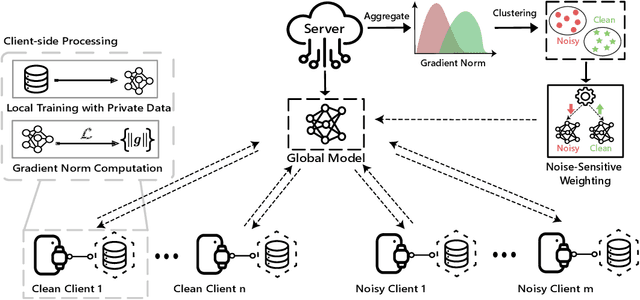
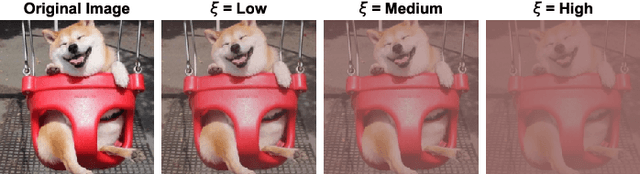
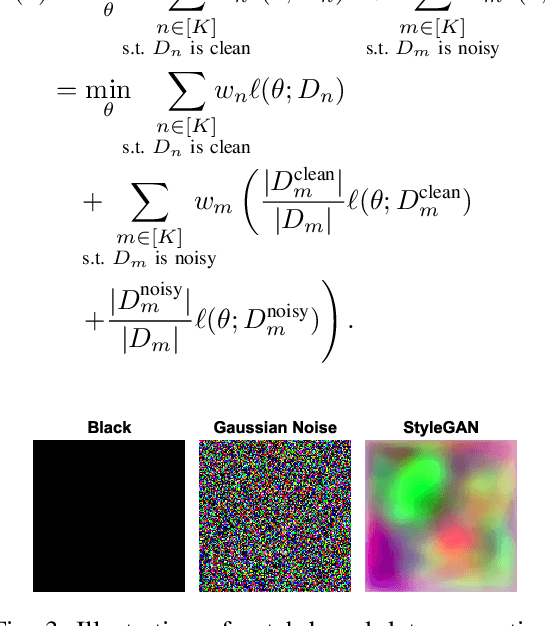
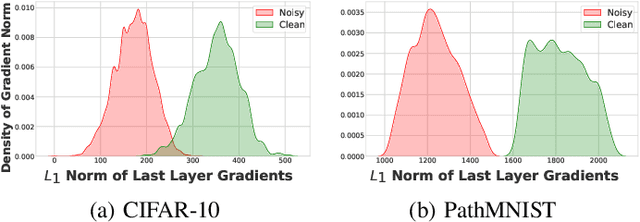
Federated learning (FL) has emerged as a prominent method for collaboratively training machine learning models using local data from edge devices, all while keeping data decentralized. However, accounting for the quality of data contributed by local clients remains a critical challenge in FL, as local data are often susceptible to corruption by various forms of noise and perturbations, which compromise the aggregation process and lead to a subpar global model. In this work, we focus on addressing the problem of noisy data in the input space, an under-explored area compared to the label noise. We propose a comprehensive assessment of client input in the gradient space, inspired by the distinct disparity observed between the density of gradient norm distributions of models trained on noisy and clean input data. Based on this observation, we introduce a straightforward yet effective approach to identify clients with low-quality data at the initial stage of FL. Furthermore, we propose a noise-aware FL aggregation method, namely Federated Noise-Sifting (FedNS), which can be used as a plug-in approach in conjunction with widely used FL strategies. Our extensive evaluation on diverse benchmark datasets under different federated settings demonstrates the efficacy of FedNS. Our method effortlessly integrates with existing FL strategies, enhancing the global model's performance by up to 13.68% in IID and 15.85% in non-IID settings when learning from noisy decentralized data.
Sonification of Facial Actions for Musical Expression
Oct 07, 2020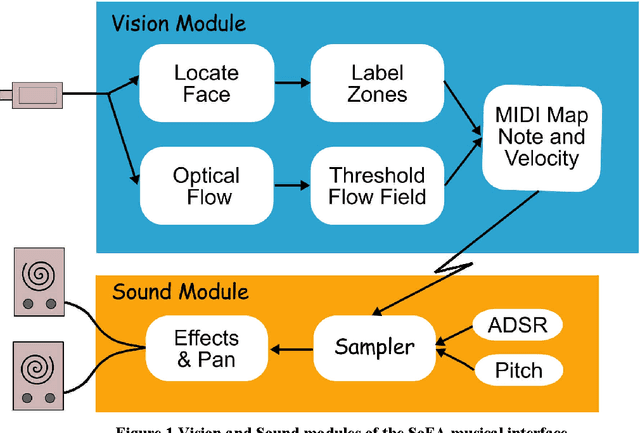
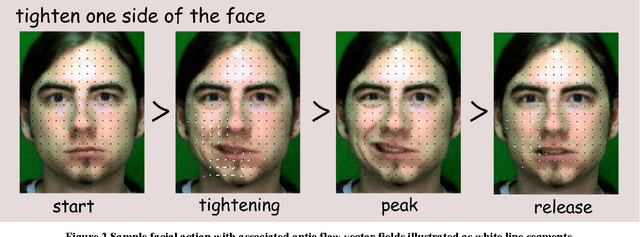
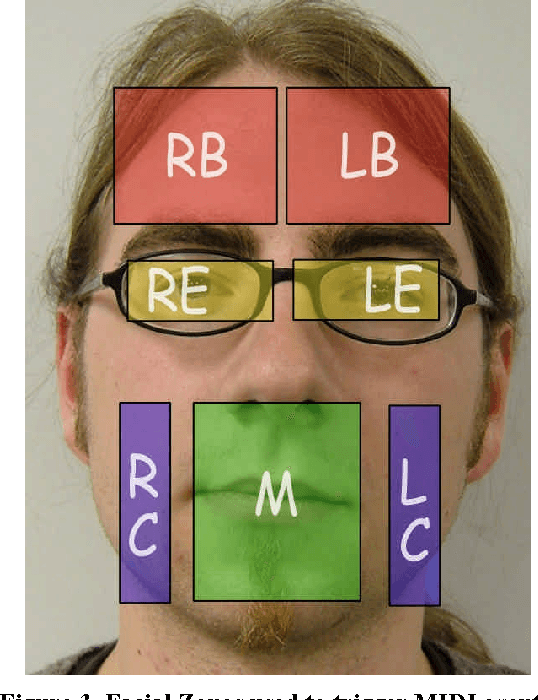
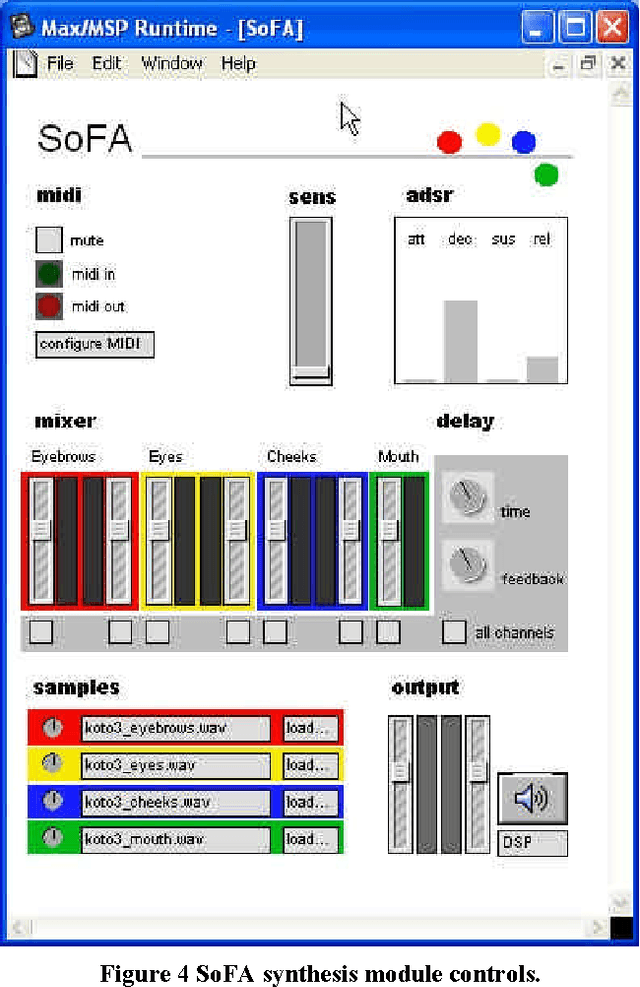
The central role of the face in social interaction and non-verbal communication suggests we explore facial action as a means of musical expression. This paper presents the design, implementation, and preliminary studies of a novel system utilizing face detection and optic flow algorithms to associate facial movements with sound synthesis in a topographically specific fashion. We report on our experience with various gesture-to-sound mappings and applications, and describe our preliminary experiments at musical performance using the system.