 Add to Chrome
 Add to Firefox
 Add to Edge
Query Symbolically or Retrieve Semantically? A Dataset and Method for Semi-Structured Question Answering
May 26, 2026
Retrieval-Augmented Generation (RAG) systems for question answering typically retrieve evidence by semantic similarity between the query and document chunks. While effective for unstructured text, this approach is less reliable on semi-structured corpora where answering may require exact filtering, aggregation, or exhaustive retrieval over structured attributes across multiple documents. Symbolic approaches support such operations, but they are often brittle on noisy natural-language corpora. We address this gap with DualGraph, a RAG framework that represents documents through two complementary views: a Textual Knowledge Graph for semantic retrieval and a Symbolic Knowledge Graph for symbolic querying over typed subject--predicate--object triples. Building on these two components, we provide multiple strategies for selecting or combining semantic and symbolic evidence.We also introduce SpecsQA, a benchmark from a commercial shopping website with semi-structured product documents and manually curated questions spanning open-ended and specification-oriented retrieval. Experiments show that DualGraph consistently outperforms state-of-the-art dense-retrieval, GraphRAG, symbolic, and table-oriented baselines across question types.Code and data are available at https://github.com/corneliocristina/DualGraphRAG.

A Benchmark for Audio Reasoning Capabilities of Multimodal Large Language Models
Jan 27, 2026The present benchmarks for testing the audio modality of multimodal large language models concentrate on testing various audio tasks such as speaker diarization or gender identification in isolation. Whether a multimodal model can answer the questions that require reasoning skills to combine audio tasks of different categories, cannot be verified with their use. To address this issue, we propose Audio Reasoning Tasks (ART), a new benchmark for assessing the ability of multimodal models to solve problems that require reasoning over audio signal.
Augmenting Polish Automatic Speech Recognition System With Synthetic Data
Oct 30, 2024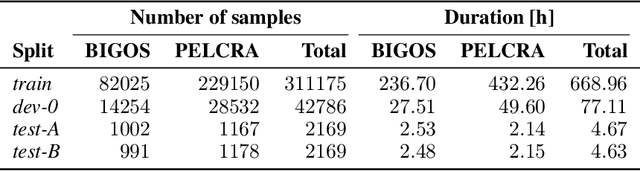
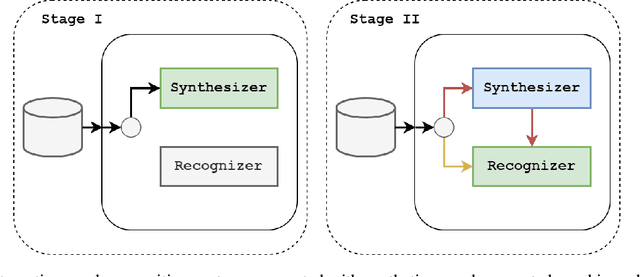

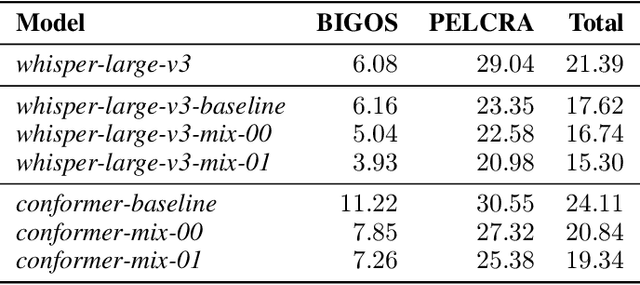
This paper presents a system developed for submission to Poleval 2024, Task 3: Polish Automatic Speech Recognition Challenge. We describe Voicebox-based speech synthesis pipeline and utilize it to augment Conformer and Whisper speech recognition models with synthetic data. We show that addition of synthetic speech to training improves achieved results significantly. We also present final results achieved by our models in the competition.
Spoken Language Corpora Augmentation with Domain-Specific Voice-Cloned Speech
Jun 11, 2024In this paper we study the impact of augmenting spoken language corpora with domain-specific synthetic samples for the purpose of training a speech recognition system. Using both a conventional neural TTS system and a zero-shot one with voice cloning ability we generate speech corpora that vary in the number of voices. We compare speech recognition models trained with addition of different amounts of synthetic data generated using these two methods with a baseline model trained solely on voice recordings. We show that while the quality of voice-cloned dataset is lower, its increased multivoiceity makes it much more effective than the one with only a few voices synthesized with the use of a conventional neural TTS system. Furthermore, our experiments indicate that using low variability synthetic speech quickly leads to saturation in the quality of the ASR whereas high variability speech provides improvement even when increasing total amount of data used for training by 30%.