 Add to Chrome
 Add to Firefox
 Add to Edge
Describe-Then-Act: Proactive Agent Steering via Distilled Language-Action World Models
Mar 24, 2026
Deploying safety-critical agents requires anticipating the consequences of actions before they are executed. While world models offer a paradigm for this proactive foresight, current approaches relying on visual simulation incur prohibitive latencies, often exceeding several seconds per step. In this work, we challenge the assumption that visual processing is necessary for failure prevention. We show that a trained policy's latent state, combined with its planned actions, already encodes sufficient information to anticipate action outcomes, making visual simulation redundant for failure prevention. To this end, we introduce DILLO (DIstiLLed Language-ActiOn World Model), a fast steering layer that shifts the paradigm from "simulate-then-act" to "describe-then-act." DILLO is trained via cross-modal distillation, where a privileged Vision Language Model teacher annotates offline trajectories and a latent-conditioned Large Language Model student learns to predict semantic outcomes. This creates a text-only inference path, bypassing heavy visual generation entirely, achieving a 14x speedup over baselines. Experiments on MetaWorld and LIBERO demonstrate that DILLO produces high-fidelity descriptions of the next state and is able to steer the policy, improving episode success rate by up to 15 pp and 9.3 pp on average across tasks.

ANTHROPOS-V: benchmarking the novel task of Crowd Volume Estimation
Jan 03, 2025

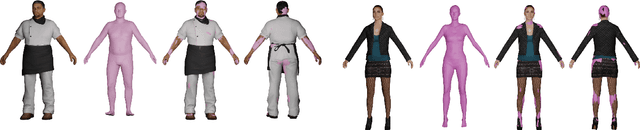

We introduce the novel task of Crowd Volume Estimation (CVE), defined as the process of estimating the collective body volume of crowds using only RGB images. Besides event management and public safety, CVE can be instrumental in approximating body weight, unlocking weight sensitive applications such as infrastructure stress assessment, and assuring even weight balance. We propose the first benchmark for CVE, comprising ANTHROPOS-V, a synthetic photorealistic video dataset featuring crowds in diverse urban environments. Its annotations include each person's volume, SMPL shape parameters, and keypoints. Also, we explore metrics pertinent to CVE, define baseline models adapted from Human Mesh Recovery and Crowd Counting domains, and propose a CVE specific methodology that surpasses baselines. Although synthetic, the weights and heights of individuals are aligned with the real-world population distribution across genders, and they transfer to the downstream task of CVE from real images. Benchmark and code are available at github.com/colloroneluca/Crowd-Volume-Estimation.
MoDiPO: text-to-motion alignment via AI-feedback-driven Direct Preference Optimization
May 06, 2024
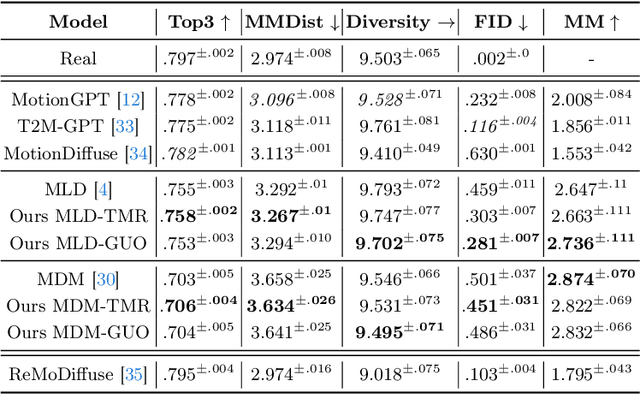

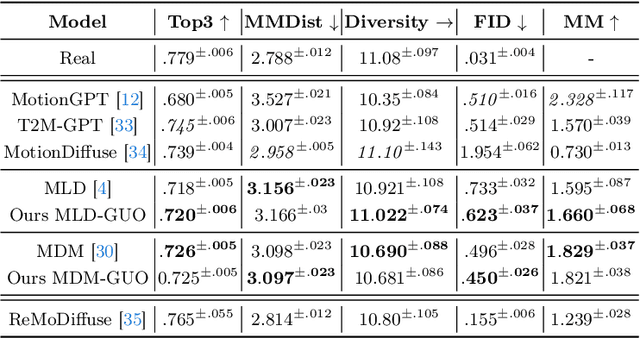
Diffusion Models have revolutionized the field of human motion generation by offering exceptional generation quality and fine-grained controllability through natural language conditioning. Their inherent stochasticity, that is the ability to generate various outputs from a single input, is key to their success. However, this diversity should not be unrestricted, as it may lead to unlikely generations. Instead, it should be confined within the boundaries of text-aligned and realistic generations. To address this issue, we propose MoDiPO (Motion Diffusion DPO), a novel methodology that leverages Direct Preference Optimization (DPO) to align text-to-motion models. We streamline the laborious and expensive process of gathering human preferences needed in DPO by leveraging AI feedback instead. This enables us to experiment with novel DPO strategies, using both online and offline generated motion-preference pairs. To foster future research we contribute with a motion-preference dataset which we dub Pick-a-Move. We demonstrate, both qualitatively and quantitatively, that our proposed method yields significantly more realistic motions. In particular, MoDiPO substantially improves Frechet Inception Distance (FID) while retaining the same RPrecision and Multi-Modality performances.
AI-based Data Preparation and Data Analytics in Healthcare: The Case of Diabetes
Jun 13, 2022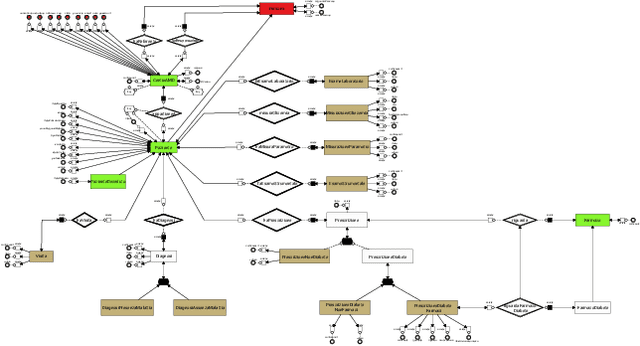
The Associazione Medici Diabetologi (AMD) collects and manages one of the largest worldwide-available collections of diabetic patient records, also known as the AMD database. This paper presents the initial results of an ongoing project whose focus is the application of Artificial Intelligence and Machine Learning techniques for conceptualizing, cleaning, and analyzing such an important and valuable dataset, with the goal of providing predictive insights to better support diabetologists in their diagnostic and therapeutic choices.