 Add to Chrome
 Add to Firefox
 Add to Edge
Site-Specific MIMO Channel Generation via Diffusion and Flow Matching: Fidelity, Efficiency, and Downstream Utility
Jun 18, 2026
This paper explores the use of generative models to synthesize high-quality, site-specific multiple-input multiple-output (MIMO) channel data, addressing the high cost of the extensive measurement campaigns required to acquire real-world data for AI-native wireless networks. Two location-conditioned generative paradigms are compared: a conditional denoising diffusion implicit model (cDDIM), and a conditional flow matching model (cFMM). Both these models generate MIMO channel matrices conditioned on user coordinates, to preserve the spatial structure of the deployment site. The approaches are evaluated across three dimensions: statistical fidelity (including beam consistency and effective rank), generation efficiency, and utility in downstream tasks such as channel-state information compression and beam alignment. Results across diverse propagation scenarios (28 GHz and 3.5 GHz, both line-of-sight and non-line-of-sight) demonstrate that both models accurately capture site-specific characteristics, even when trained on scarce ground-truth data. Notably, cFMM achieves a quality comparable to cDDIM with roughly an order of magnitude less inference time. Augmenting scarce site-specific datasets with these synthetic channels yields hefty performance gains in downstream physical layer tasks compared to using scarce data alone or stochastic channels.

Pilot-to-Data Power Ratio in RIS-Assisted Multiantenna Communication
Jul 29, 2025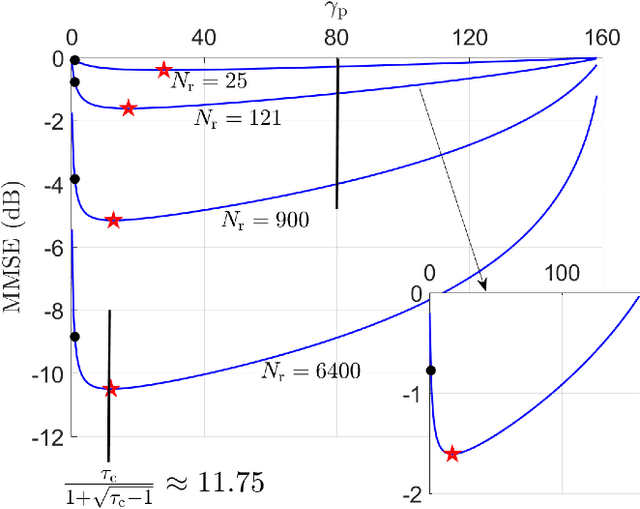
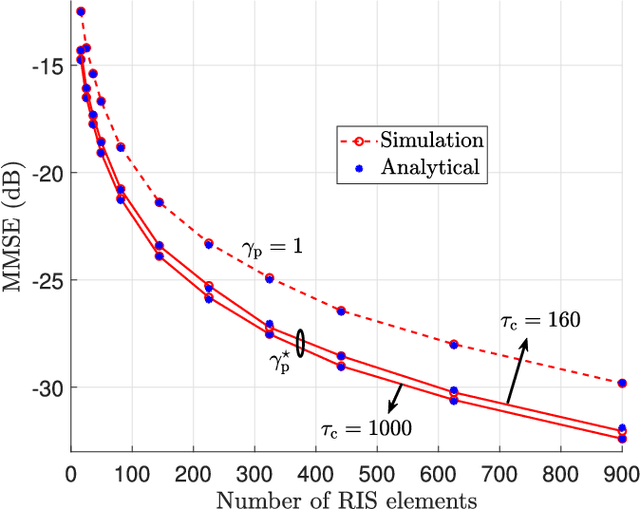
The optimization of the \gls{pdpr} is a recourse that helps wireless systems to acquire channel state information while minimizing the pilot overhead. While the optimization of the \gls{pdpr} in cellular networks has been studied extensively, the effect of the \gls{pdpr} in \gls{ris}-assisted networks has hardly been examined. This paper tackles this optimization when the communication is assisted by a RIS whose phase shifts are adjusted on the basis of the statistics of the channels. For a setting representative of a macrocellular deployment, the benefits of optimizing the PDPR are seen to be significant over a broad range of operating conditions. These benefits, demonstrated through the ergodic minimum mean squared error, for which a closed-form solution is derived, become more pronounced as the number of RIS elements and/or the channel coherence grow large.