 Add to Chrome
 Add to Firefox
 Add to Edge
Predictive Modeling of Power Outages during Extreme Events: Integrating Weather and Socio-Economic Factors
Dec 27, 2025
This paper presents a novel learning-based framework for predicting power outages caused by extreme events. The proposed approach specifically targets low-probability, high-consequence outage scenarios and leverages a comprehensive set of features derived from publicly available data sources. We integrate EAGLE-I outage records (2014-2024) with weather, socio-economic, infrastructure, and seasonal event data. Incorporating social and demographic indicators reveals underlying patterns of community vulnerability and provides a clearer understanding of outage risk during extreme conditions. Four machine learning models (Random Forest (RF), Support Vector Machine (SVM), Adaptive Boosting (AdaBoost), and Long Short-Term Memory (LSTM)) are evaluated. Experimental validation is performed on a large-scale dataset covering counties in the lower peninsula of Michigan. Among all models tested, the LSTM network achieves the lowest prediction error. Additionally, the results demonstrate that stronger economic conditions and more developed infrastructure are associated with lower outage occurrence.

Deep Learning-Based Weather-Related Power Outage Prediction with Socio-Economic and Power Infrastructure Data
Apr 03, 2024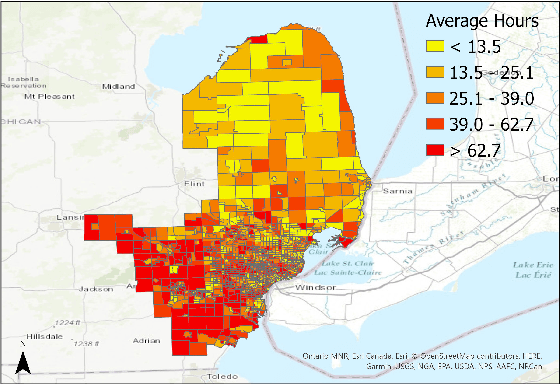
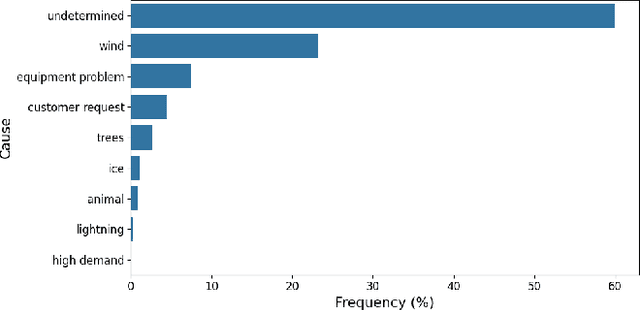
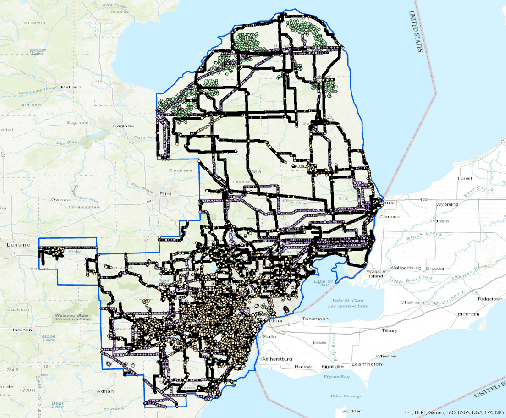
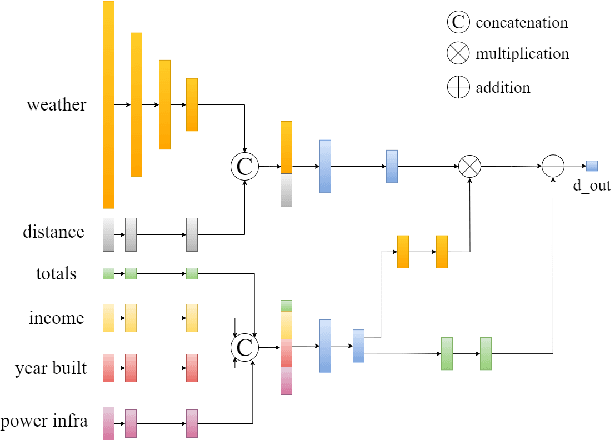
This paper presents a deep learning-based approach for hourly power outage probability prediction within census tracts encompassing a utility company's service territory. Two distinct deep learning models, conditional Multi-Layer Perceptron (MLP) and unconditional MLP, were developed to forecast power outage probabilities, leveraging a rich array of input features gathered from publicly available sources including weather data, weather station locations, power infrastructure maps, socio-economic and demographic statistics, and power outage records. Given a one-hour-ahead weather forecast, the models predict the power outage probability for each census tract, taking into account both the weather prediction and the location's characteristics. The deep learning models employed different loss functions to optimize prediction performance. Our experimental results underscore the significance of socio-economic factors in enhancing the accuracy of power outage predictions at the census tract level.