 Add to Chrome
 Add to Firefox
 Add to Edge
Synthetic Defect Image Generation for Power Line Insulator Inspection Using Multimodal Large Language Models
Mar 09, 2026
Utility companies increasingly rely on drone imagery for post-event and routine inspection, but training accurate defect-type classifiers remains difficult because defect examples are rare and inspection datasets are often limited or proprietary. We address this data-scarcity setting by using an off-the-shelf multimodal large language model (MLLM) as a training-free image generator to synthesize defect images from visual references and text prompts. Our pipeline increases diversity via dual-reference conditioning, improves label fidelity with lightweight human verification and prompt refinement, and filters the resulting synthetic pool using an embedding-based selection rule based on distances to class centroids computed from the real training split. We evaluate on ceramic insulator defect-type classification (shell vs. glaze) using a public dataset with a realistic low training-data regime (104 real training images; 152 validation; 308 test). Augmenting the 10% real training set with embedding-selected synthetic images improves test F1 score (harmonic mean of precision and recall) from 0.615 to 0.739 (20% relative), corresponding to an estimated 4--5x data-efficiency gain, and the gains persist with stronger backbone models and frozen-feature linear-probe baselines. These results suggest a practical, low-barrier path for improving defect recognition when collecting additional real defects is slow or infeasible.

Deep Learning-Based Electricity Price Forecast for Virtual Bidding in Wholesale Electricity Market
Nov 25, 2024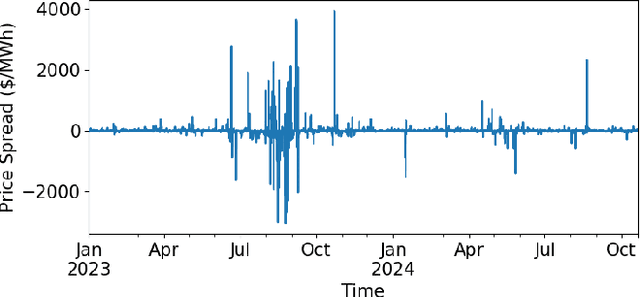
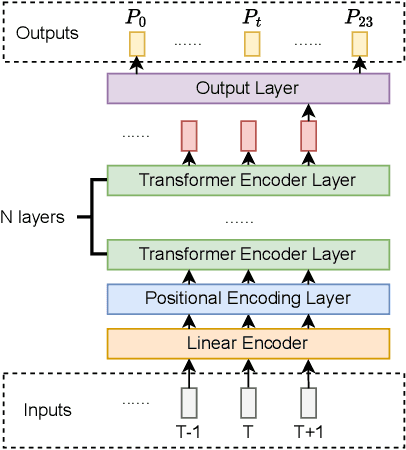
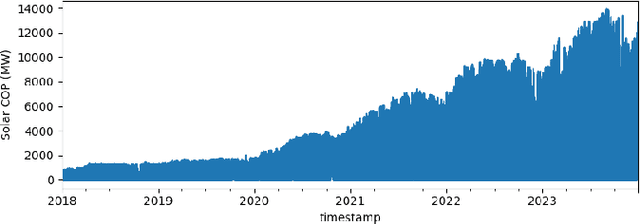
Virtual bidding plays an important role in two-settlement electric power markets, as it can reduce discrepancies between day-ahead and real-time markets. Renewable energy penetration increases volatility in electricity prices, making accurate forecasting critical for virtual bidders, reducing uncertainty and maximizing profits. This study presents a Transformer-based deep learning model to forecast the price spread between real-time and day-ahead electricity prices in the ERCOT (Electric Reliability Council of Texas) market. The proposed model leverages various time-series features, including load forecasts, solar and wind generation forecasts, and temporal attributes. The model is trained under realistic constraints and validated using a walk-forward approach by updating the model every week. Based on the price spread prediction results, several trading strategies are proposed and the most effective strategy for maximizing cumulative profit under realistic market conditions is identified through backtesting. The results show that the strategy of trading only at the peak hour with a precision score of over 50% produces nearly consistent profit over the test period. The proposed method underscores the importance of an accurate electricity price forecasting model and introduces a new method of evaluating the price forecast model from a virtual bidder's perspective, providing valuable insights for future research.
Deep Learning-Based Weather-Related Power Outage Prediction with Socio-Economic and Power Infrastructure Data
Apr 03, 2024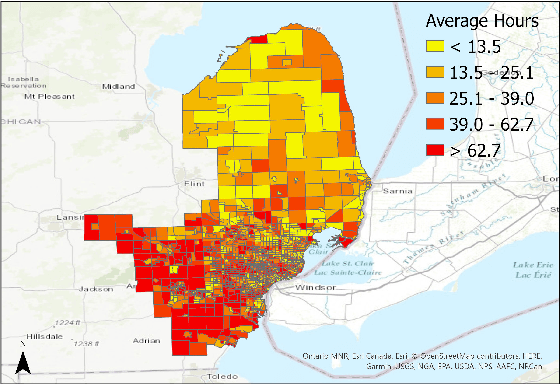
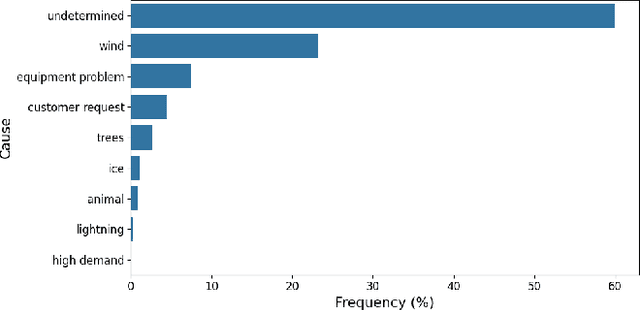
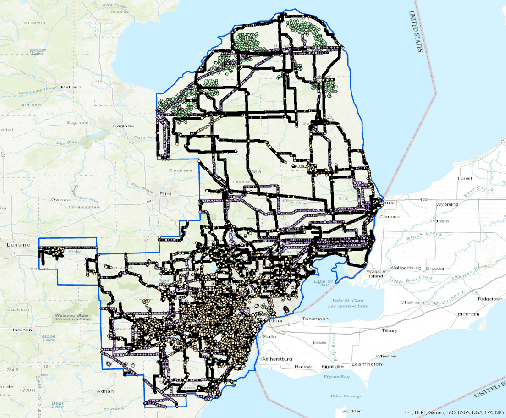
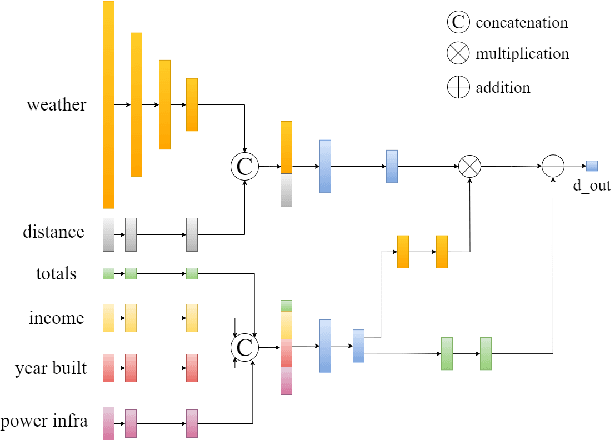
This paper presents a deep learning-based approach for hourly power outage probability prediction within census tracts encompassing a utility company's service territory. Two distinct deep learning models, conditional Multi-Layer Perceptron (MLP) and unconditional MLP, were developed to forecast power outage probabilities, leveraging a rich array of input features gathered from publicly available sources including weather data, weather station locations, power infrastructure maps, socio-economic and demographic statistics, and power outage records. Given a one-hour-ahead weather forecast, the models predict the power outage probability for each census tract, taking into account both the weather prediction and the location's characteristics. The deep learning models employed different loss functions to optimize prediction performance. Our experimental results underscore the significance of socio-economic factors in enhancing the accuracy of power outage predictions at the census tract level.