 Add to Chrome
 Add to Firefox
 Add to Edge
Lean-Quantum: Toward AI-Assisted Formalization of Quantum Information
Jul 06, 2026
Quantum information theory is built on entropic quantities; among them, the sandwiched Rényi relative entropy is a fundamental divergence with various applications, and its data processing inequality (DPI) under quantum channels is a cornerstone result. In this work, we present a Lean 4 library for quantum information, designed as a reusable formal infrastructure for theoretical analysis. As a central demonstration of the library, we formalize the DPI for the sandwiched Rényi relative entropy for positive semidefinite operators on finite-dimensional quantum systems. The library provides a basis-independent operator-theoretic framework for finite-dimensional quantum mechanics compatible with the standard mathematical library Mathlib, including reusable interfaces for finite-dimensional systems, states, channels, tensor products, partial traces, Choi operators, Kraus representations, and Stinespring representations. It also builds infrastructure for noncommutative trace inequalities, including operator monotonicity and convexity via the real continuous functional calculus, block-operator positivity, Hilbert-Schmidt operator spaces, Jensen's operator inequality, generalized perspectives, operator power means, and Lieb-Ando trace inequalities. On top of this framework, we formalize entropy-specific ingredients for the DPI: variational formulas for the sandwiched quasi-entropy via Young and reverse-Young inequalities, tensor-product compatibility of real powers, and Haar measures on unitary groups. Together, these components yield a Lean formalization of the DPI, give strong subadditivity as a corollary, and provide the last missing component needed to complete the Lean formalization of the generalized quantum Stein's lemma. More broadly, the development provides machine-checkable foundations for future formalized and AI-assisted research in quantum information theory.

Think-to-Talk or Talk-to-Think? When LLMs Come Up with an Answer in Multi-Step Reasoning
Dec 02, 2024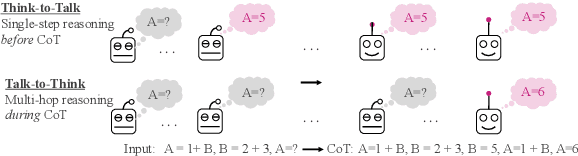
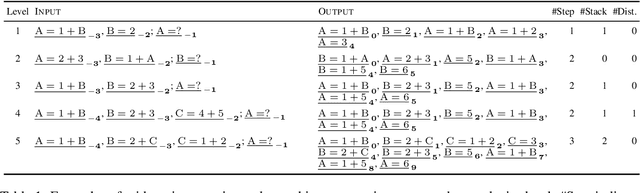
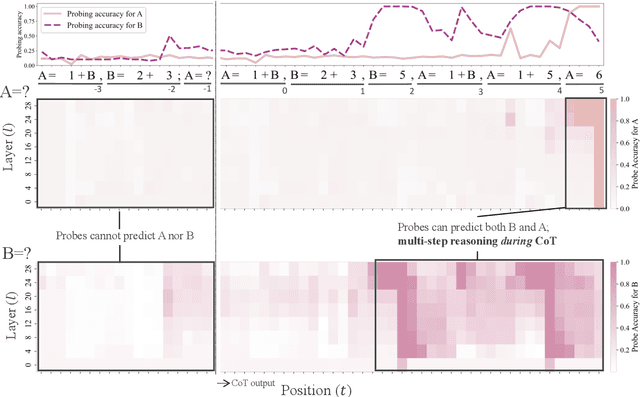
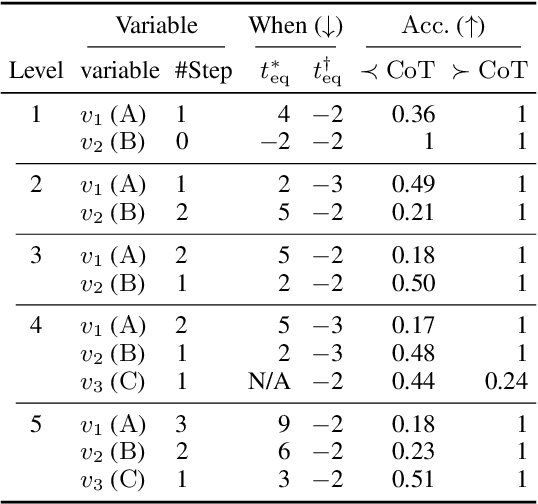
This study investigates the internal reasoning mechanism of language models during symbolic multi-step reasoning, motivated by the question of whether chain-of-thought (CoT) outputs are faithful to the model's internals. Specifically, we inspect when they internally determine their answers, particularly before or after CoT begins, to determine whether models follow a post-hoc "think-to-talk" mode or a step-by-step "talk-to-think" mode of explanation. Through causal probing experiments in controlled arithmetic reasoning tasks, we found systematic internal reasoning patterns across models; for example, simple subproblems are solved before CoT begins, and more complicated multi-hop calculations are performed during CoT.
First Heuristic Then Rational: Dynamic Use of Heuristics in Language Model Reasoning
Jun 23, 2024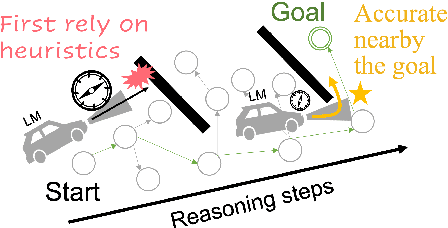

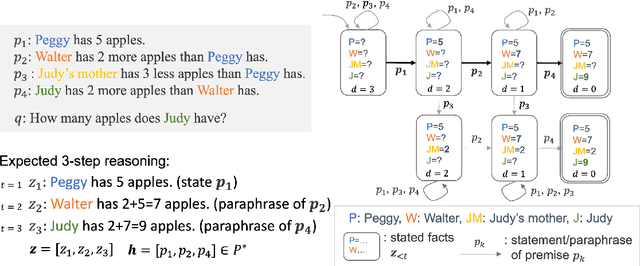
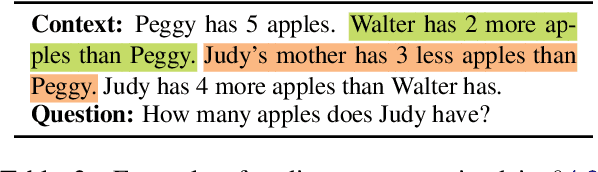
Multi-step reasoning is widely adopted in the community to explore the better performance of language models (LMs). We report on the systematic strategy that LMs use in this process. Our controlled experiments reveal that LMs rely more heavily on heuristics, such as lexical overlap, in the earlier stages of reasoning when more steps are required to reach an answer. Conversely, as LMs progress closer to the final answer, their reliance on heuristics decreases. This suggests that LMs track only a limited number of future steps and dynamically combine heuristic strategies with logical ones in tasks involving multi-step reasoning.
J-UniMorph: Japanese Morphological Annotation through the Universal Feature Schema
Feb 22, 2024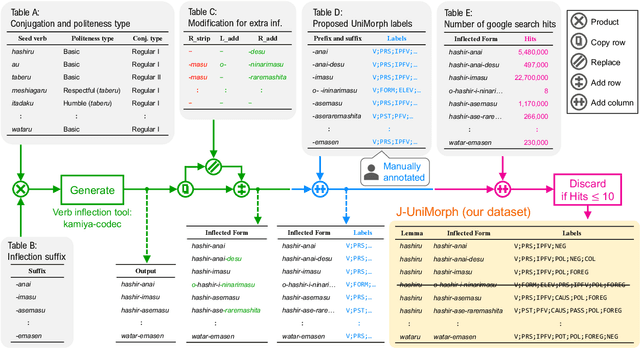
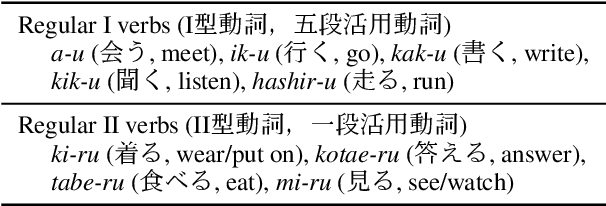
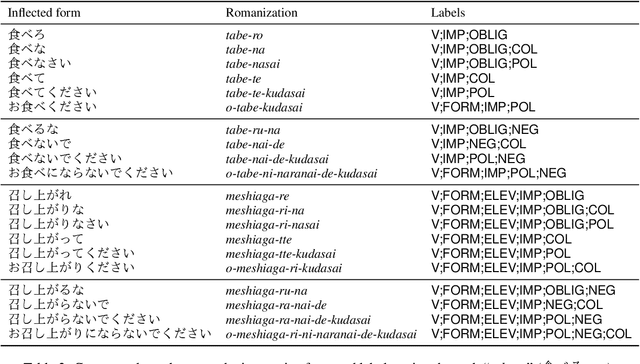
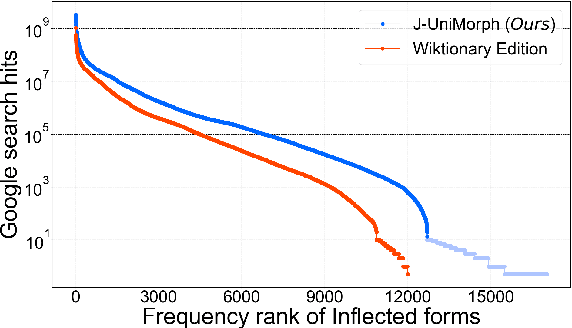
We introduce a Japanese Morphology dataset, J-UniMorph, developed based on the UniMorph feature schema. This dataset addresses the unique and rich verb forms characteristic of the language's agglutinative nature. J-UniMorph distinguishes itself from the existing Japanese subset of UniMorph, which is automatically extracted from Wiktionary. On average, the Wiktionary Edition features around 12 inflected forms for each word and is primarily dominated by denominal verbs (i.e., [noun] +suru (do-PRS)). Morphologically, this form is equivalent to the verb suru (do). In contrast, J-UniMorph explores a much broader and more frequently used range of verb forms, offering 118 inflected forms for each word on average. It includes honorifics, a range of politeness levels, and other linguistic nuances, emphasizing the distinctive characteristics of the Japanese language. This paper presents detailed statistics and characteristics of J-UniMorph, comparing it with the Wiktionary Edition. We release J-UniMorph and its interactive visualizer publicly available, aiming to support cross-linguistic research and various applications.