 Add to Chrome
 Add to Firefox
 Add to Edge
Lean-Quantum: Toward AI-Assisted Formalization of Quantum Information
Jul 06, 2026
Quantum information theory is built on entropic quantities; among them, the sandwiched Rényi relative entropy is a fundamental divergence with various applications, and its data processing inequality (DPI) under quantum channels is a cornerstone result. In this work, we present a Lean 4 library for quantum information, designed as a reusable formal infrastructure for theoretical analysis. As a central demonstration of the library, we formalize the DPI for the sandwiched Rényi relative entropy for positive semidefinite operators on finite-dimensional quantum systems. The library provides a basis-independent operator-theoretic framework for finite-dimensional quantum mechanics compatible with the standard mathematical library Mathlib, including reusable interfaces for finite-dimensional systems, states, channels, tensor products, partial traces, Choi operators, Kraus representations, and Stinespring representations. It also builds infrastructure for noncommutative trace inequalities, including operator monotonicity and convexity via the real continuous functional calculus, block-operator positivity, Hilbert-Schmidt operator spaces, Jensen's operator inequality, generalized perspectives, operator power means, and Lieb-Ando trace inequalities. On top of this framework, we formalize entropy-specific ingredients for the DPI: variational formulas for the sandwiched quasi-entropy via Young and reverse-Young inequalities, tensor-product compatibility of real powers, and Haar measures on unitary groups. Together, these components yield a Lean formalization of the DPI, give strong subadditivity as a corollary, and provide the last missing component needed to complete the Lean formalization of the generalized quantum Stein's lemma. More broadly, the development provides machine-checkable foundations for future formalized and AI-assisted research in quantum information theory.

Lean Formalization of Generalization Error Bound by Rademacher Complexity
Mar 25, 2025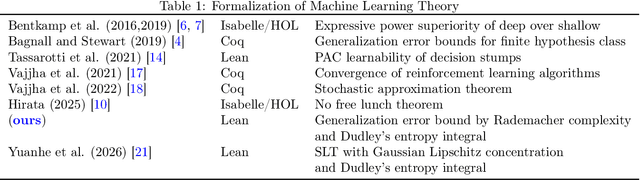

We formalize the generalization error bound using Rademacher complexity in the Lean 4 theorem prover. Generalization error quantifies the gap between a learning machine's performance on given training data versus unseen test data, and Rademacher complexity serves as an estimate of this error based on the complexity of learning machines, or hypothesis class. Unlike traditional methods such as PAC learning and VC dimension, Rademacher complexity is applicable across diverse machine learning scenarios including deep learning and kernel methods. We formalize key concepts and theorems, including the empirical and population Rademacher complexities, and establish generalization error bounds through formal proofs of McDiarmid's inequality, Hoeffding's lemma, and symmetrization arguments.