 Add to Chrome
 Add to Firefox
 Add to Edge
Has Automated Essay Scoring Reached Sufficient Accuracy? Deriving Achievable QWK Ceilings from Classical Test Theory
Apr 21, 2026
Automated essay scoring (AES) is commonly evaluated on public benchmarks using quadratic weighted kappa (QWK). However, because benchmark labels are assigned by human raters and inevitably contain scoring errors, it remains unclear both what QWK is theoretically attainable and what level is practically sufficient for deployment. We therefore derive two dataset-specific QWK ceilings based on the reliability concept in classical test theory, which can be estimated from standard two-rater benchmarks without additional annotation. The first is the theoretical ceiling: the maximum QWK that an ideal AES model that perfectly predicts latent true scores can achieve under label noise. The second is the human-like ceiling: the QWK attainable by an AES model with human-level scoring error, providing a practical target when AES is intended to replace a single human rater. We further show that human--human QWK, often used as a ceiling reference, can underestimate the true ceiling. Simulation experiments validate the proposed ceilings, and experiments on real benchmarks illustrate how they clarify the current performance and remaining headroom of modern AES models.

Difficulty-Controllable Multiple-Choice Question Generation Using Large Language Models and Direct Preference Optimization
Oct 22, 2025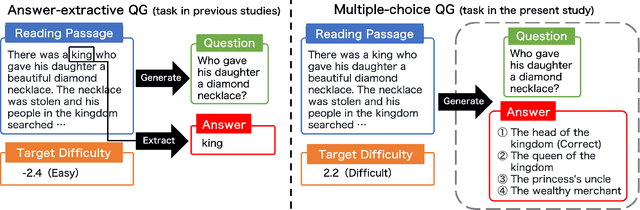
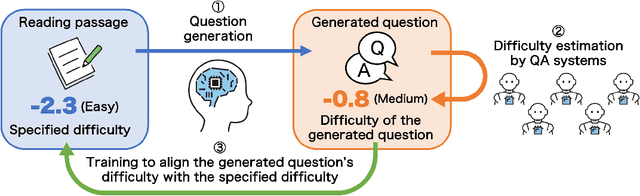
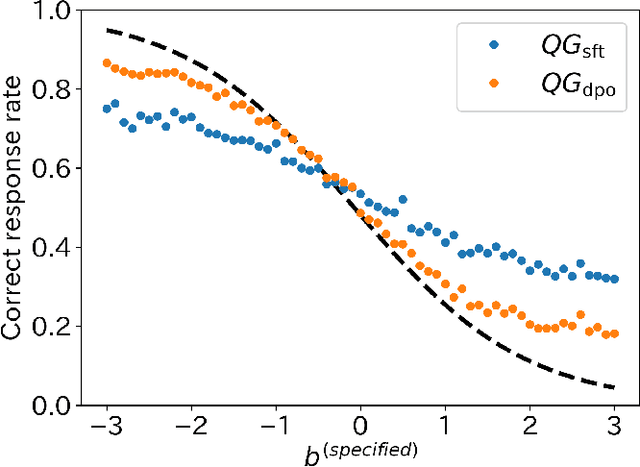
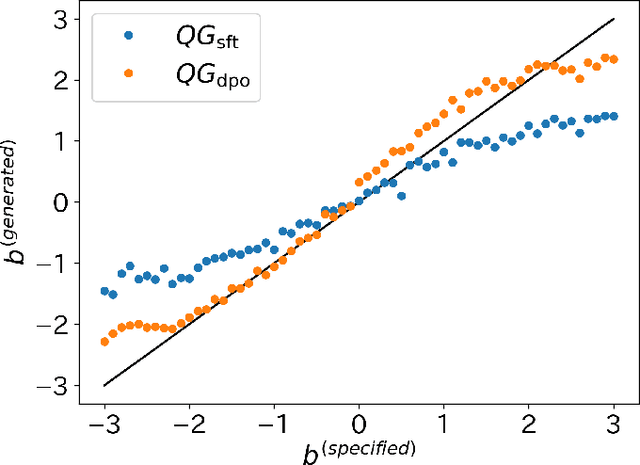
Difficulty-controllable question generation for reading comprehension has gained significant attention in the field of education as a fundamental tool for adaptive learning support. Although several neural question generation methods have recently succeeded in controlling difficulty, conventional approaches still face two major limitations. First, they cannot directly generate multiple-choice questions, which are the most widely used question type in educational contexts. Second, they are not explicitly trained to optimize the accuracy of difficulty control, leaving room for further improvement in difficulty controllability. To address these limitations, this study proposes a novel difficulty-controllable multiple-choice question generation method for reading comprehension which leverages a large language model trained using a direct preference optimization technique to improve the accuracy of difficulty control.
Tell Me Who Your Students Are: GPT Can Generate Valid Multiple-Choice Questions When Students' (Mis)Understanding Is Hinted
May 09, 2025The primary goal of this study is to develop and evaluate an innovative prompting technique, AnaQuest, for generating multiple-choice questions (MCQs) using a pre-trained large language model. In AnaQuest, the choice items are sentence-level assertions about complex concepts. The technique integrates formative and summative assessments. In the formative phase, students answer open-ended questions for target concepts in free text. For summative assessment, AnaQuest analyzes these responses to generate both correct and incorrect assertions. To evaluate the validity of the generated MCQs, Item Response Theory (IRT) was applied to compare item characteristics between MCQs generated by AnaQuest, a baseline ChatGPT prompt, and human-crafted items. An empirical study found that expert instructors rated MCQs generated by both AI models to be as valid as those created by human instructors. However, IRT-based analysis revealed that AnaQuest-generated questions - particularly those with incorrect assertions (foils) - more closely resembled human-crafted items in terms of difficulty and discrimination than those produced by ChatGPT.