 Add to Chrome
 Add to Firefox
 Add to Edge
MAPS: A Synthetic Dataset for Probing Vision Models in a Controlled 3D Scene Space
May 19, 2026
Modern vision models achieve strong performance on standard benchmarks, yet their aggregate accuracy reveals little about which scene properties drive their predictions. Existing robustness benchmarks provide important stress tests, but typically manipulate global 2D image properties, rely on entangled real-world variation, or cover only a limited set of 3D objects and scene parameters. We introduce MAPS (Manifolds of Artificial Parametric Scenes), a scalable instrument for controlled attribution of vision model behavior to scene parameters. MAPS comprises 2,618 curated photorealistic 3D meshes validated for recognizability across 560 ImageNet classes and provides a Blender-based rendering pipeline for on-demand image generation under continuous variation of nine independent scene-factors spanning background, camera, and lighting, extensible to other factors. To showcase its applicability, we use MAPS to evaluate 20 convolutional and transformer-based models by quantifying their reliance on these scene factors through regression-based sensitivity analysis. We find a near-universal failure axis across all tested architectures: camera distance and elevation consistently dominate recognition failure regardless of ImageNet accuracy. However, the full sensitivity structure reveals that modern CNNs and transformers cluster together, distinct from older architectures, suggesting that fine-grained architectural design choices, rather than the coarse CNN-versus-transformer distinction, are the stronger determinant of sensitivity profiles.

Mechanisms of Object Localization in Vision-Language Models
May 19, 2026Visually-grounded language models (VLMs) are highly effective in linking visual and textual information, yet they often struggle with basic classification and localization tasks. While classification mechanisms have been studied more extensively, the processes that support object localization remain poorly understood. In this work, we investigate two representative families, LLaVA-1.5 and InternVL-3.5, using a suite of mechanistic interpretability tools, including token ablations, attention knockout, and causal mediation analysis. We find that localization is driven by a containerization mechanism in which object-aligned tokens define the spatial extent of the object, while the semantic arrangement of tokens within those boundaries is largely irrelevant to the predicted box. Only a very small set of attention heads mediates the causal effect for both classification and localization, concentrating in early-mid layers for LLaVA and mid-late layers for InternVL. The two tasks share some early processing but ultimately depend on largely distinct specialized heads. Overall, we provide the first layer- and head-level account of localization in VLMs, revealing narrow computational pathways that can guide future model design and grounding objectives.
The Computational Complexity of Circuit Discovery for Inner Interpretability
Oct 10, 2024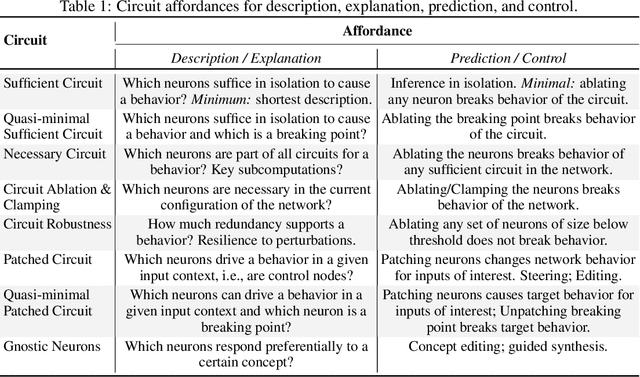
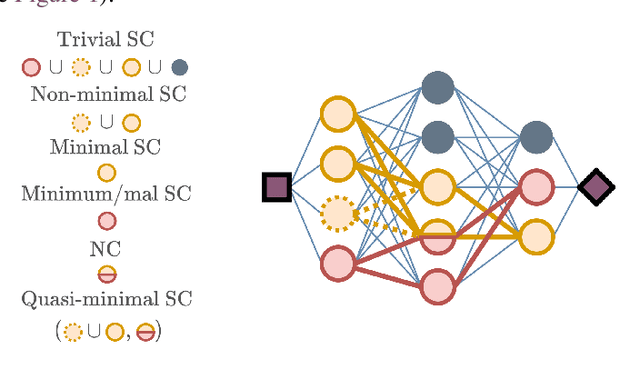
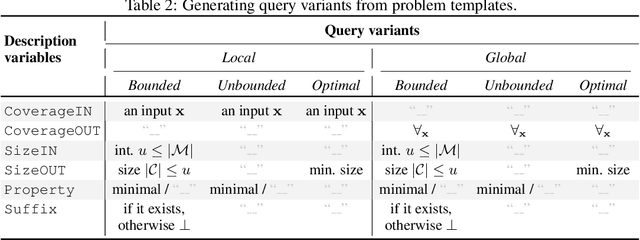
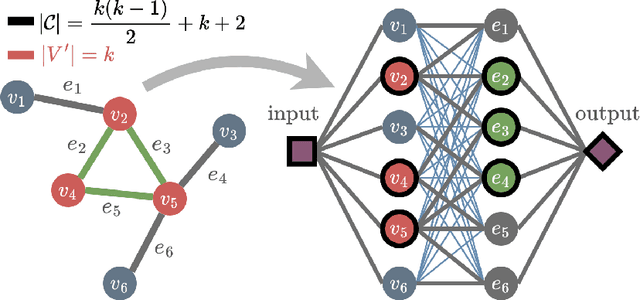
Many proposed applications of neural networks in machine learning, cognitive/brain science, and society hinge on the feasibility of inner interpretability via circuit discovery. This calls for empirical and theoretical explorations of viable algorithmic options. Despite advances in the design and testing of heuristics, there are concerns about their scalability and faithfulness at a time when we lack understanding of the complexity properties of the problems they are deployed to solve. To address this, we study circuit discovery with classical and parameterized computational complexity theory: (1) we describe a conceptual scaffolding to reason about circuit finding queries in terms of affordances for description, explanation, prediction and control; (2) we formalize a comprehensive set of queries that capture mechanistic explanation, and propose a formal framework for their analysis; (3) we use it to settle the complexity of many query variants and relaxations of practical interest on multi-layer perceptrons (part of, e.g., transformers). Our findings reveal a challenging complexity landscape. Many queries are intractable (NP-hard, $\Sigma^p_2$-hard), remain fixed-parameter intractable (W[1]-hard) when constraining model/circuit features (e.g., depth), and are inapproximable under additive, multiplicative, and probabilistic approximation schemes. To navigate this landscape, we prove there exist transformations to tackle some of these hard problems (NP- vs. $\Sigma^p_2$-complete) with better-understood heuristics, and prove the tractability (PTIME) or fixed-parameter tractability (FPT) of more modest queries which retain useful affordances. This framework allows us to understand the scope and limits of interpretability queries, explore viable options, and compare their resource demands among existing and future architectures.
Limited but consistent gains in adversarial robustness by co-training object recognition models with human EEG
Sep 05, 2024


In contrast to human vision, artificial neural networks (ANNs) remain relatively susceptible to adversarial attacks. To address this vulnerability, efforts have been made to transfer inductive bias from human brains to ANNs, often by training the ANN representations to match their biological counterparts. Previous works relied on brain data acquired in rodents or primates using invasive techniques, from specific regions of the brain, under non-natural conditions (anesthetized animals), and with stimulus datasets lacking diversity and naturalness. In this work, we explored whether aligning model representations to human EEG responses to a rich set of real-world images increases robustness to ANNs. Specifically, we trained ResNet50-backbone models on a dual task of classification and EEG prediction; and evaluated their EEG prediction accuracy and robustness to adversarial attacks. We observed significant correlation between the networks' EEG prediction accuracy, often highest around 100 ms post stimulus onset, and their gains in adversarial robustness. Although effect size was limited, effects were consistent across different random initializations and robust for architectural variants. We further teased apart the data from individual EEG channels and observed strongest contribution from electrodes in the parieto-occipital regions. The demonstrated utility of human EEG for such tasks opens up avenues for future efforts that scale to larger datasets under diverse stimuli conditions with the promise of stronger effects.
Position Paper: An Inner Interpretability Framework for AI Inspired by Lessons from Cognitive Neuroscience
Jun 03, 2024
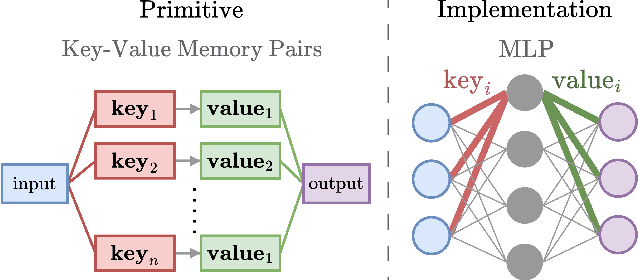

Inner Interpretability is a promising emerging field tasked with uncovering the inner mechanisms of AI systems, though how to develop these mechanistic theories is still much debated. Moreover, recent critiques raise issues that question its usefulness to advance the broader goals of AI. However, it has been overlooked that these issues resemble those that have been grappled with in another field: Cognitive Neuroscience. Here we draw the relevant connections and highlight lessons that can be transferred productively between fields. Based on these, we propose a general conceptual framework and give concrete methodological strategies for building mechanistic explanations in AI inner interpretability research. With this conceptual framework, Inner Interpretability can fend off critiques and position itself on a productive path to explain AI systems.
Analyzing Vision Transformers for Image Classification in Class Embedding Space
Oct 29, 2023


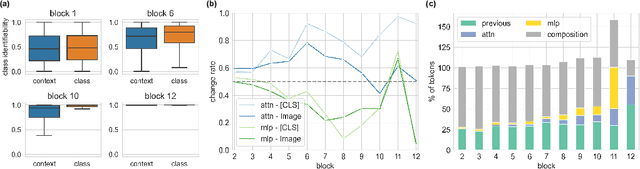
Despite the growing use of transformer models in computer vision, a mechanistic understanding of these networks is still needed. This work introduces a method to reverse-engineer Vision Transformers trained to solve image classification tasks. Inspired by previous research in NLP, we demonstrate how the inner representations at any level of the hierarchy can be projected onto the learned class embedding space to uncover how these networks build categorical representations for their predictions. We use our framework to show how image tokens develop class-specific representations that depend on attention mechanisms and contextual information, and give insights on how self-attention and MLP layers differentially contribute to this categorical composition. We additionally demonstrate that this method (1) can be used to determine the parts of an image that would be important for detecting the class of interest, and (2) exhibits significant advantages over traditional linear probing approaches. Taken together, our results position our proposed framework as a powerful tool for mechanistic interpretability and explainability research.