 Add to Chrome
 Add to Firefox
 Add to Edge
The Prosocial Ranking Challenge: Reducing Polarization on Social Media without Sacrificing Engagement
Mar 20, 2026
We report the first direct comparisons of multiple alternative social media algorithms on multiple platforms on outcomes of societal interest. We used a browser extension to modify which posts were shown to desktop social media users, randomly assigning 9,386 users to a control group or one of five alternative ranking algorithms which simultaneously altered content across three platforms for six months during the US 2024 presidential election. This reduced our preregistered index of affective polarization by an average of 0.03 standard deviations (p < 0.05), including a 1.5 degree decrease in differences between the 100 point inparty and outparty feeling thermometers. We saw reductions in active use time for Facebook (-0.37 min/day) and Reddit (-0.2 min/day), but an increase of 0.32 min/day (p < 0.01) for X/Twitter. We saw an increase in reports of negative social media experiences but found no effects on well-being, news knowledge, outgroup empathy, perceptions of and support for partisan violence. This implies that bridging content can improve some societal outcomes without necessarily conflicting with the engagement-driven business model of social media.

Social Media Algorithms Can Shape Affective Polarization via Exposure to Antidemocratic Attitudes and Partisan Animosity
Nov 22, 2024
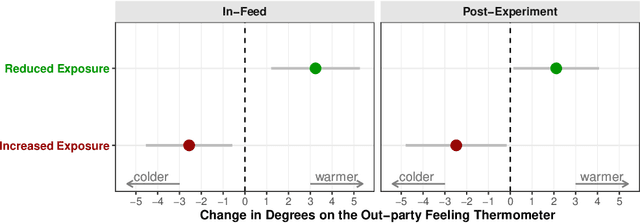


There is widespread concern about the negative impacts of social media feed ranking algorithms on political polarization. Leveraging advancements in large language models (LLMs), we develop an approach to re-rank feeds in real-time to test the effects of content that is likely to polarize: expressions of antidemocratic attitudes and partisan animosity (AAPA). In a preregistered 10-day field experiment on X/Twitter with 1,256 consented participants, we increase or decrease participants' exposure to AAPA in their algorithmically curated feeds. We observe more positive outparty feelings when AAPA exposure is decreased and more negative outparty feelings when AAPA exposure is increased. Exposure to AAPA content also results in an immediate increase in negative emotions, such as sadness and anger. The interventions do not significantly impact traditional engagement metrics such as re-post and favorite rates. These findings highlight a potential pathway for developing feed algorithms that mitigate affective polarization by addressing content that undermines the shared values required for a healthy democracy.
Counterfactual Evaluation of Peer-Review Assignment Policies
May 27, 2023Peer review assignment algorithms aim to match research papers to suitable expert reviewers, working to maximize the quality of the resulting reviews. A key challenge in designing effective assignment policies is evaluating how changes to the assignment algorithm map to changes in review quality. In this work, we leverage recently proposed policies that introduce randomness in peer-review assignment--in order to mitigate fraud--as a valuable opportunity to evaluate counterfactual assignment policies. Specifically, we exploit how such randomized assignments provide a positive probability of observing the reviews of many assignment policies of interest. To address challenges in applying standard off-policy evaluation methods, such as violations of positivity, we introduce novel methods for partial identification based on monotonicity and Lipschitz smoothness assumptions for the mapping between reviewer-paper covariates and outcomes. We apply our methods to peer-review data from two computer science venues: the TPDP'21 workshop (95 papers and 35 reviewers) and the AAAI'22 conference (8,450 papers and 3,145 reviewers). We consider estimates of (i) the effect on review quality when changing weights in the assignment algorithm, e.g., weighting reviewers' bids vs. textual similarity (between the review's past papers and the submission), and (ii) the "cost of randomization", capturing the difference in expected quality between the perturbed and unperturbed optimal match. We find that placing higher weight on text similarity results in higher review quality and that introducing randomization in the reviewer-paper assignment only marginally reduces the review quality. Our methods for partial identification may be of independent interest, while our off-policy approach can likely find use evaluating a broad class of algorithmic matching systems.