 Add to Chrome
 Add to Firefox
 Add to Edge
Beyond Foundation Models: Dimension-Aware Neural Architecture Search with Small-Data Representation Models for Cryocooler Lifetime Prediction
Aug 07, 2026
Large-scale pretrained time-series models achieve strong results through large-scale pretraining and task-agnostic representation learning, but they rely on abundant, diverse data that industrial and scientific domains often lack. We therefore propose the FSD-RM (Family of Small-Data Representation Models) paradigm as a practical alternative for limited, domain-specific telemetry. Rather than relying on large-scale pretraining, we focus on capacity-controlled representation learning using established encoder architectures (CNN1D, LSTM, GRU, Transformer), selected for their suitability in small-data settings and interpretability. These encoders are trained unsupervised on multivariate telemetry data and integrated into a two-stage pipeline for downstream lifetime prediction. To systematically examine architectural trade-offs under data constraints, we employ \textbf{dimension-aware neural architecture search (NAS)} to jointly optimize model capacity and input dimensionality. Experiments on cryocooler telemetry show that the proposed approach achieves competitive predictive performance while reducing training cost and model complexity. The contribution lies in combining established representation learning techniques within a coherent, NAS-driven framework tailored to small-data regimes, with explicitly defined parameter settings and design choices. The results indicate that effective representation learning can be achieved without large-scale pretraining when appropriate inductive bias and capacity control are applied.
* 48 pages

RUAD: unsupervised anomaly detection in HPC systems
Aug 28, 2022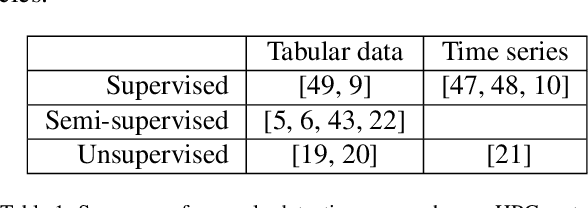
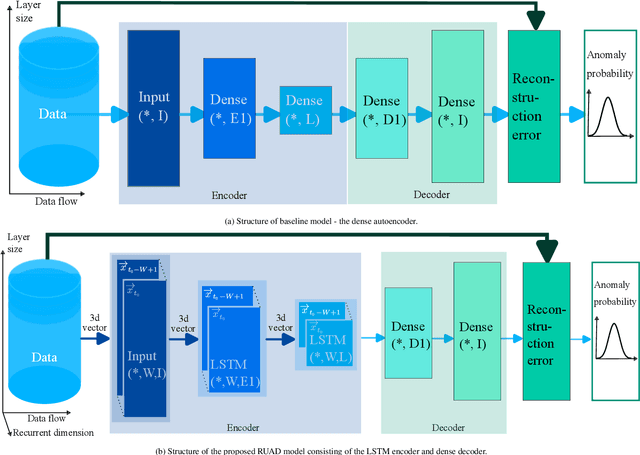
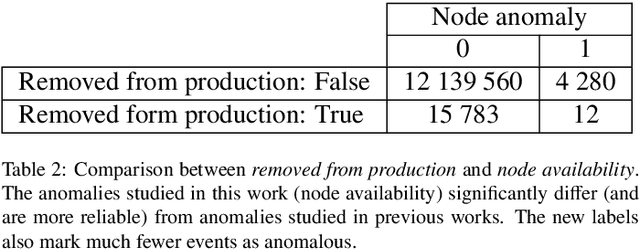

The increasing complexity of modern high-performance computing (HPC) systems necessitates the introduction of automated and data-driven methodologies to support system administrators' effort toward increasing the system's availability. Anomaly detection is an integral part of improving the availability as it eases the system administrator's burden and reduces the time between an anomaly and its resolution. However, current state-of-the-art (SoA) approaches to anomaly detection are supervised and semi-supervised, so they require a human-labelled dataset with anomalies - this is often impractical to collect in production HPC systems. Unsupervised anomaly detection approaches based on clustering, aimed at alleviating the need for accurate anomaly data, have so far shown poor performance. In this work, we overcome these limitations by proposing RUAD, a novel Recurrent Unsupervised Anomaly Detection model. RUAD achieves better results than the current semi-supervised and unsupervised SoA approaches. This is achieved by considering temporal dependencies in the data and including long-short term memory cells in the model architecture. The proposed approach is assessed on a complete ten-month history of a Tier-0 system (Marconi100 from CINECA with 980 nodes). RUAD achieves an area under the curve (AUC) of 0.763 in semi-supervised training and an AUC of 0.767 in unsupervised training, which improves upon the SoA approach that achieves an AUC of 0.747 in semi-supervised training and an AUC of 0.734 in unsupervised training. It also vastly outperforms the current SoA unsupervised anomaly detection approach based on clustering, achieving the AUC of 0.548.