 Add to Chrome
 Add to Firefox
 Add to Edge
Environmental Footprint of GenAI Research: Insights from the Moshi Foundation Model
Apr 13, 2026
New multi-modal large language models (MLLMs) are continuously being trained and deployed, following rapid development cycles. This generative AI frenzy is driving steady increases in energy consumption, greenhouse gas emissions, and a plethora of other environmental impacts linked to datacenter construction and hardware manufacturing. Mitigating the environmental consequences of GenAI remains challenging due to an overall lack of transparency by the main actors in the field. Even when the environmental impacts of specific models are mentioned, they are typically restricted to the carbon footprint of the final training run, omitting the research and development stages. In this work, we explore the impact of GenAI research through a fine-grained analysis of the compute spent to create Moshi, a 7B-parameter speech-text foundation model for real-time dialogue developed by Kyutai, a leading privately funded open science AI lab. For the first time, our study dives into the anatomy of compute-intensive MLLM research, quantifying the GPU-time invested in specific model components and training phases, as well as early experimental stages, failed training runs, debugging, and ablation studies. Additionally, we assess the environmental impacts of creating Moshi from beginning to end using a life cycle assessment methodology: we quantify energy and water consumption, greenhouse gas emissions, and mineral resource depletion associated with the production and use of datacenter hardware. Our detailed analysis allows us to provide actionable guidelines to reduce compute usage and environmental impacts of MLLM research, paving the way for more sustainable AI research.

PoM: A Linear-Time Replacement for Attention with the Polynomial Mixer
Apr 07, 2026This paper introduces the Polynomial Mixer (PoM), a novel token mixing mechanism with linear complexity that serves as a drop-in replacement for self-attention. PoM aggregates input tokens into a compact representation through a learned polynomial function, from which each token retrieves contextual information. We prove that PoM satisfies the contextual mapping property, ensuring that transformers equipped with PoM remain universal sequence-to-sequence approximators. We replace standard self-attention with PoM across five diverse domains: text generation, handwritten text recognition, image generation, 3D modeling, and Earth observation. PoM matches the performance of attention-based models while drastically reducing computational cost when working with long sequences. The code is available at https://github.com/davidpicard/pom.
Segmenting France Across Four Centuries
May 30, 2025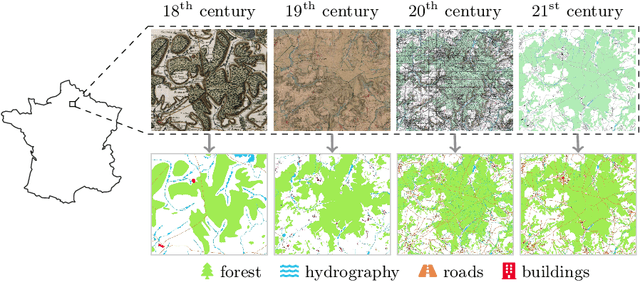
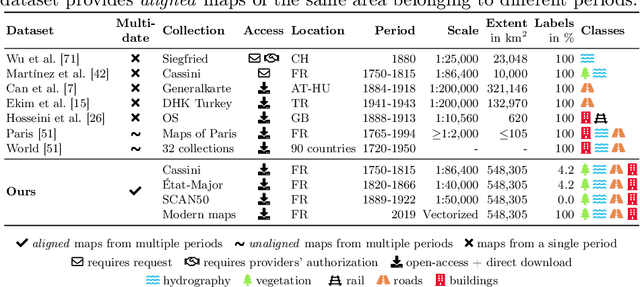
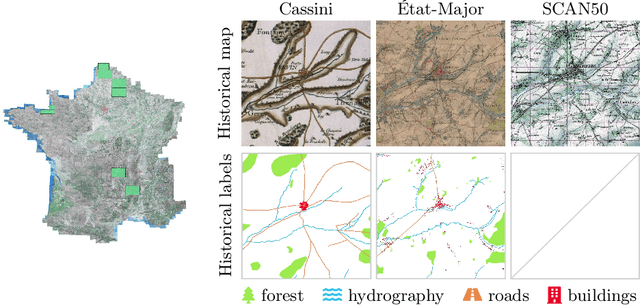
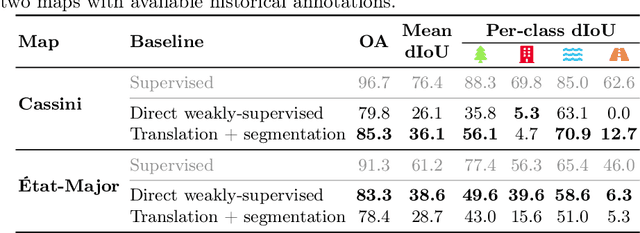
Historical maps offer an invaluable perspective into territory evolution across past centuries--long before satellite or remote sensing technologies existed. Deep learning methods have shown promising results in segmenting historical maps, but publicly available datasets typically focus on a single map type or period, require extensive and costly annotations, and are not suited for nationwide, long-term analyses. In this paper, we introduce a new dataset of historical maps tailored for analyzing large-scale, long-term land use and land cover evolution with limited annotations. Spanning metropolitan France (548,305 km^2), our dataset contains three map collections from the 18th, 19th, and 20th centuries. We provide both comprehensive modern labels and 22,878 km^2 of manually annotated historical labels for the 18th and 19th century maps. Our dataset illustrates the complexity of the segmentation task, featuring stylistic inconsistencies, interpretive ambiguities, and significant landscape changes (e.g., marshlands disappearing in favor of forests). We assess the difficulty of these challenges by benchmarking three approaches: a fully-supervised model trained with historical labels, and two weakly-supervised models that rely only on modern annotations. The latter either use the modern labels directly or first perform image-to-image translation to address the stylistic gap between historical and contemporary maps. Finally, we discuss how these methods can support long-term environment monitoring, offering insights into centuries of landscape transformation. Our official project repository is publicly available at https://github.com/Archiel19/FRAx4.git.