 Add to Chrome
 Add to Firefox
 Add to Edge
Property-Driven Synthetic Data Engineering for Data-Scarce Software Systems: Reflections from the Breast Cancer Domain
Jul 07, 2026
Modern software systems increasingly depend on data for analysis, prediction, testing, and decision-making. Yet many important domains, including medicine, safety-critical systems, and regulated industries, lack abundant, shareable, or representative data. Synthetic data generation is often proposed as a remedy, but our experience engineering software for intraoperative radiotherapy (IORT) in breast cancer treatment suggests that synthetic data shifts rather than solves the central engineering problem. The key challenge becomes deciding which properties synthetic data must preserve, how these properties should be elicited from stakeholders, how they can be validated under privacy constraints, and how they evolve. We call this problem property-driven synthetic data engineering. Drawing on a collaboration with oncologists and preliminary experiments with a sensitive IORT dataset, we identify challenges in requirements, validation, privacy, and pipeline evolution. We argue that automated software engineering research should develop methods and tools for eliciting, formalizing, checking, and evolving validity properties for synthetic data in data-scarce software systems.

Risk Under Pressure: Compute-Aware Evaluation of Adversarial Robustness in Language Models
Jun 09, 2026Adversarial robustness evaluations of large language models (LLMs) typically report attack success rate (ASR) under fixed query budgets, implicitly treating all attacks as equally costly. In practice, the computational expense of different attack strategies can vary by orders of magnitude. Consequently, ASR at a fixed budget can obscure the true effort required to jailbreak a model, thereby making it hard to determine whether an attack's cost justifies its payoff to the attacker. We propose a compute-aware evaluation framework based on computational pressure, measured in cumulative floating-point operations (FLOPs), as a proxy for adversarial effort. We introduce risk-compute curves, which map compute budgets to attack risk, and derive two metrics that summarize the average pressure required for a given attack to succeed. Across ten models spanning three families and four different stages in language model training and alignment, evaluated with three attack strategies (gradient-based, iterative refinement, and template-based) on two jailbreak robustness benchmarks, we find: (1) alignment training has non-monotonic effects on compute-space robustness; (2) scaling model size reduces gradient-based attack effectiveness but has limited impact on cheaper template-based attacks; (3) gradient-based attacks optimized on a surrogate model can transfer to a separate target model, providing a way to reduce attacker costs; (4) compute cost varies by up to ${\approx}5{\times}$ across harm categories within a single model; and (5) safety-aligned RL increases aggregate cost while leaving some categories disproportionately accessible. We release our framework to enable compute-aware risk assessment and evaluation.
Assessing Visually-Continuous Corruption Robustness of Neural Networks Relative to Human Performance
Feb 29, 2024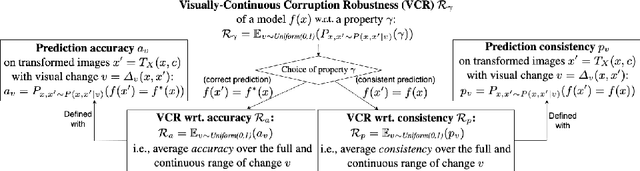
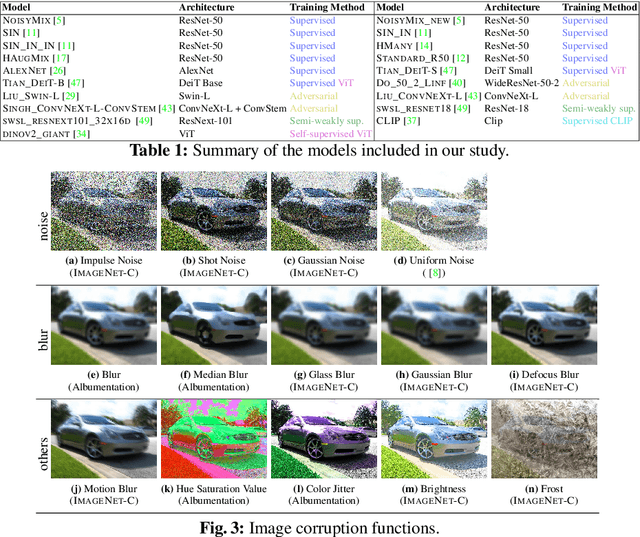
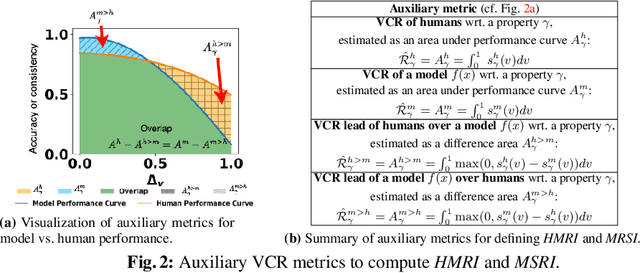
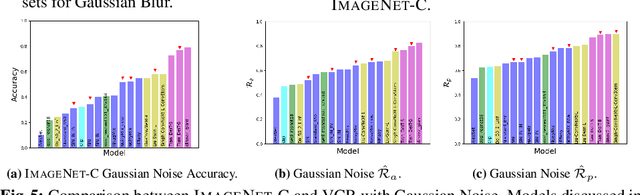
While Neural Networks (NNs) have surpassed human accuracy in image classification on ImageNet, they often lack robustness against image corruption, i.e., corruption robustness. Yet such robustness is seemingly effortless for human perception. In this paper, we propose visually-continuous corruption robustness (VCR) -- an extension of corruption robustness to allow assessing it over the wide and continuous range of changes that correspond to the human perceptive quality (i.e., from the original image to the full distortion of all perceived visual information), along with two novel human-aware metrics for NN evaluation. To compare VCR of NNs with human perception, we conducted extensive experiments on 14 commonly used image corruptions with 7,718 human participants and state-of-the-art robust NN models with different training objectives (e.g., standard, adversarial, corruption robustness), different architectures (e.g., convolution NNs, vision transformers), and different amounts of training data augmentation. Our study showed that: 1) assessing robustness against continuous corruption can reveal insufficient robustness undetected by existing benchmarks; as a result, 2) the gap between NN and human robustness is larger than previously known; and finally, 3) some image corruptions have a similar impact on human perception, offering opportunities for more cost-effective robustness assessments. Our validation set with 14 image corruptions, human robustness data, and the evaluation code is provided as a toolbox and a benchmark.
If a Human Can See It, So Should Your System: Reliability Requirements for Machine Vision Components
Feb 08, 2022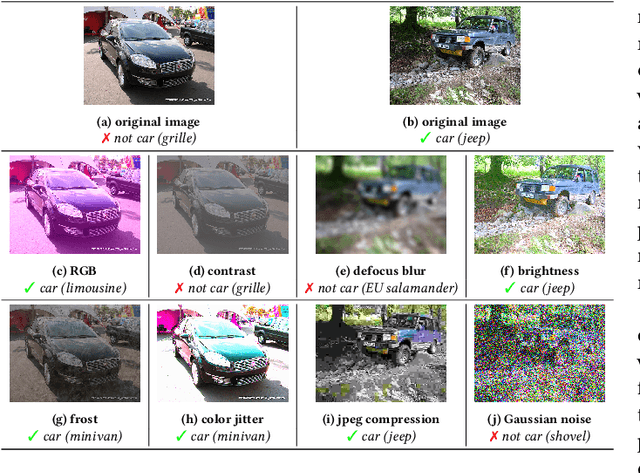
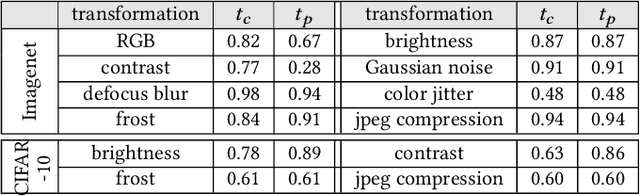
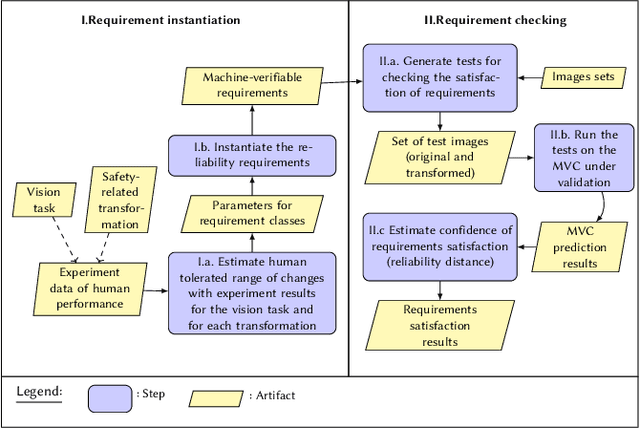
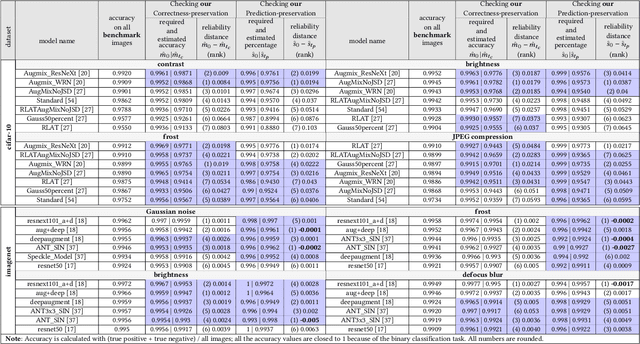
Machine Vision Components (MVC) are becoming safety-critical. Assuring their quality, including safety, is essential for their successful deployment. Assurance relies on the availability of precisely specified and, ideally, machine-verifiable requirements. MVCs with state-of-the-art performance rely on machine learning (ML) and training data but largely lack such requirements. In this paper, we address the need for defining machine-verifiable reliability requirements for MVCs against transformations that simulate the full range of realistic and safety-critical changes in the environment. Using human performance as a baseline, we define reliability requirements as: 'if the changes in an image do not affect a human's decision, neither should they affect the MVC's.' To this end, we provide: (1) a class of safety-related image transformations; (2) reliability requirement classes to specify correctness-preservation and prediction-preservation for MVCs; (3) a method to instantiate machine-verifiable requirements from these requirements classes using human performance experiment data; (4) human performance experiment data for image recognition involving eight commonly used transformations, from about 2000 human participants; and (5) a method for automatically checking whether an MVC satisfies our requirements. Further, we show that our reliability requirements are feasible and reusable by evaluating our methods on 13 state-of-the-art pre-trained image classification models. Finally, we demonstrate that our approach detects reliability gaps in MVCs that other existing methods are unable to detect.