 Add to Chrome
 Add to Firefox
 Add to Edge
The Impact of CutMix on Reliability and Robustness in Semantic Segmentation
Aug 19, 2026
Ensuring not only high accuracy but also reliable and robust predictions is critical for the deployment of semantic segmentation models in safety-critical applications such as autonomous driving. Despite the widespread use of CutMix - a simple yet powerful data augmentation strategy - its effect on the reliability and robustness in dense predictions tasks remains unexplored. Motivated by recent findings that semi-supervised segmentation methods, where CutMix is a core component, can severely degrade reliability, this study isolates and systematically analyzes the influence of CutMix on segmentation accuracy, calibration, and uncertainty quality. We evaluate two representative architectures, the CNN-based DeepLabV3+ and the transformer-based SegFormer, across both in-domain and out-of-domain scenarios. Our results show that CutMix has only a minor impact on segmentation accuracy but consistently improves the reliability, particularly under distribution shifts. These improvements indicate that CutMix primarily enhances the trustworthiness of the model's calibration and uncertainty rather than the raw segmentation prediction itself. This distinction is crucial for safety-critical deployment, where reliable confidence estimates are as important as raw performance.

MVM-IOD: An Industrial Object-Centric Benchmark Dataset for the Evaluation of 3D Reconstruction Methods
Jun 15, 20263D object reconstruction, and camera pose estimation in industrial applications are challenging tasks, as errors are costly while the computation time is often limited. The complexity of typical industrial objects further complicates these tasks. Most of the existing datasets in this context do not depict realistic industrial scenarios. Therefore, we introduce the Machine Vision Metrology Industrial Object Dataset (MVM-IOD). Images of typical industrial objects are captured systematically, by moving a camera, mounted at the end effector of an industrial robot arm, on a hemisphere around the objects. MVM-IOD contains reference camera poses and reference 3D point clouds, the acquired RGB images of 9 objects and 2 background choices resulting in 18 scenes, which allows evaluation of all image based methods that compute a 3D reconstruction, camera poses, or novel views of a scene. Based on MVM-IOD, we extensively evaluate current SOTA 3D reconstruction and camera pose estimation methods, such as Structure from Motion, Multi-View Stereo, recent feed forward methods (Visual Geometry Grounded Transformer, π3), and 2D Gaussian Splatting and report our findings as a baseline for future research. The experiments show that capture setups like ours generate out-of distribution images for feed forward methods, leading to suboptimal point clouds and camera poses. However, these out-of-distribution images can be shifted closer to the training distribution by applying simple preprocessing steps. Consequently, in certain industrial applications, feed forward methods should be used with caution.
Uncertainty Quality of VGGT: An Analysis on the DTU Benchmark Dataset
Jun 15, 2026Visual Geometry Grounded Transformer (VGGT) has already attracted a great deal of attention in a short period of time, not least due to the Best Paper Award at CVPR-2025. Similar to DUSt3R and MASt3R, VGGT aims to bring about a paradigm shift by replacing established methods like bundle adjustment and feature matching with a simple, unified, feed-forward neural network that predicts camera poses, depth maps, and dense 3D structure directly from multiple images of a scene in a few seconds. A key aspect is its ability to process an arbitrary number of views consistently in a single forward pass without any post-processing or iterative optimization. For photogrammetry, this opens new possibilities for real-time, scalable, and accessible 3D reconstruction. In this context, not only high reconstruction accuracy but also high-quality uncertainty estimates are crucial, as they foster trust and enable robust quality assurance. This paper therefore investigates the quality of VGGT's uncertainty predictions. The analysis identifies an effective confidence threshold for filtering VGGT's raw output and demonstrates that enhancing uncertainty quality holds strong potential for improving the accuracy of its 3D reconstructions.
MooMIns -- Monocular 3D Reconstruction and Object Pose Estimation from Multiple Instances
Jun 12, 2026Simultaneous 3D reconstruction and 6D object pose estimation from a single monocular image is an inherently ill-posed problem. In industrial settings, however, multiple instances of an object are often randomly arranged in bins, implicitly providing several views of the same object within a single image. We show that this implicit multi-view geometry can be exploited to simultaneously reconstruct the object in 3D and estimate the 6D pose of each visible object instance. We present MooMIns, a new Gaussian-splatting-based approach that inverts the original Gaussian splatting formulation: instead of rendering a single scene from multiple cameras, we render multiple object instances from a single camera. Our method is initialized with SAM3 instance segmentation masks and a modified Structure from Motion (SfM) pipeline. In contrast to learned monocular depth estimation, we perform true geometry-based reconstruction from image evidence, avoiding hallucinations caused by training data priors. We evaluate MooMIns on synthetic and real bin-picking scenarios, and demonstrate accurate reconstruction of previously unseen objects as well as reliable pose estimation of individual instance
Beyond Model Size: Probing the Gaps in Visual in-Context Learning by Training a Tiny Model
Jun 09, 2026Visual in-Context Learning (VICL) aims at making progress towards adaptive vision models, that can -- based on a few examples -- adapt to a new task at test-time. With the history of in-context learning in natural language processing research, where large, parameter-heavy models are in use, one pathway that current VICL methods take is model- and data-scaling as key ingredients. Yet, it is not clear, whether these ingredients are the key for in-context learning to take shape in vision models. To stress-test such large models, we challenge them with an extreme counterexample: we train a tiny visual in-context model with merely $1$ million parameters and a modest amount of $70,000$ images. We compare the results of this severely capacity capped tiny model to $7,000\times$ larger VICL models in different adaptive settings, (1) on image data with small distribution shifts, (2) on unseen task encodings and (3) on a completely new task, i.e., the setting VICL envisions. With the chasm of training resources between the tiny- and large models, our experiments showcase a lack in how adaptive capabilities are measured, with respect to how tasks are encoded, which tasks were used in pre-training and the choice of metrics. These gaps in current VICL benchmarking underscore a need for innovation in evaluation of adaptive capabilities.
A Novel Camera-to-Robot Calibration Method for Vision-Based Floor Measurements
Mar 16, 2026A novel hand-eye calibration method for ground-observing mobile robots is proposed. While cameras on mobile robots are com- mon, they are rarely used for ground-observing measurement tasks. Laser trackers are increasingly used in robotics for precise localization. A referencing plate is designed to combine the two measurement modalities of laser-tracker 3D metrology and camera- based 2D imaging. It incorporates reflector nests for pose acquisition using a laser tracker and a camera calibration target that is observed by the robot-mounted camera. The procedure comprises estimating the plate pose, the plate-camera pose, and the robot pose, followed by computing the robot-camera transformation. Experiments indicate sub-millimeter repeatability.
Evaluation of Visual Place Recognition Methods for Image Pair Retrieval in 3D Vision and Robotics
Mar 14, 2026Visual Place Recognition (VPR) is a core component in computer vision, typically formulated as an image retrieval task for localization, mapping, and navigation. In this work, we instead study VPR as an image pair retrieval front-end for registration pipelines, where the goal is to find top-matching image pairs between two disjoint image sets for downstream tasks such as scene registration, SLAM, and Structure-from-Motion. We comparatively evaluate state-of-the-art VPR families - NetVLAD-style baselines, classification-based global descriptors (CosPlace, EigenPlaces), feature-mixing (MixVPR), and foundation-model-driven methods (AnyLoc, SALAD, MegaLoc) - on three challenging datasets: object-centric outdoor scenes (Tanks and Temples), indoor RGB-D scans (ScanNet-GS), and autonomous-driving sequences (KITTI). We show that modern global descriptor approaches are increasingly suitable as off-the-shelf image pair retrieval modules in challenging scenarios including perceptual aliasing and incomplete sequences, while exhibiting clear, domain-dependent strengths and weaknesses that are critical when choosing VPR components for robust mapping and registration.
Rethinking Semi-supervised Segmentation Beyond Accuracy: Reliability and Robustness
Jun 06, 2025Semantic segmentation is critical for scene understanding but demands costly pixel-wise annotations, attracting increasing attention to semi-supervised approaches to leverage abundant unlabeled data. While semi-supervised segmentation is often promoted as a path toward scalable, real-world deployment, it is astonishing that current evaluation protocols exclusively focus on segmentation accuracy, entirely overlooking reliability and robustness. These qualities, which ensure consistent performance under diverse conditions (robustness) and well-calibrated model confidences as well as meaningful uncertainties (reliability), are essential for safety-critical applications like autonomous driving, where models must handle unpredictable environments and avoid sudden failures at all costs. To address this gap, we introduce the Reliable Segmentation Score (RSS), a novel metric that combines predictive accuracy, calibration, and uncertainty quality measures via a harmonic mean. RSS penalizes deficiencies in any of its components, providing an easy and intuitive way of holistically judging segmentation models. Comprehensive evaluations of UniMatchV2 against its predecessor and a supervised baseline show that semi-supervised methods often trade reliability for accuracy. While out-of-domain evaluations demonstrate UniMatchV2's robustness, they further expose persistent reliability shortcomings. We advocate for a shift in evaluation protocols toward more holistic metrics like RSS to better align semi-supervised learning research with real-world deployment needs.
A Critical Synthesis of Uncertainty Quantification and Foundation Models in Monocular Depth Estimation
Jan 14, 2025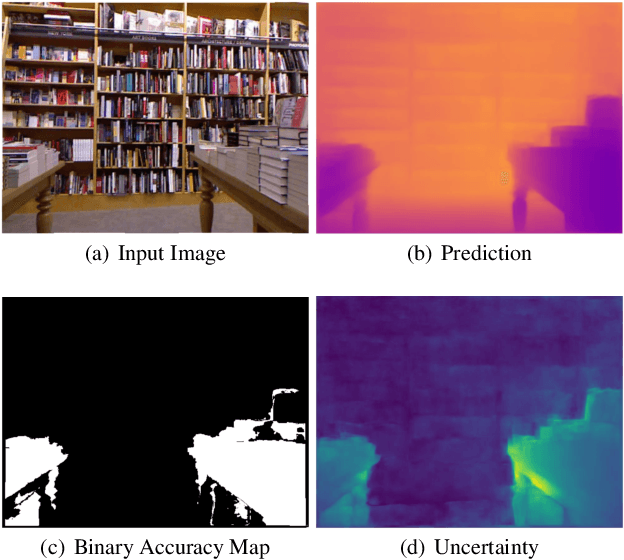
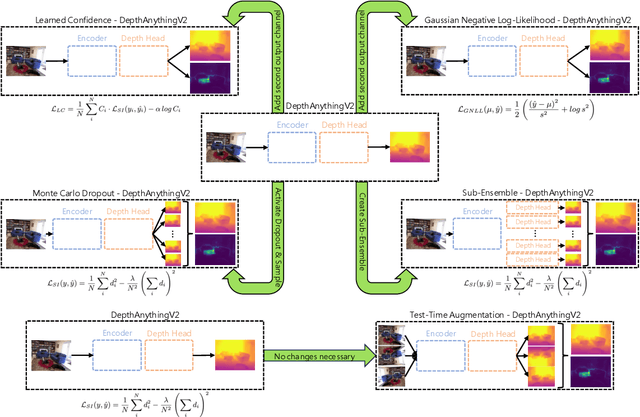
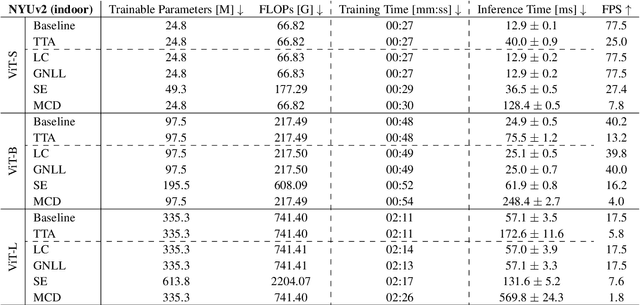

While recent foundation models have enabled significant breakthroughs in monocular depth estimation, a clear path towards safe and reliable deployment in the real-world remains elusive. Metric depth estimation, which involves predicting absolute distances, poses particular challenges, as even the most advanced foundation models remain prone to critical errors. Since quantifying the uncertainty has emerged as a promising endeavor to address these limitations and enable trustworthy deployment, we fuse five different uncertainty quantification methods with the current state-of-the-art DepthAnythingV2 foundation model. To cover a wide range of metric depth domains, we evaluate their performance on four diverse datasets. Our findings identify fine-tuning with the Gaussian Negative Log-Likelihood Loss (GNLL) as a particularly promising approach, offering reliable uncertainty estimates while maintaining predictive performance and computational efficiency on par with the baseline, encompassing both training and inference time. By fusing uncertainty quantification and foundation models within the context of monocular depth estimation, this paper lays a critical foundation for future research aimed at improving not only model performance but also its explainability. Extending this critical synthesis of uncertainty quantification and foundation models into other crucial tasks, such as semantic segmentation and pose estimation, presents exciting opportunities for safer and more reliable machine vision systems.
Optical aberrations in autonomous driving: Physics-informed parameterized temperature scaling for neural network uncertainty calibration
Dec 18, 2024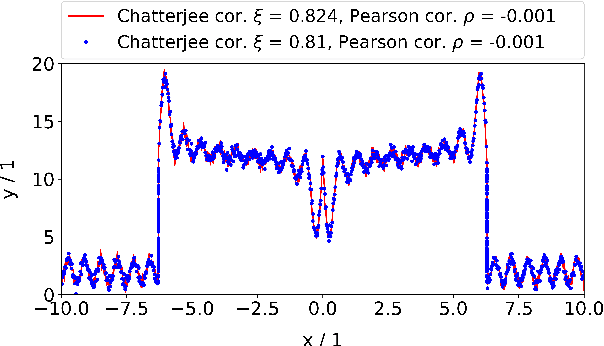


'A trustworthy representation of uncertainty is desirable and should be considered as a key feature of any machine learning method' (Huellermeier and Waegeman, 2021). This conclusion of Huellermeier et al. underpins the importance of calibrated uncertainties. Since AI-based algorithms are heavily impacted by dataset shifts, the automotive industry needs to safeguard its system against all possible contingencies. One important but often neglected dataset shift is caused by optical aberrations induced by the windshield. For the verification of the perception system performance, requirements on the AI performance need to be translated into optical metrics by a bijective mapping (Braun, 2023). Given this bijective mapping it is evident that the optical system characteristics add additional information about the magnitude of the dataset shift. As a consequence, we propose to incorporate a physical inductive bias into the neural network calibration architecture to enhance the robustness and the trustworthiness of the AI target application, which we demonstrate by using a semantic segmentation task as an example. By utilizing the Zernike coefficient vector of the optical system as a physical prior we can significantly reduce the mean expected calibration error in case of optical aberrations. As a result, we pave the way for a trustworthy uncertainty representation and for a holistic verification strategy of the perception chain.