 Add to Chrome
 Add to Firefox
 Add to Edge
Beyond Model Size: Probing the Gaps in Visual in-Context Learning by Training a Tiny Model
Jun 09, 2026
Visual in-Context Learning (VICL) aims at making progress towards adaptive vision models, that can -- based on a few examples -- adapt to a new task at test-time. With the history of in-context learning in natural language processing research, where large, parameter-heavy models are in use, one pathway that current VICL methods take is model- and data-scaling as key ingredients. Yet, it is not clear, whether these ingredients are the key for in-context learning to take shape in vision models. To stress-test such large models, we challenge them with an extreme counterexample: we train a tiny visual in-context model with merely $1$ million parameters and a modest amount of $70,000$ images. We compare the results of this severely capacity capped tiny model to $7,000\times$ larger VICL models in different adaptive settings, (1) on image data with small distribution shifts, (2) on unseen task encodings and (3) on a completely new task, i.e., the setting VICL envisions. With the chasm of training resources between the tiny- and large models, our experiments showcase a lack in how adaptive capabilities are measured, with respect to how tasks are encoded, which tasks were used in pre-training and the choice of metrics. These gaps in current VICL benchmarking underscore a need for innovation in evaluation of adaptive capabilities.

A Novel ASIC Design Flow using Weight-Tunable Binary Neurons as Standard Cells
Apr 17, 2022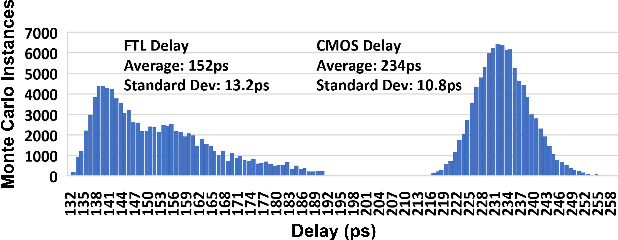
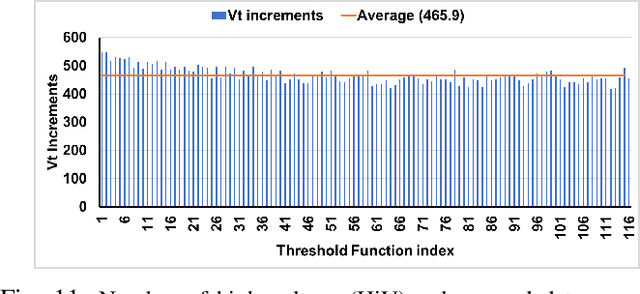
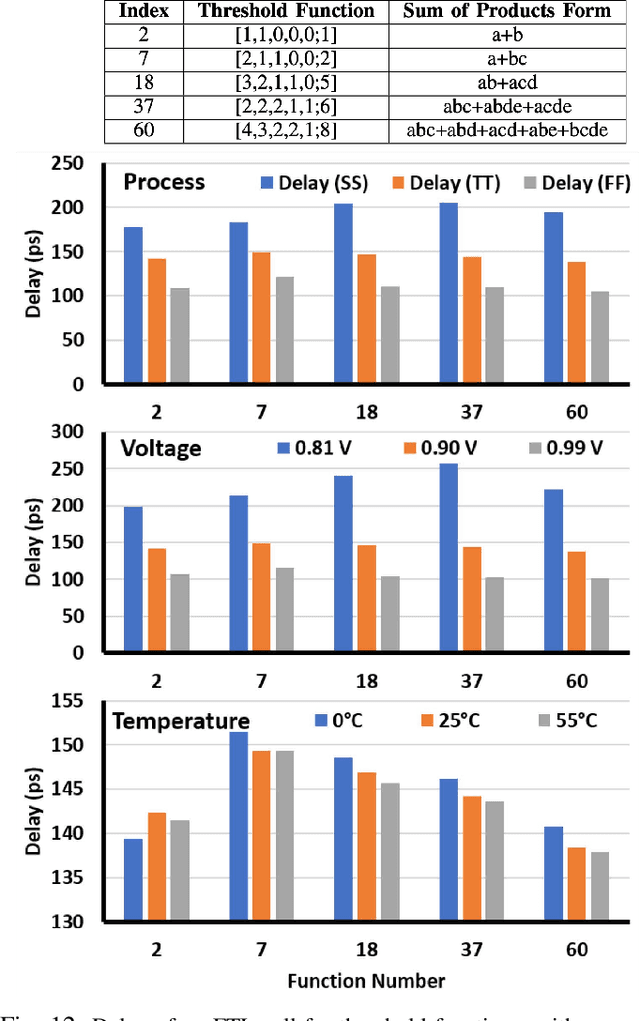
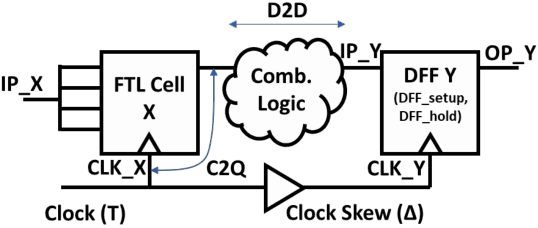
In this paper, we describe a design of a mixed signal circuit for a binary neuron (a.k.a perceptron, threshold logic gate) and a methodology for automatically embedding such cells in ASICs. The binary neuron, referred to as an FTL (flash threshold logic) uses floating gate or flash transistors whose threshold voltages serve as a proxy for the weights of the neuron. Algorithms for mapping the weights to the flash transistor threshold voltages are presented. The threshold voltages are determined to maximize both the robustness of the cell and its speed. The performance, power, and area of a single FTL cell are shown to be significantly smaller (79.4%), consume less power (61.6%), and operate faster (40.3%) compared to conventional CMOS logic equivalents. Also included are the architecture and the algorithms to program the flash devices of an FTL. The FTL cells are implemented as standard cells, and are designed to allow commercial synthesis and P&R tools to automatically use them in synthesis of ASICs. Substantial reductions in area and power without sacrificing performance are demonstrated on several ASIC benchmarks by the automatic embedding of FTL cells. The paper also demonstrates how FTL cells can be used for fixing timing errors after fabrication.
A Configurable BNN ASIC using a Network of Programmable Threshold Logic Standard Cells
Apr 04, 2021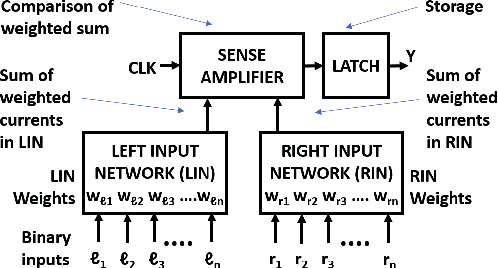
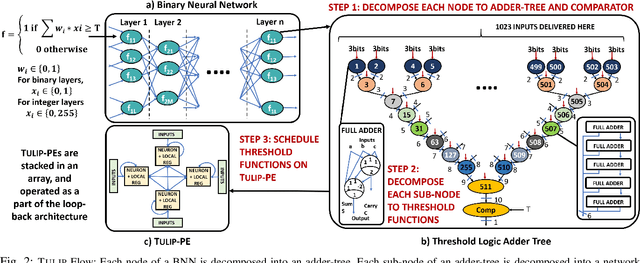
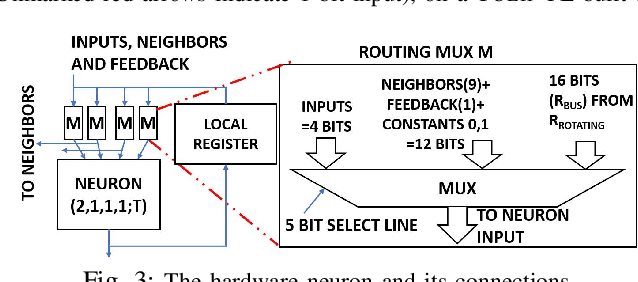
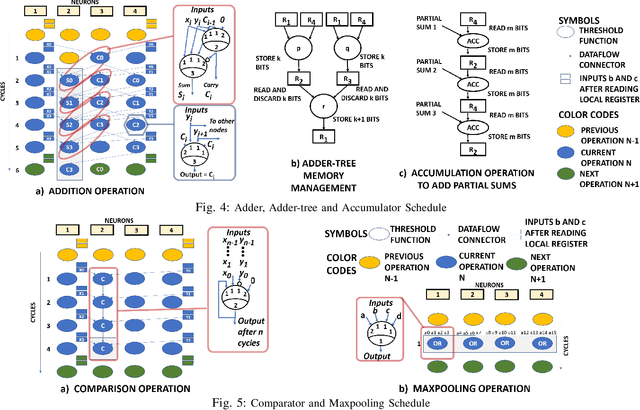
This paper presents TULIP, a new architecture for a binary neural network (BNN) that uses an optimal schedule for executing the operations of an arbitrary BNN. It was constructed with the goal of maximizing energy efficiency per classification. At the top-level, TULIP consists of a collection of unique processing elements (TULIP-PEs) that are organized in a SIMD fashion. Each TULIP-PE consists of a small network of binary neurons, and a small amount of local memory per neuron. The unique aspect of the binary neuron is that it is implemented as a mixed-signal circuit that natively performs the inner-product and thresholding operation of an artificial binary neuron. Moreover, the binary neuron, which is implemented as a single CMOS standard cell, is reconfigurable, and with a change in a single parameter, can implement all standard operations involved in a BNN. We present novel algorithms for mapping arbitrary nodes of a BNN onto the TULIP-PEs. TULIP was implemented as an ASIC in TSMC 40nm-LP technology. To provide a fair comparison, a recently reported BNN that employs a conventional MAC-based arithmetic processor was also implemented in the same technology. The results show that TULIP is consistently 3X more energy-efficient than the conventional design, without any penalty in performance, area, or accuracy.